Supreme Court hears oral argument on Trump’s effort to end birthright citizenship. Ruling expected this summer.
President Donald Trump wants to overturn long-established law that says people born in the United States are U.S. citizens
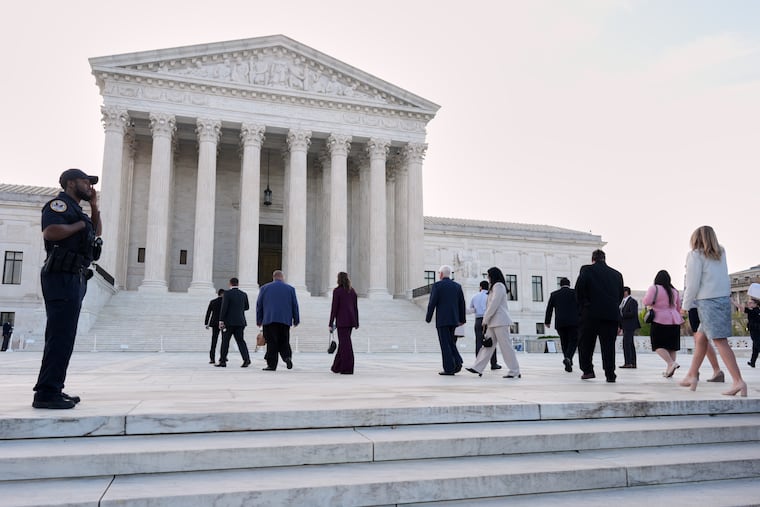
The Supreme Court heard oral arguments on Wednesday on one of the most important cases of the age, one that’s expected to define who gets to be a citizen of the United States.
Arguments in Trump vs. Barbara started at about 10 a.m. in Washington and went on for two hours, with a ruling expected this summer. The president traveled to the court to hear the arguments in person, leaving after government lawyers wrapped up their presentation.
The justices asked many pointed and specific questions, although there was no immediate indication on how they might rule. Several seemed skeptical of the Trump administration’s arguments.
Chief Justice John Roberts quickly said that it was not clear how the recognized exceptions to citizenship, such as the children of ambassadors and foreign invaders, can be applied to “a whole class of illegal aliens.”
Roberts says he wasn’t sure “how you get to that big group from such tiny and idiosyncratic examples.”
President Donald Trump wants to overturn long-established law that says anyone born in the United States is a U.S. citizen — and to deny citizenship to children born in the country to undocumented parents.
Justice Brett Kavanaugh, a Trump appointee, said Congress might have used different language in laws enacted in 1940 and 1952 if it wanted to make clear that children of people in the United States illegally or temporarily were not entitled to citizenship.
Judge Samuel Alito asked about the humanitarian issue of people who have been in the U.S. for a long time and are “subject to removal” but in “their minds” have made a permanent home in America.
Alito also said that immigration laws in the U.S. have been “ineffectively and in some cases unenthusiastically” enforced over the years.
The Supreme Court’s eventual ruling “will set the course of our country for generations to come,” said Jasmine Rivera, executive director of the Pennsylvania Immigration Coalition. “This decision will not just affect immigrants and children of immigrants, but everyone who calls the United States of America their home.”
Given the gravity, she said, the coalition is hopeful that “birthright citizenship remains intact and protected.”
Trump argues that automatic U.S. citizenship encourages people to enter the country without permission, including for so-called birth tourism, where families arrange to give birth to their children while visiting the U.S.
New Jersey’s role in bringing the case to court
On the day he was inaugurated in 2025, Trump signed an executive order to end birthright citizenship for the children of undocumented immigrants who were born in this country.
The ACLU sued within hours, and New Jersey officials went to court the next day, with then-Attorney General Matt Platkin proclaiming, “Presidents in this country have broad powers, but they are not kings.”
Wednesday’s argument represented the first time that the Supreme Court officially considered the legality of Trump’s executive order.
The co-director of New Sanctuary Movement of Philadelphia, a veteran immigrant-advocacy organization, spoke out on Wednesday as the court heard arguments.
“Today I think about all the children and babies of our members across the city,” said Peter Pedemonti in a statement. “As a father, I think about how vulnerable and precious newborns are. And yet today, our country’s highest court is hearing an argument that says Black and Brown immigrant babies do not belong here. This is a radically fringe legal theory based in white supremacy that Trump has put the power of the White House behind and now sits before the Supreme Court.”
Pedemonti called the court proceedings “a deeply troubling day for the soul of our country” and at the same time in line with Trump immigration policies that seek “to keep the U.S. white with a brutality and violence that can only come if you see Black and Brown people as not fully human.”
Birthright citizenship, simply explained, is the legal foundation under which American citizenship is automatically conferred upon people who are born in the United States. The formal term is jus soli, Latin for “right of the soil.” Automatic citizenship also extends to children who are born abroad to U.S. citizens.
Birthright citizenship is guaranteed in the Constitution by the 14th Amendment, ratified in 1868, after the end of the Civil War. It says that “all persons born or naturalized in the United States, and subject to the jurisdiction thereof, are citizens of the United States and of the state wherein they reside.” Native Americans in this country were automatically granted citizenship in 1924.
Trump and other opponents argue that the practice entices people to enter the country illegally, so that children who are born here will automatically gain American citizenship. Those citizens, at age 21, can sponsor close family members to live permanently in the United States.
The Trump administration contends that birthright citizenship had limited intent, meant only to ensure that formerly enslaved people and their children were U.S. citizens.
The administration has focused on the clause “subject to the jurisdiction thereof,” saying that excludes people with temporary or unlawful presence. The president’s order would deny citizenship to babies born in the U.S. unless at least one parent is a U.S. citizen or lawful permanent resident at the time of the birth.
Trump’s opponents say reliance on those five words makes no sense, that of course people in the United States without permission are subject to its jurisdiction ― its laws, orders, and government regulations ― the same as everyone else.
Pa. Democrats join effort to preserve ‘constitutional minimum’
In Pennsylvania, all eight Democratic federal lawmakers who represent the state have opposed Trump’s attempt to end birthright citizenship.
Along with 208 other Democrats in Congress, they signed an amicus brief in February that argued the 14th Amendment set a “constitutional minimum — a floor — for birthright citizenship” and that the administration’s arguments were incoherent.
They wrote that Trump, ignoring their authority as lawmakers, had overstepped after decades of failed attempts to change the law by constitutional means.
Pennsylvania Democrats who signed the brief were U.S. Sen. John Fetterman and U.S. Reps. Brendan Boyle, Dwight Evans, Madeleine Dean, Mary Gay Scanlon, Chrissy Houlahan, Summer Lee, and Chris Deluzio.
“The case today is about a legal principle first established over a hundred years ago,” said Philadelphia immigration attorney William A. Stock, former president of the national American Immigration Lawyers Association. “Being born in the United States makes one a citizen, excepting only children of diplomats or invading armies.”
The executive order that’s being challenged “relies on legal theories previously thought to be on the fringes of legal argument ― not completely frivolous, but overwhelmingly rejected by courts, lawyers and law professors,” Stock said.
Michele Madera, chair of the Philadelphia chapter of the American Immigration Lawyers Association, said that if Trump’s executive order were permitted to take effect, “it would cause America to lose one of its most fundamental principles ― citizenship by birth ― and would lead a vulnerable population to statelessness.”
The statelessness of children who were born in this country would have far-reaching consequences for international law and order, she said. U.S. citizens could need to hire immigration lawyers to prove that their parents were legally here when they were born, and the parents’ intent at the time of the births could be called into question.
Some Republicans in Congress have filed amicus briefs supporting Trump’s case, though none of the 11 Republicans representing Pennsylvania have signed on to them.
U.S. Sen. Ted Cruz (R., Texas) and U.S. Rep. Jim Jordan (R., Ohio) — Trump allies who have leadership positions in their respective chambers’ Judiciary committees — led a brief in January with 26 other congressional Republicans that supported the administration’s argument that the intent of the 14th Amendment was limited.
“The Framers chose to limit birthright citizenship to persons ‘subject to the jurisdiction’ of the United States. It was a common-sense choice, based on considerations of sovereignty and loyalty,” the Republicans wrote. “The Framers would have recoiled at the present debasement of citizenship, understanding that ‘jurisdiction’ requires more than mere physical presence. It demands total allegiance to the sovereign. To hold otherwise places sovereignty, citizenship, and our nation’s survival in jeopardy.”
The ACLU argues that ending birthright citizenship would upend established law along with the lives of hundreds of thousands of families, creating a permanent subclass of U.S.-born children who would be denied rights as Americans.
The history behind birthright citizenship
Defenders of birthright citizenship point to the defining Supreme Court ruling in the matter ― United States v. Wong Kim Ark, which held in 1898 that children born in the U.S. are citizens, regardless of their parents’ immigration status.
Wong Kim Ark was a Chinese American cook, born in San Francisco to immigrant parents. In 1890, both parents returned to China, and Wong, about 21, visited them there the same year. On his return, he was admitted into the U.S. on the sole grounds that he was a native-born American citizen.
Four years later in 1894, at about 25, Wong again traveled to China. But when he returned in 1895, he was denied entry by Customs officials who ruled that he was not a citizen and could be immediately deported under the Chinese Exclusion Act.
The 1882 Exclusion Act banned immigration from China amid a perceived “invasion” of supposedly job-stealing newcomers. Chinese immigrants faced widespread violence and forced expulsions from their communities amid a racist “Yellow Peril” narrative.
The Supreme Court affirmed Wong’s citizenship in 1898, citing his birth on American soil. That his parents were not citizens, and in fact were subjects of the Chinese emperor, did not matter, the court ruled.
To deny Wong his citizenship, the court said, “would be to deny citizenship to thousands of persons of English, Scotch, Irish, German, or other European parentage who have always been considered and treated as citizens of the United States.”
“If the court agrees with the administration on how to read Wong Kim Ark, that still doesn’t answer who can make the determination to end birthright citizenship for certain categories of people,” said Carol Nackenoff, Swarthmore College Richter Professor Emerita of Political Science and the author of American by Birth: Wong Kim Ark and the Battle for Citizenship.
“It is highly possible the court could say: This isn’t among the powers of the Executive,” Nackenoff said. “I don’t think they will buy the argument that earlier presidential administrations just got it wrong.”
The court could say that Congress could fix the problem by amending the Immigration and Nationality Act, the main body of laws that govern immigration to the U.S.
In court on Wednesday, Cecillia Wang, the American Civil Liberties Union legal director facing off against Solicitor General D. John Sauer, often centered her arguments on American courts’ reliance on English common law, which provides for citizenship based on the legal concept of jus soli, the “right of soil.”
“When the government tried to strip Mr. Wong Kim Ark’s citizenship on largely the same grounds they raised today, this court said no,” she said, adding “this court held that the 14th Amendment embodies the English common law rule: Virtually everyone born on U.S. soil is subject to its jurisdiction and is a citizen.”
Justice Neil Gorsuch drilled down into the aftermath of the Wong Kim Ark decision, trying to get Wang to clarify.
“Trying to understand how the legal community understood what happened in Wong Kim Ark. It seems to me it’s a mess. Maybe you can persuade me otherwise,” he asked Wang.
Bigotry against Chinese people was widespread in the U.S. in the 19th century, Wang said, with “a common view that Chinese people were inherently temporary sojourners in the country.”
She argued that it was possible that Justice Horace Gray, who wrote the Wong Kim Ark ruling, “was trying to dispel that notion.”
As of this year, 36 nations have unrestricted birthright citizenship, and another 45 have some form of restricted citizenship, according to World Population Review.
Nearly all the countries with unrestricted citizenship are in North or South America, stemming from the time when European colonial powers welcomed immigrants in order to populate their settlements. Other countries may offer citizenship based on parentage, generally to children where one or both parents are citizens.
The Associated Press contributed to this article.