There’s a hidden N.C. Wyeth mural at Penn — a 30 feet ‘heroic’ Ben Franklin you’re not allowed to see
By Peter Dobrin
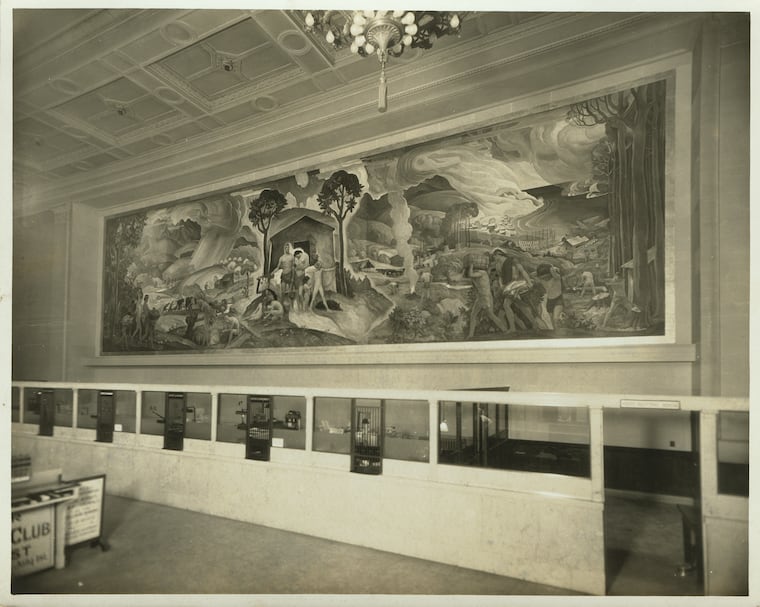
. C. Wyeth’s panoramic mural Apotheosis of the Family, long hidden from view, left viewers astonished after reappearing for public consumption in Wilmington this past December.
There’s another N. C. Wyeth monster mural in the area, though it is little known.
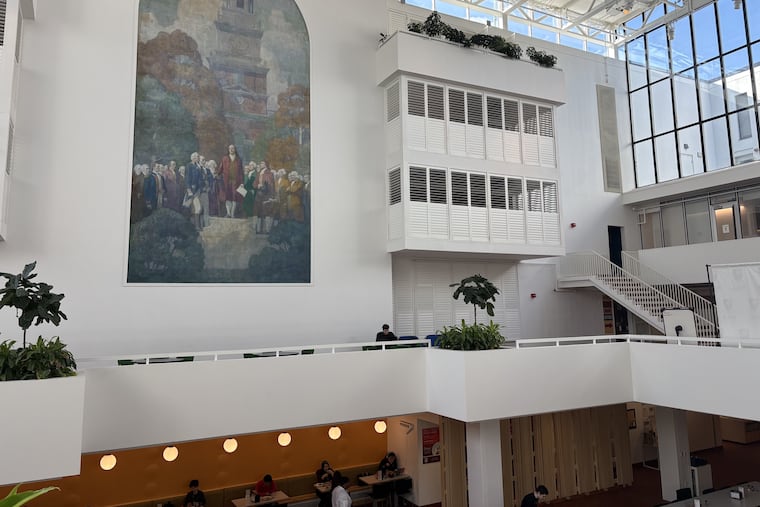
This one, An Apotheosis of Franklin, is at Penn, hung in the airy atrium of Hill College House near 34th and Walnut Streets.
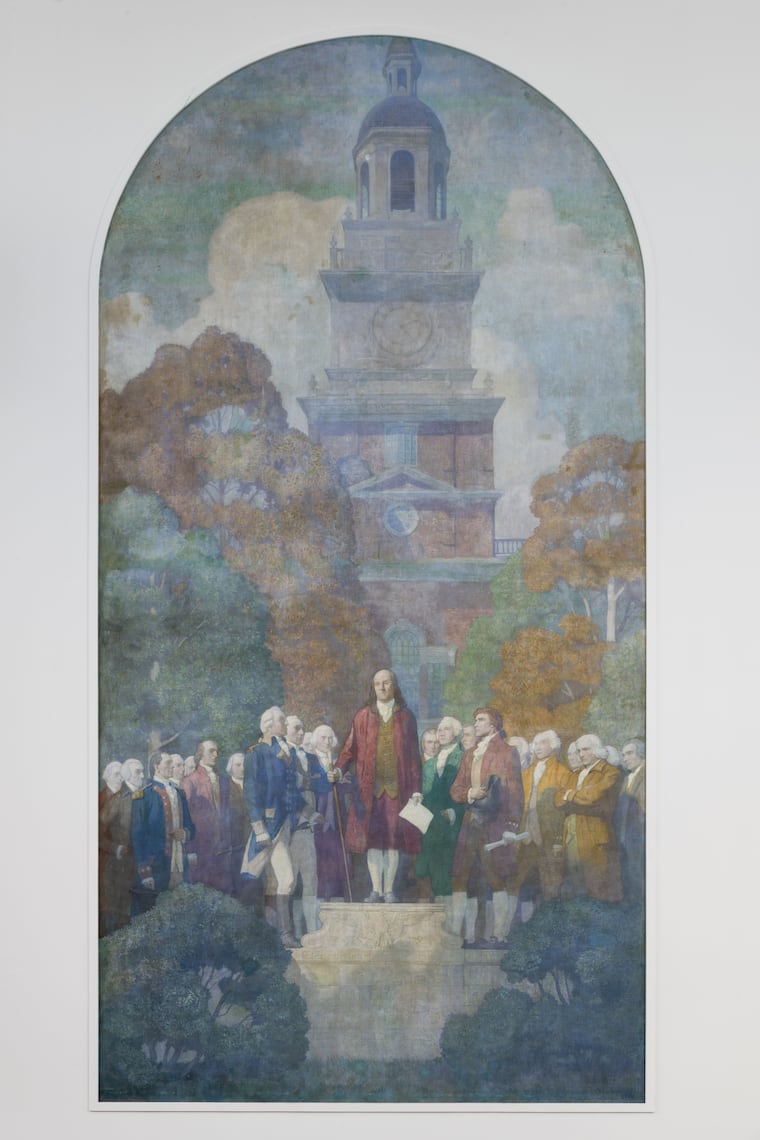
Not as large as its Wilmington cousin, it is still, at 16 feet long and 30 feet high, impressive both in scale and for its ceremonial, even worshipful, tone. Here Franklin stands on a pedestal near Independence Hall, surrounded by Founding Fathers Thomas Jefferson, George Washington, John Adams, and others.
“Having Independence Hall in the background, rising up like this in the format like a big church window, emphasizes that identification we have with Independence as the birthplace of our national religion of democracy,” says Penn art history professor Gwendolyn DuBois Shaw.
The visual vocabulary — heroism framed by puffy white clouds and trees and rendered in a particular palette of colors — gives it a specifically N. C. Wyeth look.
“It feels to me like so many of his illustrations for Scribner’s [Classics book series], creating these historical scenes that are both mythical and fictionalized,” said Shaw.
The piece may be monumental in scale, but it is also hidden — at least to non-Penn art lovers. Visitors to Hill aren’t welcome; access to the dorm building is restricted.
But there’s a significant runner-up experience available. A half-size reproduction of An Apotheosis of Franklin is on view nearby in Penn’s Arthur Ross Gallery through Dec. 13 as part of the exhibition “At Liberty: Life in the City of Brotherly Love During the Early Republic.”
An Apotheosis of Franklin is one of more than 9,000 works of art owned by Penn. In addition to the outdoor sculpture visible on school grounds, the university has pieces distributed across about 130 spots around campus.
“We have a campus loan program, so artworks are available to faculty and staff for their offices. I’d like to say that not having a fine arts museum allows us to be a little more nimble,” said Lynn Smith Dolby, director of the Penn Art Collection.
“There are so many kind of secret artworks on campus,” said Shaw, “I always marvel when I go into a colleague’s office or something and they have a piece from the collection that I had no idea we had.”
An Apotheosis of Franklin, from 1926, was — like Apotheosis of the Family — commissioned to embellish a bank. It passed from New York’s Franklin Savings Bank to Independence Hall Association, and was conserved and installed at Penn in 1978 and gifted to the university in 1990.
Placing it was a challenge.
“It’s hard for me to think of another wall on campus that could accommodate something of this size,” said Smith Dolby.
It is one of many works on campus interpreting the various dimensions of Franklin, Penn’s primary founder. Wyeth said that his own lens looked past Franklin the printer, Franklin the scientist, and so on, to focus on Franklin the patriot and statesman.
This Apotheosis catches a view very much in contrast to the more beneficent, ribald or portly portraits of Franklin frequently drawn in both image and prose.
Squinting, might one even think Franklin by Wyeth vaguely handsome?
Shaw is willing to go that far:
“He does look quite heroic.”
“At Liberty: Life in the City of Brotherly Love During the Early Republic” runs through Dec. 13, Arthur Ross Gallery (in the Fisher Fine Arts Library Building), University of Pennsylvania, 220 South 34th Street, Phila. arthurrossgallery.org
Check out what art our other reporters are raving about here.
