The painful, complicated roots of American mid-century design trace back to Japanese American concentration camps
Nakashima, Noguchi, and Asawa are artists who changed the way Americans thought of design. A Barnes exhibit wants to showcase their art without forgetting their trauma.
George Nakashima never intended to move his family to New Hope.
The famous furniture maker became one of the most sought-after artists in modern American design, considered so impactful that his home and studio in Bucks County were named a National Historic Landmark.
It was a significant recognition from the government that had previously incarcerated Nakashima, his wife, Marion, and their then newborn daughter, Mira, forcing them to relocate from their home in Seattle to the Minidoka concentration camp in Idaho in 1942.
The family was among some 120,000 Japanese Americans — including about 80,000 U.S. citizens — imprisoned during World War II due to the unsubstantiated fear that they could be foreign spies.
By that point in his late 30s, Nakashima was already a successful architect and woodworker who had earned a master’s degree from MIT and traveled the world. Incarceration shaped his artistic practice and changed his trajectory significantly. At the camp, he met a skilled carpenter who taught him traditional Japanese carpentry techniques that greatly influenced his burgeoning signature style.
New Hope became a new home to the Nakashimas in 1943 when the War Relocation Authority released them under supervision, thanks to Nakashima’s old boss Antonin Raymond, who sponsored their freedom.
(Ironically, the government respected the authority of the Czech immigrant Raymond, who was a naturalized citizen, over that of the Spokane-born Nakashima.)
The conditions of the release prevented Nakashima from pursuing architecture projects with Raymond, so he worked as a farmhand by day while continuing to craft furniture by night. He transformed the farm’s milk house into a workshop and found inspiration in the woodlands surrounding him, where he would eventually establish himself as a giant of American design for decades to come.
One of his earliest pieces after incarceration served as a poetic callback to the home he was compelled to leave behind: a coffee table made of teak wood from Washington a friend shipped to him.
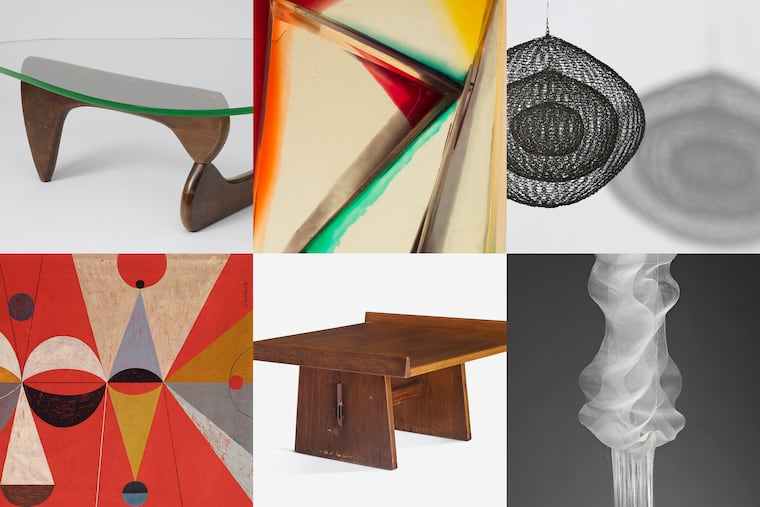
Milk House Table (1944) is one of 10 Nakashima artworks on view at the Barnes Foundation this fall as part of its American art programming marking the 250th anniversary of the nation’s founding. The exhibit “Noguchi to Asawa: Designing Postwar America” examines six renowned Japanese American artists whose work defined modern American art and design in the mid to late 20th century — all of whom were severely impacted by mass incarceration.
“This project is focused on six pretty iconic Japanese American artists who very much collectively shaped the look and the feel of mid-century America. The idea was to really look at the collective impact of this pivotal moment of Japanese incarceration during World War II, not only in the lives and careers of these artists, but by extension, in American art and design,” said Barnes curator Cindy Kang, who spearheaded the exhibit. “The roots of American modernism actually do extend into the Japanese incarceration camps. Some of these artists received their first really important artistic experiences there because they were incarcerated with professional artists, and that very much shaped the direction of their future careers.”
Two generations are represented in the show — those who were older, established artists before incarceration (Nakashima, sculptor/designer Isamu Noguchi, and sculptor Leo Amino) and a younger generation who had formative experiences learning from artists while incarcerated (graphic designer S. Neil Fujita, fiber artist Kay Sekimachi, and sculptor Ruth Asawa).
Their works span media, from wood furniture to copper wire sculptures to jazz album covers. (Fujita got his start at a Philadelphia ad agency and taught at the Philadelphia Museum College of Art, which was later named University of the Arts, before becoming the design director at Columbia Records.) The final room in the exhibit evokes a typical postwar American living room with everything made by Japanese American artists that underscores how essential their artwork became to the aesthetics of modern design.
“You may not have a Noguchi Akari lamp, but you may have the knockoffs from Target and Ikea,” said Kang.
In her research, Kang explored how wartime incarceration contributed to the complicated formation of an Asian American political identity following decades of anti-immigration policies and discrimination. She found that these artists’ assimilation into the legacy of American design often sidelined or erased their connections to these historic injustices.
“Especially with Nakashima and Noguchi, their work has been so fully assimilated into American design that the fact that they have these histories is so buried … you don’t even connect American design with these histories,” Kang said.
“That’s what I was trying to bring out [in this show]... You see a Noguchi or Nakashima chair or lamp or table and think, ‘Oh yeah that’s American design,’ and then not have any idea that it’s connected to Asian American history.”
Who gets to be an “American”? That question weighed heavily on Kang as she developed the exhibit and studied the historic period when the U.S. government imprisoned thousands of immigrants, including American citizens and children. She had no idea just how timely her project would feel opening this year, as the U.S. government continues to imprison tens of thousands of immigrants under President Donald Trump’s second administration.
“It really was not in our minds that this would be as relevant, or as on the nose as it is today, that’s really unfortunate,” said Kang. “We need to keep remembering we’ve been through this and we already know this is not a good direction. We need to learn this lesson again.”
For many of the featured artists, life after incarceration provided an opportunity to move past that traumatic time — they often did not discuss or share details about their imprisonment with their families or others. However, younger generations of Asian Americans, including the artists’ descendants, want to interrogate these histories further to understand how that trauma lingered on in the lives of these beloved artists.
For his part, Nakashima told his daughter that “his wounds healed over and left no scars.”
Still, he kept pieces of wood he collected from the Minidoka camp, which he used to create case furniture for their family home. In the exhibit, one of these remnants will be on display: a branch of dried bitterbrush.
“Noguchi to Asawa: Designing Postwar America,” runs through Jan. 10, 2027 at The Barnes Foundation, 2025 Benjamin Franklin Pkwy., Philadelphia, 215-278-7000 or barnesfoundation.org