Time is running out for Uber tax negotiations, and Philly teachers and advocates are pleading: reverse classroom budget cuts
“Put up or shut up,” an education advocate told Council. Teachers and others talked about the devastating impact of Philadelphia School District cuts as the deadline for a City Council budget nears.
Time is running out for the restoration of hundreds of school-based jobs via Mayor Cherelle L. Parker’s proposed $1-per-trip rideshare tax.
City Council must give preliminary approval to a budget plan on Thursday in order to meet the July 1 deadline for final passage. Parker wants to use the Uber tax to raise $50 million to reverse Philadelphia School District cuts.
Here’s why it matters at Science Leadership Academy at Beeber, a West Philadelphia school of 500 students in grades 5 through 12.
SLA Beeber is projecting the loss of seven teaching positions, staff and parents briefed on the 2026-27 budget say. That will leave the school unable to offer art or physical education to its lower-school students. It will raise class sizes, wipe out money for any non-sports extracurricular activities, and leave the school without an athletic director.
This all comes as SLA Beeber prepares for a major, district-ordered change.
“We’re supposed to be absorbing another school in a year,” said Hannah Zieve, an SLA Beeber teacher. “How are we supposed to plan for that?”
Parents and staff also say the budget squeeze is forcing a loss of crucial climate staff, who help keep order at the school.
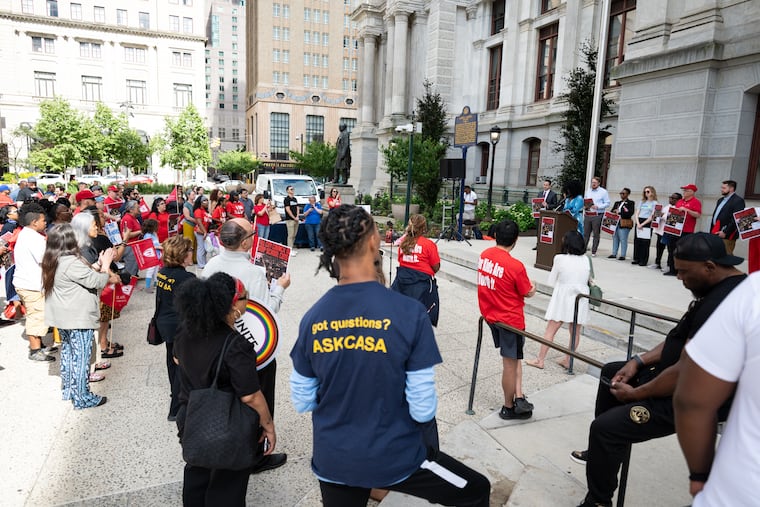
About 75 people — teachers, education advocates, and labor leaders — gathered at City Hall Tuesday to ratchet up the pressure on Council with clapping, cheering, signs, and speeches.
In addition to an aggressive lobbying campaign from Uber, the rideshare tax proposal has faced skepticism in City Council. No member of Council has publicly said they support the $1-per-ride plan.
» READ MORE: Philly schools’ learning outpaces other big-city districts post-pandemic, a new report says
Arthur Steinberg, president of the Philadelphia Federation of Teachers, said the district — rightly — is crowing over being recently named as tops in the nation in post-pandemic learning rates among big-city districts. But, he said, it’s imperiled by the cuts.
“That is why this rideshare tax is so critically important,” said Steinberg.
Moira Hull, a first-grade teacher at Hancock Elementary in the Northeast, said it was “deeply troubling” that the district stands to lose 340 school-based roles because of the cuts.
“We know that losing school staff will devastate school communities,” said Hull.
Ryan Rutledge, a recent Temple University graduate who just completed student teaching at GAMP, a Philadelphia School District magnet, earned extra income as a rideshare driver.
He’s strongly in favor of the rideshare tax, Rutledge said — companies like Uber and Lyft are “corporate marauders, with a scheme to pillage our people.” (An Uber spokesperson has said if the tax is passed, the company will pass it along to riders.)
» READ MORE: Philly Mayor Cherelle Parker wants big tech companies to pay up. With the clock ticking, she’s meeting resistance.
The district must operate more efficiently, Rutledge said, but efficiency “cannot come at the cost of student safety or teacher jobs. We must increase revenue, and we can do that by passing the corporate rideshare tax.”
Though Pennsylvania has underfunded low-wealth districts like Philadelphia for decades, and has been ordered to remedy that, the fix will take years, as several speakers pointed out.
Only Council has the will and ability to save the district in the short term, said Laura Boyce, executive director of Teach Plus Pennsylvania.
“Put up or shut up,” Boyce said to Council. “Stop talking the talk. Start walking the walk.”
