Jaguars are ready to come back, but the border wall might stop them
Jaguars once ranged across Arizona as far north as the Grand Canyon, but now they are so rare the sight of one on a trail camera near the border is cause for celebration.
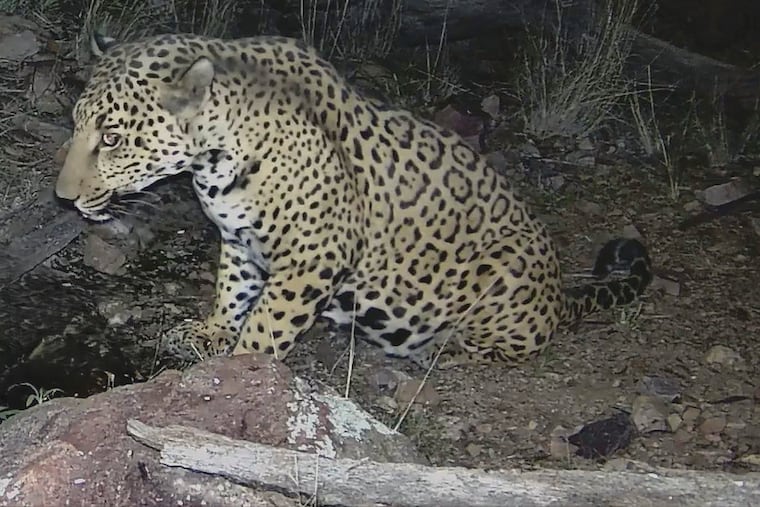
Movement triggers a trail camera in a wildlife preserve in northern Sonora, Mexico, 2 miles south of the border with the United States. It captures two adult jaguars winding through oak thickets and tall grasses. The cats look relaxed, softly vocalizing to each other.
It’s remarkable to see any jaguars in these borderlands. But to observe two together is unheard of, said Ganesh Marín, a researcher with the environmental group Borderlands Restoration Network. Even more jaw-dropping is that one of the big cats looks to be a female. “When I saw it, I was excited,” Marín said of watching the video in 2023. “I thought, ‘This is fantastic.’”
No native female jaguars have been seen in the United States, or anywhere particularly close, for more than 70 years. So Marín waited for more evidence before he went public. He collected several more sightings of the cat, which he and his adviser named Adela. Then, this year, a camera-trap video surfaced that gave a clear view of another jaguar’s rear end, proving, according to Marín and other cat experts, that the individual in question is a female.
“It’s a game changer,” said Eamon Harrity, a researcher with Sky Island Alliance, a conservation science group.
Including Adela, five or six jaguars have been recorded at the wildlife preserve, Cuenca Los Ojos, since 2020, suggesting that the jaguar is closer than previously thought to reestablishing a population on the doorstep of the United States. “It totally deflates the narrative that female jaguars are over 100 miles to the south,” Harrity said. “They could be a day away from the U.S., or already here.” At the same time, the only known jaguar in the United States, a male named Cinco, has been roaming throughout southern Arizona. He has everything he needs — except a mate.
Geopolitics might get in the way of his acquiring one. Since 2025, contractors working for the Department of Homeland Security have finished 56 miles of new wall along the U.S.-Mexico border and 48 miles of secondary fencing. In Arizona, many areas of the border will soon have two 30-foot walls right next to each other. This barrier is poised to cut off three of the four most important remaining wildlife corridors between Mexico and Arizona, threatening the jaguar’s re-expansion despite all the positive recent signs. The wall, Harrity said, would make it “very unlikely the jaguars can come back on their own to the U.S. — at least for now.”
‘No campfire dies without talk of him’
Jaguars once roamed much of Sonora, western New Mexico, and Arizona, as far north as the Grand Canyon. The size of the population is unknown, but it was probably small and widely dispersed. Although they have long been revered in both countries — naturalist Aldo Leopold wrote in 1949 that the jaguar’s mythic nature so pervaded the borderlands that “no campfire dies without talk of him” — jaguars were also once regularly killed on sight, by government officials as well as hunters.
Since 1949, when a hunter killed a female jaguar near Arivaca in southern Arizona, no native female had been seen in the United States, or anywhere particularly close to the border in Mexico. The northernmost core breeding population was thought to be centered near the community of Sahuaripa, more than 100 miles south of the border, which includes a private protected area for the species called the Northern Jaguar Reserve.
A turning point came in early March 1996, when rancher Warner Glenn set off to hunt cougars in the Peloncillo Mountains, which start at the Mexican border and run north, straddling Arizona and New Mexico. His dogs caught the scent of a large cat and gave chase, and the feline finally stopped on a rocky outcropping. Peering up through pinyon pines, the rancher realized this was no mountain lion; it was a full-grown male jaguar.
Still, in 1997, with only a few such sightings of roaming males, the jaguar was listed as endangered. In 2014, the U.S. Fish and Wildlife Service designated more than 760,000 acres of critical habitat for the big cats, but after lawsuits from mining and ranching groups, that dropped to 640,000 acres.
Soon after Marín set up the camera network in 2020 for a doctoral project at the University of Arizona, he was elated to record a male jaguar he named Bonito, and a second male shortly after. Then came Adela and yet another male in 2023.
When Marín first saw the video of the two jaguars, he thought Adela was female because she has a smaller frame. Also, two males are unlikely to appear together and vocalize, he explained.
This year, he reinspected a video from April 2023 that showed a clear view of a jaguar’s rear end, and did a double take: No testicles were visible. And the spot pattern looked different from Adela’s, suggesting it could be a second female.
He sent the clip to Brett Dickson, a wild cat expert with Conservation Science Partners. “I was struck right away that I was likely looking at a female,” said Dickson, who forwarded the video to jaguar experts. (The video also shows the cat has skin folds that look like mammary glands. The possibility that this could be a lactating female “cannot be ruled out,” Dickson said.) Seven of the nine scientists agreed it was female; two are unsure.
While male jaguars can range hundreds of miles from their birthplace in search of new territory and mates, females generally do not travel as far from where they were born, and their mobility is a limiting factor in the species’ expansion. Seeing a female in Cuenca most likely means that she was born nearby, and that the breeding range of the jaguar extends farther north into the species’ historical territory than previously thought.
The ‘fabric of the jaguar’
To revisit the spot where Adela first showed up, Marín and Valerie Gordon, executive director of Cuenca Los Ojos, drove into the northernmost foothills of the Sierra Madre. A hike through grassy hills punctuated by oaks and mesquite took them to a spot where Marín lashed a camera around an alligator juniper back in 2020.
Less than 2 miles away — a brief stroll for a jaguar — they pointed out the short vehicle barrier on the U.S. border. This is one of the most important remaining unwalled wildlife corridors in the Southwest United States, Marín said.
A walk into the mountains took them to another camera that filmed Adela, showing her softly huffing as she passed. Marín gestured southward, where he envisions female jaguars making up a continuous thread that stretches vast distances through Mexico and far beyond. “The fabric of the jaguar is closer than we thought,” he said.
Under the first Trump administration, 30-foot fencing impervious to most large animals went up along more than 220 miles of the border in Arizona, curtailing north-to-south wildlife movement and depleting aquifers, since contractors use vast quantities of water for construction, said Myles Traphagen, a researcher with Cuenca. As codified in the Real ID Act of 2005, the homeland security secretary has the authority to waive nearly any law — including the Endangered Species Act — in building border walls.
John Mennell, a DHS spokesperson, said in a statement that the department planned to incorporate an unknown number of small wildlife passages, and referred further questions to the Fish and Wildlife Service, which declined to comment. These openings would be 8.5 inches by 11 inches, too small for jaguars.
Cameras on both sides of a 30-foot border wall in Cuenca Los Ojos have shown large wildlife pacing, trying to get through. Animals including bears, mountain lions, and jaguars have to move long distances to find water in arid areas, and border fencing makes this more difficult, Gordon said.
In the spring, Traphagen took a drive to check on the status of the wall, passing through the Baboquivari Mountains, a sacred place within the Tohono O’odham Nation. To the south, he saw contractors putting up 30-foot panels of new wall, one of about six places in Arizona where such work has begun, and miles of razor wire had been strung up.
“That corridor has been open since time immemorial,” said Kinley Ragan, a biologist with the Phoenix Zoo, who manages a network of cameras in the area. “We know this will have serious impacts on wildlife. It’s quite devastating.”
Several groups have worked to protect jaguars in Mexico, where the species is listed as endangered. For example, to change attitudes and make the animals more valuable alive than dead, the Northern Jaguar Reserve started a program in 2002 that compensates ranchers for trail camera photos of cats.
Since 2010, jaguar populations have increased throughout Mexico by about 30%, to a total of more than 5,300, according to a Mexican jaguar census released last year and led by Gerardo Ceballos, an ecologist and a senior researcher at the National Autonomous University of Mexico.
Among the main threats have been illegal hunting and retaliatory killings for perceived cattle predation, though research shows the cats much prefer native wildlife. Killings still happen, but the situation seems to have improved over the last two decades. Ceballos has argued for years that a female jaguar could return to the United States soon, if the two countries continue working together to protect habitat and connectivity.
While jaguars might not be welcomed back by every segment of society, they are rare and shy enough that they present no risk to humans. The return of an apex predator would be good for the area’s ecology, and an indicator that the environment is doing well, said Susan Malusa, director of the University of Arizona wild cat research center.
Females would enjoy the same legal protection as males, as endangered species, but ecologically and symbolically, the return of females would be a much bigger deal and would make jaguar conservation more urgent rather than theoretical.
Back at the spot where the first video was taken, Gordon mused about how vast this tract of wilderness is, and Marín noted how important it will be to keep this border free of 30-foot-tall walls while reestablishing wildlife corridors where possible.
“Jaguars are coming back,” Marín said, if we don’t get in their way. “I hope the U.S. is prepared for that — prepared to let that happen.”
This article originally appeared in the New York Times.