The problem is not that we disagree; it’s how we disagree
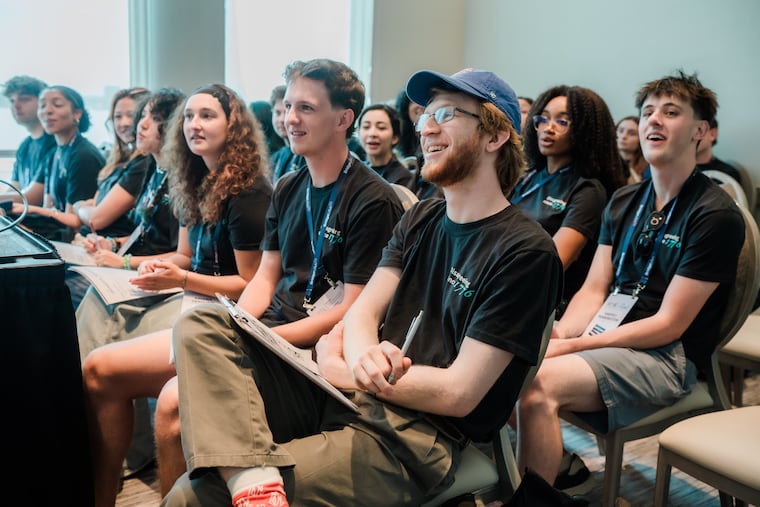
At the 2026 BridgeUSA National Summit in Philadelphia, college students made the case that talking to people you disagree with isn’t just possible — it’s the whole point of politics.
I love hearing from readers. From those who agree and those who disagree. Unless I mess up, I try to respond to everyone who invested their time in what I had to say and then cared enough to write in. The only kind of feedback I abhor is the one that accuses me of bias, because duh.
Whether you’re reading this in print (bless you) or online (thank you), it should be clear we are in the Opinion section, and bias, in the sense of a bent or an outlook, is how we do. However, I do not consider my side of the story to be the end of it. Regardless of whether someone is moved to drop me a line or not, I am here for the conversation.
This is what happens in real life, at least ideally. I say something, and you say something back, and if we disagree, we at least respect each other’s right to do so.
Unfortunately, the hardening of political positions seems to be doing away with even that. I know liberals who feel it’s a waste of time to try and talk to someone who thinks differently on trans rights, for example, just like I know conservatives who believe there’s nothing they care to learn from some socialist “Dumocrat.”
Perhaps that’s why — even with the decade or two (or three) age gap between the participants and me — there was a feeling of kinship for me at the 2026 BridgeUSA National Summit held recently in Philadelphia. The group, which has 130 chapters on college campuses across the country, wants to ensure we don’t stop talking (and listening) to each other — especially if we disagree.
» READ MORE: On immigration, your side is lying to you | Luis F. Carrasco
And no, this isn’t some equivocating, middle-of-the-road, fine-people-on-both-sides kind of thing, Manu Meel, BridgeUSA cofounder and CEO, said. The organization’s goal isn’t to find common ground or change the way people think, but to urge and teach students to use their strong opinions to engage respectfully and constructively with those who have different beliefs.
To hear the 27-year-old Meel tell it, Americans have always had differing opinions, and that disagreement is the engine of democracy. What our young nation would look like, in fact, was forged in disagreement. The problem today isn’t that there are disparate points of view, he said.
“The real divide is between the open-minded MAGA people, the open-minded liberals, the curious conservatives, and the close-minded ideologues,” Meel noted. “The real divide is between the builders and the breakers.”
The breakers in this case are the extremists on both sides of the political spectrum, those who make up for what they lack in numbers with the volume of their voices and rigidity of their views. The ones who stoke the outrage machine and scare the majority into silence.
Sahar Toshtzar, a 21-year-old political science student at Drexel, told me she feels that fear often keeps people from engaging.
“Sometimes it can be a little bit isolating having a mission of wanting to bridge the political divide,” she said. “Nobody really wants to talk about politics; nobody feels safe enough to talk.”
For Toshtzar, her first BridgeUSA events on campus about a year ago proved revelatory.
» READ MORE: How the White House turned a Pennsylvania trooper’s death into an immigration scare story | Luis F. Carrasco
“I went to the discussions that we had, and it was, ‘Wow, people are talking like normal,’” she said. “I’m laughing with a conservative and relating to something completely outside of politics with them.”
The experience didn’t alter her beliefs, but it changed her opinion about those she disagreed with politically, she said, and she hoped that perhaps they shifted their opinion, as well.
I think that’s the biggest lesson to learn from engaging with people we disagree with. Our differences aren’t the issue. Deciding we can’t talk about them is — and that decision is just a choice we dress up as a fact. If we can start to acknowledge that, it will become much harder for those who fearmonger and demonize to control the public discourse, to degrade our politics until it is all a zero-sum game meant to humiliate the losing side.
Of course, there are a few people who you absolutely cannot reach, and some you may not even want to be in the same room with, but, again, they are in the minority. Speaking from experience, even someone who may seem initially hostile can turn out to be willing to engage in conversation. So, to paraphrase Hillary Clinton, don’t put all your deplorables in one basket.
Better still, we can learn from young people like Meel and Toshtzar.
“At the end of the day, it’s a basic social skill to be able to sit down and talk to somebody. To stay calm, hear them out, and have them hear you out. Maybe even change your opinion on something,” Toshtzar said. “If you can’t do that, the basics of politics don’t exist.”
We could certainly do far worse than sticking to the basics.
