How Philly’s new Broad Street planters will turn what could be a grand urban avenue into a highway
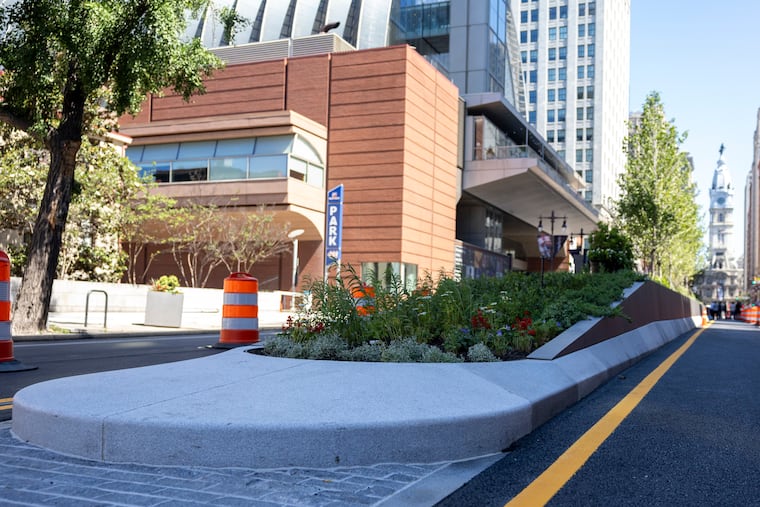
A beta test for an Avenue of the Arts project has added concrete planters to the median, which are blocking views, choking off street life, and making things worse, not better.
Broad Street is one of Philadelphia’s great ceremonial boulevards.
A defining urban design element in William Penn’s pathbreaking 1682 plan for Philadelphia, Broad Street intersects with Market at Penn Square, creating the armature for the colonial city that gives Philadelphia its je ne sais quoi — its unique sense of place. For out of this intersection sprang our majestic City Hall, anchoring the four original quadrants of Penn’s city, each coalescing around one of Penn’s great public squares.
South Broad Street is a place where the city comes together. Think of the great swell of civic ecstasy that suffused the street on either of the occasions in recent years when it hosted the Eagles’ Super Bowl victory celebrations. And then there is the perennial only-in-Philadelphia Mummers Day Parade, which animates the street on New Year’s Day as glittering costumes and the strains of string bands bounce and reverberate among the canyons of South Broad.
Still, the street struggles to invite people to linger, stroll, dine, and shop along its sidewalks on a daily basis, never matching the urban vibrancy of the great streets of the world like Fifth Avenue in Manhattan or Oxford Street in London. And it’s not for lack of trying.
The Avenue of the Arts was created to do just this during the Rendell administration. In defining an area for the performing arts, the street soon saw the arrival of the Kimmel Center, the Wilma Theatre, and other arts-based performance spaces. And yet, the street continued to flounder as a welcoming urban place.
» READ MORE: S. Broad Street gets a new landscaped median — and it’s just the start of what’s planned
Now, to be sure, South Broad has a lot going for it. One need only stand at the intersection of Broad and Walnut, surrounded by handsome towering buildings with majestic light fixtures along the sidewalk, and you have a sense of what the street was — and what it could be. The street certainly needs some TLC, but not radical surgery.
Which makes the recent “improvements” on the block of South Broad in front of the Kimmel Center all the more perplexing.
For there, officials have unveiled a beta test for a new Avenue of the Arts streetscape project smack in the middle of South Broad Street that includes an egregious four-foot-high continuous planter with trees on top of it. All intended to increase the attractiveness of the street and thereby encourage a livelier street life.
But therein lies the rub.
In creating this continuous concrete highway divider-cum-planter in the center of the street, the project actually has a chilling effect on South Broad. Not only do the planter and the trees destroy the primacy of the view of City Hall tower along the street, but it reinforces the nature of Broad Street as a highway, and makes it impossible to see the other side of the street while either walking or driving. And forget about parades and festivals.
We are told this is to be replicated on the street from City Hall to Washington Avenue to the tune of $150 million, or $15 million per block. Who thought this was a good idea?
And, as if to add insult to injury, the project proposes outsized planters along the sidewalks that will further isolate the two sides of the street, crowd out whatever street life exists, and create, along with the tall planter in the center of the street, a series of cattle chutes for 10 blocks.
Welcome to Broad Street Narrows.
This can’t stand. The project must not be replicated along the length of the Avenue of the Arts. There are ways to integrate plantings into great streets, such as along Michigan Avenue in Chicago, but they are low in scale, do not include trees in the center of the street, and do not destroy the sensation of the street as a whole.
And the proposed planters have got to go, as well. One could think of planting shade trees along the sidewalk offering respite from the sun and inviting people to sit along the street and have a bite to eat. The subway concourse below South Broad is extremely wide and could undoubtedly accommodate the tree roots below grade.
The goal of increasing street life is crucial. To do so, it would be better to widen the sidewalks to allow for cafes and strolling. Street life needs foot traffic, and foot traffic is generated by people living, working, and shopping in the area, along with attending performances.
How is it that a street lined with hotels, residences, and offices has only one place for outdoor dining — at Arthaus? Broad Street wants bustling sidewalks, but landscaping and hardscape improvements alone will not increase street life. We learned this the hard way on the ill-fated Chestnut Street Transitway of the 1970s, and the planter fiasco should serve as a cautionary tale for the current design process for Market East.
We must not fall prey to the false choice that in order to maximize urban vibrancy, we must sink millions of dollars solely into landscaping and other surface improvements.
South Broad can be the best it can be with some thoughtful planning and a little gentle nurturing — it doesn’t need a Jersey barrier running down the middle of the street.
Alan Greenberger served as deputy mayor for economic development and director of commerce under Mayor Michael A. Nutter, and chaired the Philadelphia City Planning Commission. Most recently, he served as vice president of real estate and facilities at Drexel University. He is a fellow of the American Institute of Architects. Harris M. Steinberg served as the founding executive director of PennPraxis at the School of Design at the University of Pennsylvania. He led the planning process for the Central Delaware Waterfront, which is currently guiding the development of the riverfront. Most recently, he served as the founding executive director of the Lindy Institute for Urban Innovation at Drexel University. He is a fellow of the American Institute of Architects.