Letters to the Editor | Sept. 20, 2026
Inquirer readers on the threats posed by artificial intelligence and the controversy over the rapper Macklemore’s comments about the situation in Gaza.
School parking problem
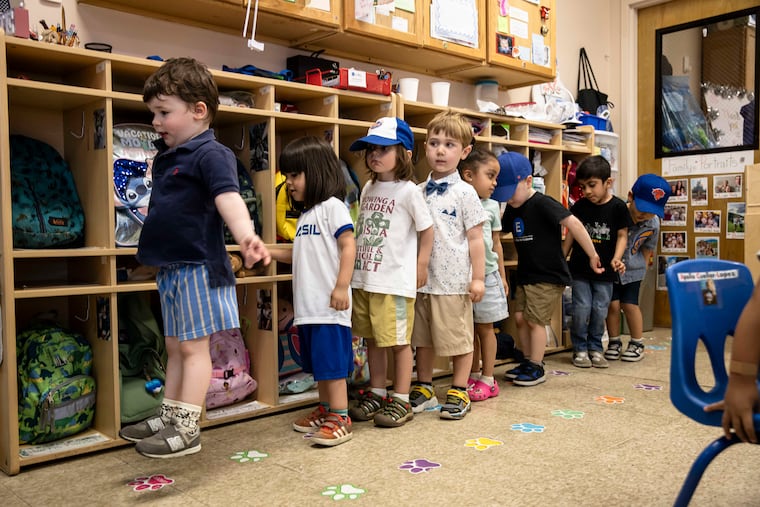
Academy at Palumbo’s Home and School Association is disappointed by City Council President Kenyatta Johnson’s inaction regarding the school parking crisis highlighted in Kristen A. Graham’s recent article.
Johnson’s spokesperson said that “… any discussion of changes to parking policy must consider the impact on the broader community.” For the past three years, we have repeatedly appealed to Johnson’s office for assistance. He has had plenty of time to conduct discussions, assess the impact, and propose a resolution.
The irony is that Palumbo staff already use parking spots in the surrounding neighborhood during school hours. The immediate impact falls on our teachers and students. Teachers consistently face a choice: either disrupt instructional time to move their car every two hours or incur costly tickets. Academy at Palumbo’s working conditions are our students’ learning conditions. The parking crisis impacts working conditions.
Businesses and residents can apply for parking permits through the Philadelphia Parking Authority. Why can’t a similar permit system be established for school district staff? It’s time for leadership to stop stalling and come up with a plan to support our educators.
Julie Kaeli, former president, Academy at Palumbo Home and School Association, and Alex Du, president, Academy at Palumbo Home and School Association, Philadelphia
Raising leaders
An African proverb asserts, “The ruin of a nation begins in the homes of its people” — an expression that offers profound commentary on recent events in Center City, in which large groups of teenagers were involved in confrontations with the police. Diverging from a broader national frame, an examination of the Philadelphia community reveals acute challenges regarding youth engagement in destructive behaviors. This reality necessitates a rigorous inquiry into behaviors that border on juvenile delinquency, marked by a lack of structural boundaries, the erosion of respect for authority, and a diminishing moral compass during sporadic social media gatherings. Many of these gatherings lead to vandalism and open acts of aggression toward authority figures.
It is also important to recognize that these negative behaviors are not indicative of all children, as many youths demonstrate socially healthy and responsible behaviors during meetups with peers. However, because of social media, these events typically lead to generalizations about children, thereby influencing policy.
Investigating these dynamics requires analyzing content, the extent and efficacy of parental and caregiver involvement, alongside efforts to reconstruct and adopt a newfound lens of social values and expectations within the community. A fundamental question arises concerning the precise level of responsibility borne by parents and primary caregivers. It is imperative that households actively instill prosocial virtues prior to a child’s entry into the public sphere. Ultimately, while fostering individualism and character, in-home adults must maintain accountability for conduct that borders on juvenile delinquency, ensuring youth positively represent both the family and the wider community.
We realize it is not solely on the family to achieve this aim; it also takes a healthy community. Likewise, city administrators need to think outside the box when investing in and creating educational, recreational, and vocational opportunities that align with children’s interests. This must include a 21st-century approach to devising a solution to this dilemma.
Darin Toliver, vice president, cofounder, Black Men at Penn Inc.
Eyes closed
Recent accounts of Washington’s lukewarm response to the artificial intelligence crisis are chilling. The leaders of tech companies have said AI could end humanity as it grows so powerful it can’t be controlled. So how does the president of our country respond? He calls it a “hoax,” which is what he calls everything he chooses not to believe. His position is that we cannot fall behind China in AI development, so he will just ignore the very real consequences. Unless a change in policy or direction benefits him, he is not interested.
So will our congressional leaders step up and do the right thing?
Senate Majority Leader John Thune thinks we should address the AI problem with a “light touch.” Apparently he, too, does not take the opinions of the experts seriously.
Meanwhile, Speaker of the House Mike Johnson is promoting Donald Trump’s plan to give $5,000 to every American adult if the Republicans hold the House and Senate on Nov. 3. Never mind that this is clearly a bribe that will never be paid.
Johnson also does not seem to recognize the urgency of the AI situation, or simply does not care.
The lack of an appropriate response from our Republican leaders is just further evidence they need to be removed from leadership positions — all of them.
Kathleen Clements, Philadelphia
City-owned censorship
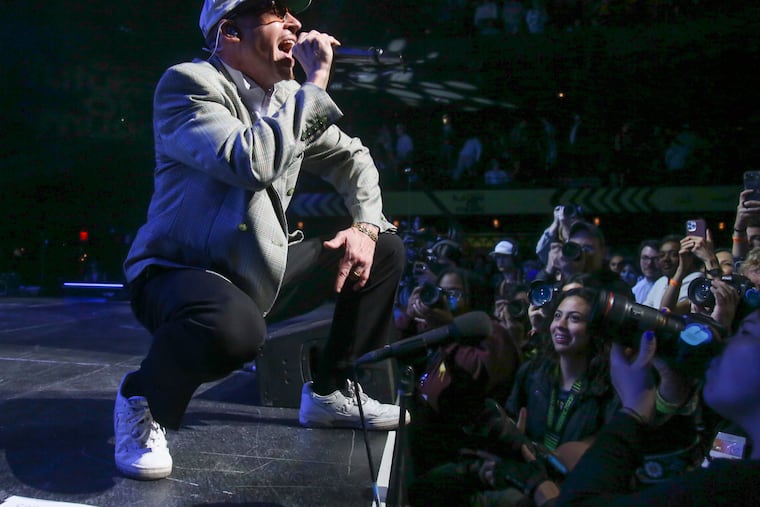
The recent decision to forbid the rapper Macklemore from performing at Lincoln Financial Field because of his criticism of the situation in Gaza is an utter embarrassment. While it is becoming unfortunately common for those in power to censor views and voices that are critical of them, this is a particularly egregious example made worse by the stadium operators’ lack of transparency.
Why can’t they give us an answer about how the owner of the New England Patriots, of all people, was allowed to deliver an ultimatum to Ed Sheeran (whom Macklemore was set to be the opening act for) on behalf of our publicly owned stadium here in Philadelphia? Regardless of your opinions on Macklemore’s comments, everyone should condemn this assault on free expression that utilizes a city-owned asset.
Tim Schautz, Philadelphia
. . .
Perhaps today’s era of oversensitivity that Jonathan Zimmerman describes in his recent column also applies to the situation in Gaza. These days, when you are critical of the Israeli government, you are subject to being called an antisemite. Don’t believe it? Rapper Macklemore was removed as an opening act for Ed Sheeran’s tour because he said two words: “Free Palestine.” He also said: “To all of my Jewish brothers and sisters: Criticism of Israel, criticism of apartheid, being against genocide in no way is criticism of you. My message is for peace, love, and for all human beings to be treated with dignity, respect, and equality.”
It’s a shame that in America today, criticizing another country’s government can get you canceled. What about our First Amendment rights?
Roy Lehman, Woolwich Township
Greenhouse gas limits
As the Environmental Protection Agency goes rogue, ignoring the growing toll of climate change on humanity and canceling climate pollution limits, states are called on to step up. Pennsylvania, the nation’s second-largest producer of natural gas, has a special obligation to rein in its industry’s emissions of methane, a highly potent climate pollutant and threat to public health. This is all the more critical with the data center stampede let loose here, threatening to add massive new gas-fired power.
Gov. Josh Shapiro and the state Department of Environmental Protection have announced plans for new state limits on methane emissions. They need to make those rules the strongest possible. Seeking a weaker path palatable to the gas industry would fail Pennsylvanians’ health and welfare.
Robin Mann, Rosemont
Join the conversation: Send letters to letters@inquirer.com. Limit length to 150 words and include home address and day and evening phone number. Letters run in The Inquirer six days a week on the editorial pages and online.