Mississippi’s hard history, a search for justice, and the strange death of Nolan Wells
Amid concerns in the African American community about judicial fairness, a grand jury declined to pursue charges in the death of a Black teen who died after boating with a group of white friends.
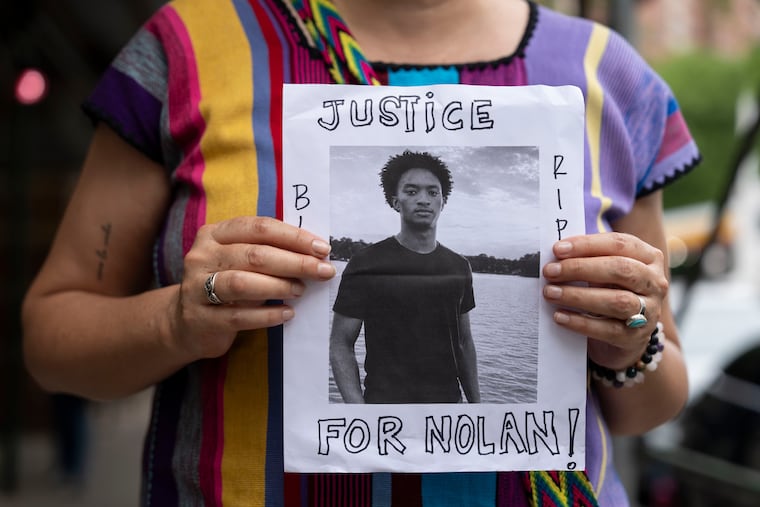
I was angry when I learned that a grand jury found no cause for criminal charges in the death of Nolan Wells, a Black teenager who died after a July 4 boat trip to an island in Mississippi with a group of white friends.
The facts surrounding the case were strange from the time Wells went missing. His friends said the 18-year-old wanted to stay on Bird Island to talk to a girl, so they left without him, and Wells left his phone on the boat. Days later, when Wells’ body was found floating in the waters off the island, Jackson County sheriff officials declared that no foul play was suspected.
Then, just days after the grand jury concluded Wells’ death was “consistent with drowning,” Wells’ family released details from the official autopsy report from the Mississippi medical examiner. The autopsy indicated that there was no water in the lungs, stomach, or throat of Wells, which begs the question: How does one drown without ingesting water?
That troubling question, along with a history that includes countless lynchings, the murder of Emmett Till, and the murder of voting rights activist Medgar Evers, demands a deeper investigation. Yet I know, in that secret place where my ancestral memory lives, that the investigation might never take place.
Wells’ family did all they could to find the truth. They hired attorney Benjamin Crump, sued social media companies for cell phone records, and hired an independent pathologist to conduct a second autopsy after the Mississippi medical examiner performed the initial postmortem. Wells’ friends were mostly silent, but the internet was not. Observers retreated to their familiar corners — left and right, progressive and conservative, bigoted and anti-racist. Our opinions of the case tended to be shaped by our long-held views and lived experience.
Perhaps that’s why, when Jackson County District Attorney Angel Myers McIlrath promised to conduct a fair and thorough investigation, I was skeptical. Then, when she announced that she would convene a grand jury, I was hopeless.
I had already watched police officers walk away unscathed after a conservative attorney general in Kentucky convened a grand jury in the shooting death of Breonna Taylor. I remembered a grand jury refusing to indict Officer Darren Wilson after he killed unarmed teen Michael Brown in Ferguson, Mo.
Because grand juries operate in secret and only view the evidence presented to them by the prosecutor, the outcome is heavily influenced by the prosecutor. I believe that’s why we don’t see criminal charges in cases like the tragic death of Nolan Wells.
Just as my ancestral memory calls out to me and screams for racial justice, the history of Mississippi calls out to the current power structure and demands white supremacy.
That’s why, after closed-door proceedings and a state autopsy report that was never fully released, after unexplained blunt force trauma to the back of Wells’ head and body, after the family received the body without the neck structures or the organs, the grand jury could conclude Wells likely drowned.
It’s why the district attorney could release a redacted grand jury report, never share all the evidence, and scold the public for questioning whether race played a role in Wells’ death.
“What I cannot accept, what I cannot ignore, is that false narratives that Nolan’s death was somehow racially motivated, and that this is a case of another young Black man denied justice by a racist, corrupt system, were perpetuated and allowed to spread,” McIlrath said in a video explaining the grand jury’s decision. “There is not a shred of evidence to support these narratives.”
Perhaps the DA can’t accept what she framed as false narratives, but how can we know they’re false? The grand jury operated in secret, then released a report with some of the details blacked out. There was no preliminary hearing, no public airing of evidence, and no real attempt to answer the family’s ongoing questions about what happened to their son.
There is only one thing that I know to be true in the death of Nolan Wells, and his mother, Christine Wonsley, gave voice to it in the wake of the grand jury’s findings.
“Last night was a reminder that our son’s life does not matter to those who hold positions that are supposed to serve and protect the public,” Wonsley said.
It breaks my heart that she’s right.