Pa. leads in casino tax revenue
From 2009 through 2012, Pennsylvania collected more money from casino gambling taxes than any other state. The four-year total was $5.4 billion.
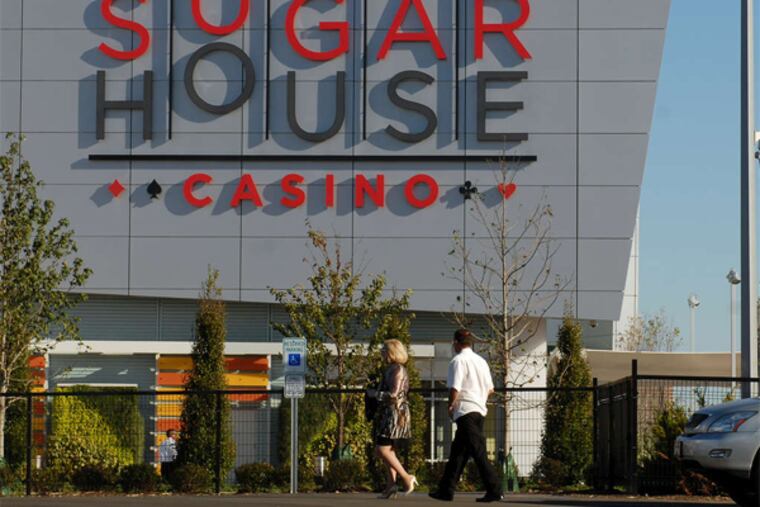
From 2009 through 2012, Pennsylvania collected more money from casino gambling taxes than any other state. The four-year total was $5.4 billion.
Because it keeps almost half the money casinos win from gamblers - more than all but a couple of states - Pennsylvania's casino tax revenue even topped the combined totals of Nevada and New Jersey, long the two biggest gambling states, from 2009 through 2012.
But in the 12 months ended June 30, Pennsylvania's total take of $1.41 billion was 2.8 percent less than the $1.44 billion the year before, as the spread of casinos in Maryland, Ohio, and New York turned the tables on Pennsylvania.
With casino winnings flat at $3.14 billion in fiscal 2013, it is unclear how much more Pennsylvania's casino industry will grow.
"It seems like they're very close to being mature," said David G. Schwartz, director of the Center for Gaming Research at the University of Nevada, Las Vegas.
As it is, since late 2006, when the state's first slot machines lit up, casinos have emerged as an industry with more than $3 billion in annual revenue, surpassing New Jersey, which had more than a two-decade head start, as the second-biggest U.S. gambling market.
That surge happened during a period that included the most debilitating U.S. economic slump since the 1930s and at a time when many public schools have struggled for money and the state's roads and bridges have crumbled. Pennsylvania officials last week added or increased weight restrictions on 1,000 bridges.
Is the state better off with casinos?
For former Gov. Ed Rendell, who has been a casino advocate since the 1990s when he was Philadelphia's mayor, the answer is easy.
"Casino gaming has been an unqualified success," Rendell said in an interview last week, citing billions in tax revenue and thousands of jobs.
"The harm is not nonexistent, but it's minimal," he said. He argued that some "people were going to become gambling addicts whether we had gambling or not."
The consequences of losing the money would be dire, said Sharon Ward, executive director of the Pennsylvania Budget and Policy Center in Harrisburg. "If you took this money away tomorrow, you would have either large cuts in education or large property-tax increases, or both," Ward said.
Pennsylvania's gambling bounty came largely at the expense of New Jersey and other states that already had gambling, though not entirely.
"I don't think there's any question, it's not only displaced Atlantic City, but increased the total amount that's wagered in these places," said Alan Malloch, a nonresident senior fellow in the Metropolitan Policy Program at the Brookings Institute.
Assessing the impact of the casinos on the state's economy is difficult because it is unclear how much money was taken from other states' residents and how much money was taken from other sectors within the state.
"If anybody has $10,000 they use on consumer purchases in any given year, the money they spend on casinos is going to come out of that pool, and it's going to mean less on something else," said Malloch, who has written about the social and economic impacts of gambling.
"What people constantly speculate about," he said, "is it less [spending] on going to Phillies games, or going kayaking, or is it less on food and clothing for the kids?"
What can be tracked more easily, in broad strokes at least, are the taxes that come from Pennsylvania casinos.
In the year ended June 30, casinos generated $264 million for the Pennsylvania Race Horse Development Fund, $121 million for Pennsylvania Gaming Economic Development and Tourism Fund, and $111 million dedicated to local projects, such as a new arena for the Pittsburgh Penguins and bond payments for Lower Bucks Hospital in Bristol.
The biggest chunk - $782.5 million - is going into property-tax relief for fiscal 2014. It will amount to an average $200 for every participating household.
Distributed by school district, the amounts in Southeastern Pennsylvania range from $35 in tiny Bryn Athyn to $641 in state-controlled Chester-Upland, according to data from the Pennsylvania Department of Education.
In Upper Dublin, where the average property-tax bill climbed the most in the region over the last decade, according to an Inquirer report in July, the gambling relief is expected to be $308 on a $5,245 median bill.
Taxpayers don't see the money, though. It flows directly to the school districts. Extra help goes to seniors.
Philadelphia's portion of revenue this year is $86.3 million that is supposed to reduce wage taxes.
In 2006, a city study projected the wage tax would drop from 4.3 percent for residents then to 3.6 percent in fiscal 2010 - thanks to casino tax revenue. The reality was that the wage tax rate stood at 3.9296 in fiscal 2010. It's now 3.92 percent for residents.
Doing something to fight rising property taxes was a top priority in the 2000s when gambling was pushed through, said Frank Gamrat, a senior research associate at the Allegheny Institute for Public Policy in Pittsburgh.
"The bottom line, of course, is it didn't make a dent for the average property owner in Pennsylvania, but yet the schools got the money," he said.
Ward, of the budget center, called the property-tax relief significant. It's partially psychological: People complain about a $250 increase in taxes, but dismiss a $250 decrease as nothing, she said.
The money might be spent differently today, Ward said. "I think if you were to enact gaming in Pennsylvania today," she said, "you'd probably spend the money more directly on the schools."