He blames Rohm & Haas for wife's death
IN SUMMER 1978, Antonio Ranalli and Olivia Zagrabbe found love at 20th and Porter streets. It was 8 a.m., a hot Monday in August, and they were waiting for the No. 17 bus.
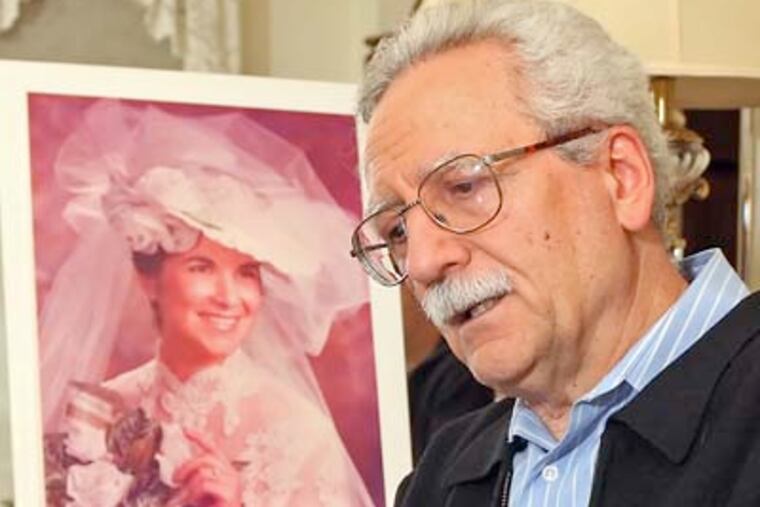
IN SUMMER 1978, Antonio Ranalli and Olivia Zagrabbe found love at 20th and Porter streets. It was 8 a.m., a hot Monday in August, and they were waiting for the No. 17 bus.
"She fell in love with my accent," the Italian immigrant said of the South Philly native. "I had my dreams to share with someone." They began seeing each other every night and got hitched the following year.
"She was indeed very beautiful. Not just physically, but more than anything else, she had an inner beauty," Ranalli said. "When I saw her cross the street, I knew she was my lady."
He worked for a Center City insurance company. She had her "dream job" at Rohm & Haas, the Philadelphia-based specialty-chemical giant. In 1982, their son, Daniel, was born.
"She was my world," Ranalli said.
It was a storybook romance, until a Sunday morning a few years ago. They were getting ready for church, when Olivia said:
"Tony, I feel strange."
Doctors found a large mass in her brain in January 2006. She died of brain cancer 14 months later, two hours after she received the last rites. She was 60.
"I never cried before," Ranalli said. "My mother died, my father died, I never cried. I hear her name now and cry."
But he doesn't want it to end this way. Ranalli, 62, believes there is a link between the chemicals Olivia was exposed to at Rohm & Haas and the brain cancer that killed her and at least a dozen other employees who had worked at the company's research complex, in Spring House, Montgomery County.
And he wants company officials held accountable for allegedly failing to protect his wife - and for not telling her years later that they were investigating brain cancers there. Ranalli said she could have sought treatment earlier had she known.
"A little act of kindness on their part could have helped her live longer," Ranalli said.
Rohm & Haas, which recently merged with Dow Chemical Co., says that working conditions are safe at the 11-building Spring House Technical Center, a former farm that serves as the company's research-and-development headquarters.
A globe-trotting model
Olivia Ranalli's office was in the company's headquarters in Philadelphia, but she frequently visited Spring House while working in the sales department of the leather-chemicals division, according to the family attorney.
During the 1970s, she would travel to Milan, London and Paris to gather fashion "intelligence" so the company could produce chemicals that would make leather goods fashionable. She also would model the jackets, handbags and other items that had been treated with chemicals.
Two in-house studies, one completed in 2004, the other in 2007, have uncovered no "statistically significant correlation" between brain tumors and chemicals there, according to Rohm & Haas spokesman Syd Havely.
Thomas Haag, the former director of corporate development at Rohm & Haas, has a different take.
"In common Philadelphia language, they're full of s---," said Haag, who retired in 1991.
Internal company memos - pried loose through lawsuits and workers' compensation claims filed by Ranalli and relatives of other cancer victims - are shedding light on who knew what, and when, about possible health risks on the 140-acre campus.
"The facts are pretty strong," said plaintiffs' attorney Aaron Freiwald, seated behind court documents stacked on his desk.
One memo, for instance, shows that a Rohm & Haas chemist had raised concerns about organic solvents at Spring House as far back as 1982. Ledelle Collier, who sampled the air in and around the buildings, wrote that test results "indicate that the entire Spring House research atmosphere is contaminated with organics expelled from all of the buildings."
Collier found that contaminated air was re-entering two buildings through the air intakes.
"All of this stuff is being exhausted out and then right back into the workplace," Freiwald said.
Spring House site manager David Greenley said the company handles chemicals "in a safe and careful manner every day."
"We take safety very seriously and we are proud of our environmental, health and safety performance," Greenley said.
Case is pending
In May 2007, Antonio Ranalli filed a wrongful-death lawsuit against Rohm & Haas, one of seven similar cases pending in the Philadelphia Common Pleas Court.
The company is seeking to have the suit dismissed, saying that it is a workers' compensation case that does not belong in court. The trial judge sided with Ranalli, but Rohm & Haas appealed to Superior Court, which is expected to rule soon on whether the case can move forward. That decision could be crucial to the six other suits.
Ranalli's lawsuit argues that his wife was exposed to vinyl chloride, a known carcinogen, and other chemicals; that Rohm & Haas didn't warn her of the cancer risk, and that the company failed to inform her after she left that it was investigating a dozen brain-cancer cases among Spring House employees.
"If I would have known, I could have had my wife screened every six months or so," Ranalli said.
After undergoing surgery in January 2006, Olivia lost mobility on the right side of her body. She couldn't talk or swallow and eventually was confined to a hospital bed in the living room.
"She was ravaged by the illness," he said.
When Olivia died in March 2007, St. Joseph's Prep, where she had worked as an assistant to the principal after leaving Rohm & Haas, was closed because so many students and teachers wanted to attend her funeral.
"Every time she went to bed, she would hold my hand," Ranalli said, recalling their married life. "She laid my clothes out perfectly so they would match. Even the socks."
'No actionable claim . . . '
Havely denies that the company committed any wrongdoing. The company's attorneys argue in court filings that there is no evidence that Rohm & Haas "made any false statement to Mrs. Ranalli, and there thus is no actionable claim of fraud," among other reasons why the case should be thrown out.
Haag says the company should have realized earlier that chemical exposure could be dangerous for employees. He believes that the company's sluggish response may have cost lives.
In 1996, Haag, a chemist who worked for the company for 38 years, wrote a letter to Philip Lewis, a Rohm & Haas vice president, expressing his concerns about company chemists amid news of brain tumors among Amoco workers in Illinois. Noting that a young Rohm & Haas chemist had died of brain cancer years earlier, Haag questioned whether the chemist might have been exposed to the same types of chemicals Amoco was using.
Lewis wrote back that he would look into it. It wasn't until 2001, when another Spring House scientist was diagnosed with brain cancer - believed at the time to be the 10th case - that the company decided to conduct an epidemiological study to determine whether the site had an elevated risk of cancer.
Havely denied that officials were negligent in assessing the risk or slow to respond to the cancer deaths.
"We looked at what we had. In '96 we did not see anything" unusual in terms of deaths or disease patterns among employees, he said.
In a September 2001 e-mail to Lewis marked "urgent," company epidemiologist Arvind Carpenter estimated that the Spring House brain-cancer rate could be two to five times normal.
After conducting two studies, Carpenter reported no link between the chemicals and the illnesses, nor an elevated brain-cancer rate among the 4,800 employees who had worked at Spring House.
Those studies, however, have been criticized by the National Institute for Occupational Safety and Health, which said the methodologies were flawed.
"The conclusions were ridiculous. They made Spring House sound like a health spa," Haag said of the studies, adding: "I know six people who died of brain cancer . . . in one hallway in one building over a 20-year period."
Freiwald says the company studies are "bogus."
One of his experts estimates that the brain-cancer rate at the Spring House site is at least three times the natonal rate.
Although Rohm & Haas is standing by Carpenter's conclusions, it has hired the University of Minnesota to perform another analysis of the cancers.
The university is expected to complete its work next year.
"It's a safe place," Havely said of the Spring House site.
Tony Ranalli isn't so sure. He simply doesn't believe that no link exists between the tumors and the chemicals produced there. "They say it was a coincidence," he said, "but I don't think this is a coincidence at all."