Healthy lunches a hit at Friends School Haverford
Four-year-old Frank Iguodala's palate is a sensitive thing. When savory bread pudding with butternut squash arrives on his lunch plate instead of his favorite, chicken nuggets, the hesitation is one of a discerning critic.
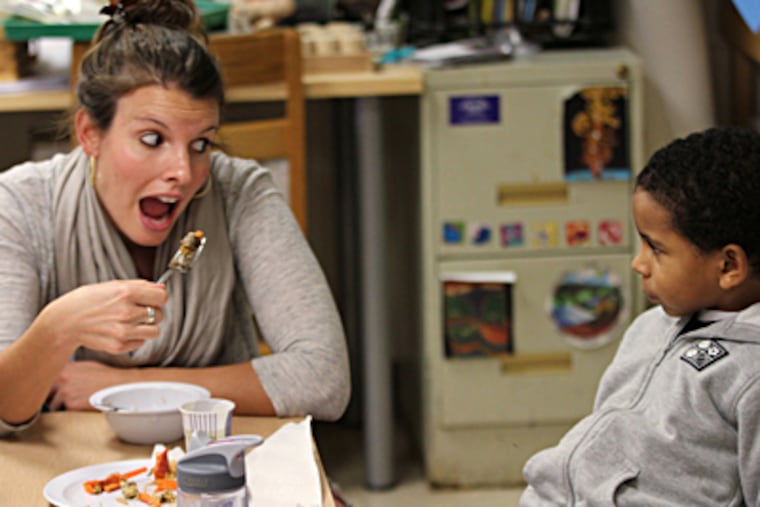
Four-year-old Frank Iguodala's palate is a sensitive thing.
When savory bread pudding with butternut squash arrives on his lunch plate instead of his favorite, chicken nuggets, the hesitation is one of a discerning critic.
Teacher Melissa McMenamin encourages the Friends School Haverford student to taste. One small bite follows another. Then a pause . . . .
"It's a little bit great," Frank said.
Chalk up another one for Chef Allie Hauptman, the tattooed, bandana-wearing former prep cook at a gourmet hot dog restaurant who is helping to lead the Delaware County school in a new culinary direction.
Hauptman is part of Friends School Haverford's new Community Lunch pilot program, an effort to craft a menu that reflects the school's environmental and Quaker sensibilities. Out with the cheesesteaks. In with the vegetarian shepherd's pie.
"It just doesn't make nutritional sense" to have processed frozen foods made in a factory far away when healthy foods are grown nearby," said Michael Zimmerman, head of the 140-student school.
So once a week, on Wednesdays, students and staff dine on healthier options made by Hauptman. The lunchtime meal is offered free to all students: Those who buy a packaged option supplied by the Haverford School District and those who bring their lunch from home.
A nationwide transformation of lunch menus is under way as a result of increasing concern about childhood obesity, said registered dietitian Lori McCoy, a vice president of the School Nutrition Association of Pennsylvania and food services director at the Colonial School District.
Individual school and district approaches vary depending on the equipment, budget, and staff resources available, McCoy said.
Friends School Haverford officials have committed $30,000 to the effort and hired Hauptman after she beat two competitors for the job in a cook-off. Her turkey meat loaf sandwich and zucchini pickles trounced the competition.
On Fridays, Hauptman orders ingredients from the Lancaster Farm Fresh Co-op. Deliveries come on Mondays. Sometimes, the meals are made with vegetables from the school's on-campus micro-farm.
Since the program began in September, Hauptman has prepared kale and white bean soup, and homemade applesauce, ketchup, and peanut butter.
Tomatoes for the ketchup came from the school garden, and Hauptman, 25, taught several students how to blanch them for peeling in the school's small kitchen.
She calls the menu offerings a vast improvement over easy-fix advertised foods for children that she says were popular when she grew up in the 1990s. They were "neon colored and came with a toy," said Hauptman, who is a self-taught and who also edits cookbooks.
Parents have been equally delighted and welcome the break from paying for or preparing lunch, Zimmerman said.
About half the school's 140 students in prekindergarten through seventh grade regularly buy the packaged lunches. The remainder bring lunch.
School leaders began planning the initiative about a year ago to complement the school's environmental-education approach, Zimmerman said.
The school's micro-farm has peppers, tomatoes, kale, onions, carrots, four hens, and a pumpkin patch. Students plant and pick the vegetables.
In the school's "What's on your plate" unit, students study the foods they eat and the cost to the environment.
"If you eat grapes in Philadelphia in January, somebody has put them on a plane from Chile, so there's all that jet fuel in the environment," Zimmerman said.
But Wednesday's lunch is all about using ingredients that are seasonal and locally grown.
After each meal, the students or their teachers rate the lunch.
So far, the five-star offerings include baked sweet potato fries, homemade corn bread, and kale soup.
Macaroni and cheese made with sharp cheddar got a thumbs-down.
"I like the program," said seventh-grader Aliya Rouine, a vegetarian. "I know everybody thinks it's healthier and locally grown. I just think it's good."
Fifth-grader Henry Reed, 10, helps serve lunch to the prekindergarteners and eats with them on Wednesdays.
"Some of the food is amazing and some of it is new and unfamiliar, so it's not as good," Henry said. "But I like the change."
School officials hope the initiative will encourage students to think differently about their food. The program will likely expand to three days a week next fall and five days in fall 2014.
"We are putting a value on taking the time to eat," Zimmerman said. "We're not saying, 'Come on, come on, we've got things to do.' We are saying, 'This is an important part of life. Pay attention to what you're eating.' "