In a new program, Drexel students can borrow laptops at library kiosk
Drexel University sophomore Hyo Jung Cha needed to listen to audio clips for her Japanese class on Thursday afternoon but didn't feel like lugging her laptop to the school's Hagerty Library.
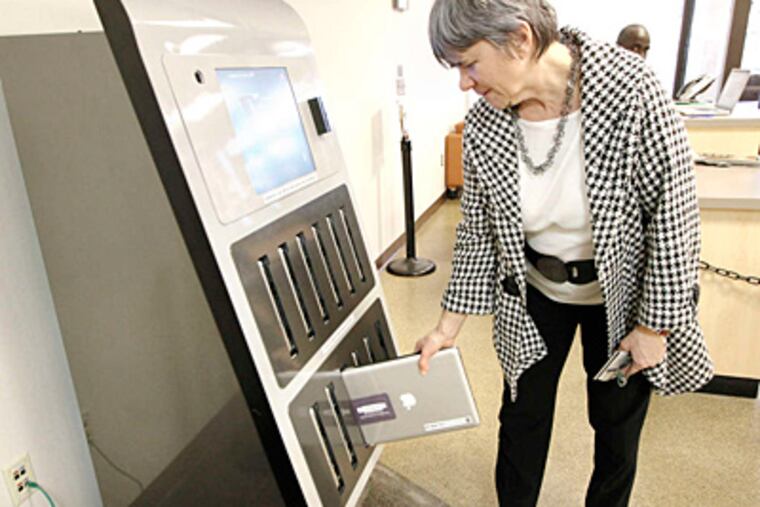
Drexel University sophomore Hyo Jung Cha needed to listen to audio clips for her Japanese class on Thursday afternoon but didn't feel like lugging her laptop to the school's Hagerty Library.
So she decided to use the library's newest addition - a laptop kiosk. Students swipe their identification card at the 24-hour kiosk and out pops a shiny silver MacBook, which they can use free for up to five hours.
Drexel reports it is the first school in the area to dispense computers via the kiosk, designed to give students access to laptops more easily and after the circulation desk is closed for the night.
The Texas company that sold Drexel the kiosk, LaptopsAnytime, said Drexel and New York University were the only two on the East Coast to have installed the units, said Matthew Buscher, company president.
Even though Cha could have borrowed a laptop from the circulation desk in the afternoon, she preferred to use the machine.
"You don't have to wait in line, so it's more comfortable," said Cha, 20, an international area studies major from Blue Bell. "You just grab it and go."
Danuta A. Nitecki, dean of the libraries, likened the kiosks to a Zipcar.
"You don't have to clean it. You don't have to maintain it. You just borrow it when you need it. Then just park it back there and don't worry about it."
The machine, a box with a display screen and 12 slots for computers on the front panel, recharges the laptop, wipes away personal information, and makes it available for loan again. If a student returns the laptop after a short time, the machine asks whether there was a problem and allows the student to report the issue. Maintenance staff closely monitors the kiosk and responds when necessary.
Nitecki said the idea came from Omer Hashmi, a 2012 Drexel graduate who at the time was student government representative. He was concerned about students toting laptops to and from the library at night for safety reasons.
Her staff discovered the kiosk option. It isn't the first time Drexel has been in the forefront of a new educational technology. In 1983, it was the first university in the United States to require all freshmen to buy their own personal computers.
"It's reflective of the culture here," said Nitecki, who came to Drexel three years ago from Yale, where she was associate university librarian. "We're very much technology driven."
The library also is exploring rolling out printers and scanners that produce three-dimensional objects.
The kiosk, which holds 12 laptops, was installed Dec. 4, the last week of classes. As of 10 a.m. Thursday, the laptops had been borrowed 385 times, Nitecki said. The highest use time has been 2 to 3 p.m.
She expects use to increase as more students discover the service. The new semester started last week.
Students must keep the laptops in the library. The machine is in the Bookmark Cafe, which is open 24 hours.
Freshman Ryan Escobar, 19, checked one out Thursday because his friends wanted to do an online study group for their English class and he didn't feel like going back to the dorm to get his computer.
"My computer is actually really old," added Escobar, a civil and architectural engineering major from Chicago. "I'd rather use these."
Hashmi, 22, who earned his bachelor's and master's degrees in chemical engineering from Drexel, was excited to hear the university had acted on his concern.
"It's a very good initiative. I want to say thank you," said Hashmi, now a process engineer for Linde North America, a German maker of industrial gases with U.S. headquarters in Murray Hill, N.J.
While carrying his phone as a freshman, Hashmi was chased by someone and became wary of toting anything valuable, especially at night.
"Students are an easy target, especially if they're not from around here," said Hashmi, who came to Drexel from Dubai, where he was born and raised.
The kiosks cost $12,000 to $30,000, depending on size, Buscher said. The first school to get one, 18 months ago, was Westminster College in Utah, he said. Columbia has signed on to put one in its library, he said.
Depending upon the level of their popularity, Drexel may install machines in other areas of campus, Nitecki said.