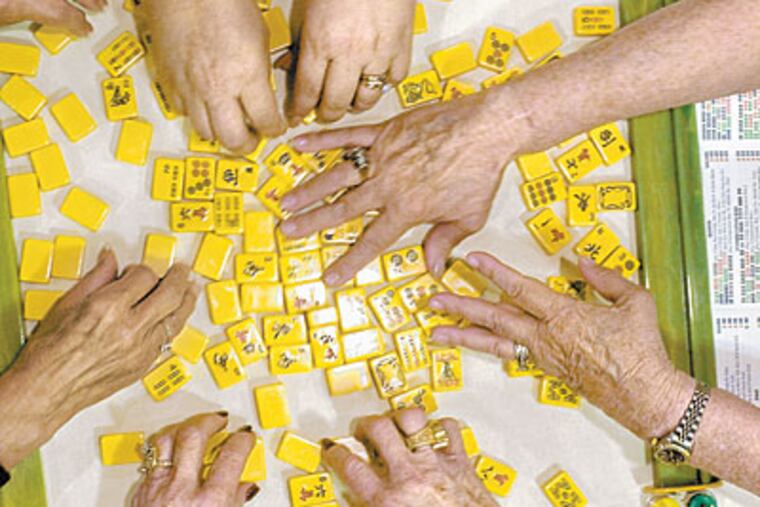
Inside a Lancaster hotel conference room, the murmur of 136 excited women fills the air. When the clock strikes 10 a.m., a smooth voice comes over the loudspeaker: "OK ladies, we're on the clock." And the room explodes with a racket of clickety-clack.
The uninitiated might run for cover - or at least an aspirin. While one mah-jongg game comprises a table and 152 tiles, the Four Seasons Mah Jongg Tournament is host to 34 tables and 5,168 tiles. Yet to these women, the clicking of faux-ivory tiles is music to their ears.
A glimpse around the tournament reveals a different set of tiles for every table: One player's sparkly, red tiles match her nail polish. Another has a pink cancer-survivor set.
Lois Madow, 73, president of the American Mah-Jongg Association, can attest to the popularity of personalized sets. The association, which sells mah-jongg tiles as well as accessories such as toilet seat covers and nail appliqués, gets requests for some racy engravings, but most are for names or nice things, like the word mazel - Hebrew for luck.
"People have mah-jongg sets to match every room in their house," Madow said. "The kitchen, dining room, and Florida room."
The Chinese
mah-jongg
, loosely translated, means "clattering sparrows," which refers to the sound of the tiles when mixed or shuffled, according to Elaine Sandberg in her book
A Beginner's Guide to American Mah Jongg
.
Mah-jongg has its roots in China and was brought to the United States in 1920 by Joseph Babcock, an American who had been working in Shanghai. He published a simplified version of the game in a how-to booklet and applied for a patent. The game, similar in play to rummy, was a huge hit nationally, but each group of players seemed to create its own rules. Usually, a game involves four players who draw and discard the marked tiles until one player assembles a winning hand.
In 1937, a handful of enthusiasts of "mahj" formed a charitable nonprofit called the National Mah Jongg League to standardize the rules of American mah-jongg and issue an annual card with yearly playing hands.
Many of the Mah Jongg League founders were Jewish, according to Internet mah-jongg guru and historian Tom Sloper, which is probably why so many Jewish women play this Chinese game.
Seventy-five percent of participants in this tournament and six others throughout the year are Jewish, according to organizer Joanne Bourne of Lakewood, N.J., but non-Jewish attendance is on the rise, as well as participants in general.
"There is a tremendous increase in players because we are more of a game society today," said Ruth Unger, 82, president the league, where she started working as a secretary in 1964. "And we're also a more mobile society. You just need to put one mah-jongg player in a new community who is eager to teach new players."
League membership alone is closing in on 300,000.
Unger cited a trend among third- and fourth-generation women, now joining the game they had long rejected.
"I often hear from younger women who say they can't believe they're playing mah-jongg," Unger said. "They swore they'd never play and now they're more addicted than their mothers."
Dena Britton, 63, of Northeast Philadelphia, has been playing for 15 years - small change compared with most others at the tournament, who averaged 25 to 50 years.
"My sister wanted me to learn, but I told her I have a child and a business," Britton said. "But when my husband got sick, my sister told me I needed an outlet." Now Britton is a self-affirmed "mah-jongg queen," who teaches the game to others. "People in their 70s are anxious to learn. Most are Jewish, but there's a blend. And now even men are learning."
In the course of three hours, the women at the tournament play 12 lightning-fast games, switching tables every 50 minutes. This is repeated over three days for a total of 48 games. Top prize at the tournament is $550 - clearly not the main reason people travel from as far away as Ohio and Virginia.
Instead, they come for the kinship. To them, the sound of clacking tiles is the tune of friendship blended with a bit of friendly competition. At home they enjoy this melody two, three, four and sometimes five times a week.
Sharon Snyder, 53, of Owings Mills, Md., started playing when her daughter was 1 and she wanted to get out of the house. She has been playing with the same group for 22 years. "At my mother's funeral, all my family was there, but it was the mah-jongg girls who stood right behind me."
Estelle Stiebel, 91, of Richmond, Va., was dolled-out in an "I'm Crazy for Mah Jongg" T-shirt she bought at the Mahj at the Taj Tournament in Atlantic City. The game, she claims, is what keeps her young.
"Each tournament is like a little reunion," Bourne said.
Unger offers a piece of advice to those who want to learn the game: "Play. Enjoy the camaraderie you'll get. And play with your mother if you can. The game will give you many fond memories."