The reemergence of a late Philadelphia artist
Only a handful of Philadelphians remember Salvatore Meo (19142004) because the artist, born and raised in South Philadelphia, spent most of his career in Rome. And those who do recall him probably didn't witness the arc of his development as an artist.
Only a handful of Philadelphians remember Salvatore Meo (19142004) because the artist, born and raised in South Philadelphia, spent most of his career in Rome. And those who do recall him probably didn't witness the arc of his development as an artist.
Though Meo was included in "The Art of Assemblage" at the Museum of Modern Art in 1961, had a few other shows in Philadelphia and New York, and won positive reviews from the New York Times and Art News, sightings of his work were increasingly rare in Rome and the United States after 1963. Meo, it is said, was not one to suffer the gallery system gladly.
Since his death, however, the word has gradually been getting out.
Mary Angela Schroth, the director of the Roman contemporary art center Sala 1, has established the Salvatore Meo Foundation to keep his former studio behind the Trevi Fountain open and to provide information on his work.
Here in Meo's native city, Schroth and Sid Sachs, director of the University of the Arts' Rosenwald-Wolf Gallery, have organized the first large-scale exhibition ever of the artist's assemblages. (A smaller show of his work will open at the Pavel Zoubok Gallery in New York on Nov. 13).
The Rosenwald-Wolf is particularly appropriate for Meo's reentry into the art world, it turns out: He attended the University of the Arts when it was still the Pennsylvania Museum School of Industrial Art, before studying at the Tyler School of Art and the Barnes Foundation.
Meo's art was eerily ahead of its time. Just a glance at the dates on some of the works at the Rosenwald-Wolf show that he used found, abject materials as the sole components of his works as early as 1946, when he was a student at Tyler and would have had to make an effort to see earlier work in a similar vein by Kurt Schwitters, Joan Miro or Arthur Dove.
His gritty, modestly scaled 1950s compositions predate those of Robert Rauschenberg, who visited Meo in Rome with Cy Twombly in 1952. (Meo later insisted that Rauschenberg had borrowed his use of everyday objects in assemblages).
Loretto
, a piece from 1954 that features one large piece of crushed metal that looks like part of a car, brings to mind John Chamberlain, who began working with metal car parts later in that decade. Meo also clearly influenced a few of the artists associated with Arte Povera (a term coined in 1967 by the Italian art critic Germano Celant, to describe art made with poor materials), though he was never officially part of that group.
Prescient or not, Meo's poetic arrangements of humble castoffs make you see your surroundings in a new light. Even the grimy parking garage a few doors south on Broad Street, its rectangular facade slashed by a bar of shiny yellow paint, had a forlorn beauty I'd never appreciated before.
Deep, blue
Mel Davis' first one-person show at Larry Becker Contemporary Art joins two bodies of work: the latest paintings from her "Leptis Magna" series, and an entirely new group of small paintings on found wood.
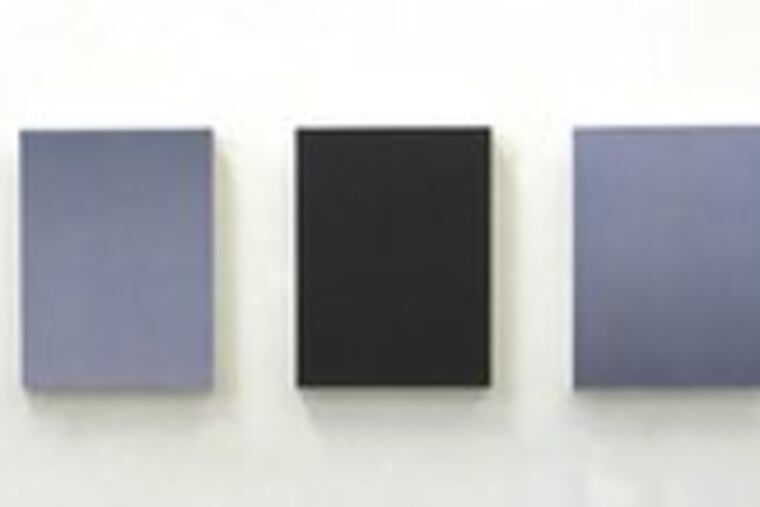
The "Leptis Magna" paintings, inspired by British writer Geoff Dyer's story of his journey to the ruined Libyan city of that name, are composed of multiple layers of paint that give them a look of great depth, like a bottomless pool; but they also suggest a shimmering mirage, with a slightly metallic luster.
The found-wood pieces take Davis in an entirely different direction.
These rough bits of wood (further distressed by Davis) are painted flat indigo blue or pale turqouise and look like artifacts that washed up along a coastal road in Mississippi after a hurricane.
They're as lovely in their own way as Davis' "Leptis Magna" paintings, as they seem to embody time in the same mysterious way.