New PAFA director bringing an unusual perspective
When Harry Philbrick - recently named director of the museum at the Pennsylvania Academy of the Fine Arts - wasn't much more than a kid, he landed a summer job working in a Provincetown art gallery, out at the very tip of Cape Cod.
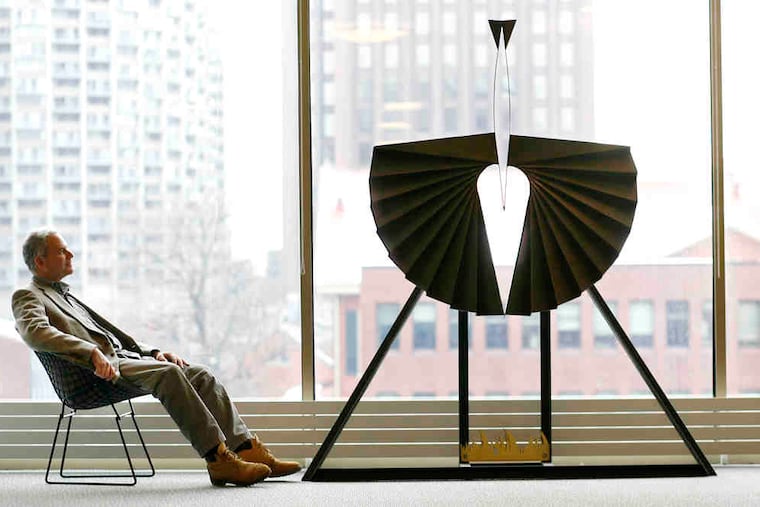
When Harry Philbrick - recently named director of the museum at the Pennsylvania Academy of the Fine Arts - wasn't much more than a kid, he landed a summer job working in a Provincetown art gallery, out at the very tip of Cape Cod.
What could be bad? Philbrick was painting seriously, and the gallery had a great show: abstract work by Judith Rothschild, former student of Provincetown's famed Hans Hoffmann.
One day, Rothschild came around and looked at Philbrick's work and liked what she saw.
"It was the first time I'd had anyone who was a serious, knowledgeable artist come and talk to me about my work," said Philbrick, now 52, more than 30 years and a career removed from the encounter. "It completely blew me away. It was fantastic. So I called her up the next day and said, 'Look, I'm moving to New York to go to art school, but is there any chance I can come and study with you?' "
Rothschild said yes.
So began an intense education. As it happened, Philbrick never attended art school, and later he came to the conclusion that his future lay with running art organizations, not making art.
But the experience with Rothschild, who visited his studio for long sessions every week, and his determined efforts to create will give Philbrick an unusual perspective for the academy museum.
"We're very excited about it," said David R. Brigham, the academy's president and chief executive. "As an artist, he brings the ability to build on our contemporary art program, to communicate with the community of artists . . . and to communicate with our students and alumni."
Brigham, the previous museum director, is a scholar of late-18th- and 19th-century American art and culture, and he is quick to point out that Philbrick's work as an artist is not all he will bring when he assumes his new position March 1.
"He's had 14 years of success running a museum," said Brigham. "That's his principal credential to lead our museum."
Philbrick comes to the academy from the Aldrich Contemporary Art Museum in Ridgefield, Conn., where he was director from 1996 until last fall; previously he was the museum's director of education.
At the Aldrich, Philbrick was tightly focused on presenting contemporary art, running a building campaign that doubled the Aldrich's size, and energizing its educational programming.
"He has a strong background in arts education," said Brigham. "Fine-arts education is our mission."
Philbrick, a soft-spoken, casual man who was apartment-hunting in Philadelphia recently (he and his wife, Carolyn Coleburn, are just trying to get their bearings here for the moment) said he was very much in tune with the academy's broad historic sweep.
"My field professionally has been in contemporary art, but my interest has really been 19th-century American, early-20th-century art as a sort of foundation for everything I do now," he said. "That combination [at the academy] of the great historic American collection with a real interest in enhancing and revitalizing the contemporary program was attractive."
The academy recently announced sales from its collection in order to acquire holdings in Hudson River school painting, various modernist areas, works by women, and contemporary art.
What will Philbrick and his focus mean for the museum and its collection as it seeks to bolster its contemporary cred?
"I don't think that the bedrock is going to change," he said. "That's the great historical strength of the museum. So my goal is not to change that, but to build on that and to enhance that."
For one thing, he said, he would "love to see as much dialogue as possible between the museum and the school."
There really is no contradiction there. Many of the great "historic" academy holdings were painted by students and faculty and acquired when new. Works by Eakins, Daniel Garber, Thomas Anschutz, and many others were very contemporary when they entered the academy's vaults.
"I really look at a museum as a place that can connect an artist with a viewer," Philbrick said. "That artist may have been dead for 200 years, or he may be alive and well. But the function of the museum is to create that connection between the object that the artist has made - which is timeless, it has the same energy it had when it was made - and the viewer. . . .
"So the fact that the museum has an art school associated with it, and there are living artists here working and creating, is something that's enormously attractive to me."
The academy is also in the early planning stages for renovation of its historic Frank Furness-designed building at Broad and Cherry Streets. Climate-control systems, roof issues, and other matters will be addressed.
"That might perhaps have scared some people, but it actually interested me and intrigued me," said Philbrick. "I loved doing the new building that we did at the Aldrich. Oddly enough, the capital campaign and the construction was fascinating to me and very enjoyable."
But renovation is in the future. First, he said, he needs to "understand the institution" and its needs. "I certainly come to it with some ideas for shows that might be interesting down the line," he said, "but it's way too early for me to be sticking my oar in the water on that."