Seger a little short on firepower at Wells Fargo Center
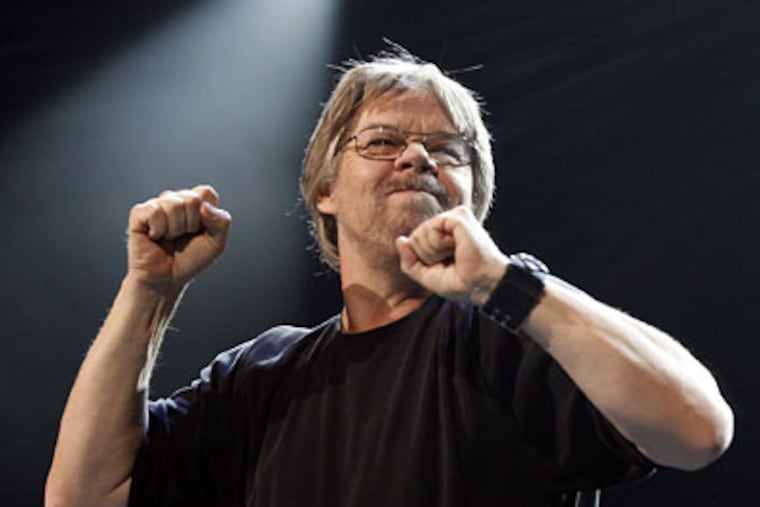
Plenty of rock stars play the role of Everyman in song, but few look the part as thoroughly as Bob Seger. In jeans and a short-sleeve button-down shirt, he looked less like he belonged onstage at the Wells Fargo Center on Saturday night than like someone who might be in line with you at Home Depot. At least until he put on a black headband a few songs into his two-hour set, Seger could have passed as a member of his own audience.
Plenty of rock stars play the role of Everyman in song, but few look the part as thoroughly as Bob Seger. In jeans and a short-sleeve button-down shirt, he looked less like he belonged onstage at the Wells Fargo Center on Saturday night than like someone who might be in line with you at Home Depot. At least until he put on a black headband a few songs into his two-hour set, Seger could have passed as a member of his own audience.
Aside from the kettle drums perched on a platform at the rear of the stage, the show's staging was unremarkable, without the bells and whistles that accompany most arena shows. The current incarnation of Seger's long-running Silver Bullet Band was something of a special effect in itself, swelling at times to more than a dozen members. But while Bruce Springsteen can make a similarly sized ensemble seem like a small army, Seger has never shown anything like his descendant's ambition. (Springsteen turned up onstage with Seger in New York last week, but didn't repeat the cameo here.)
Although Seger has announced plans to record a new album next year - his first in six years, and only his third in the last two decades - the impetus for this tour is a new greatest-hits collection, whose track list was almost identical to the show's. He was more generous with selections from his breakthrough album, 1976's Night Moves, adding "Sunspot Baby" and "Come to Poppa" to more obvious selections, and threw in covers of songs by Tina Turner and Little Richard to acknowledge some of his deepest influences. Turner's "Nutbush City Limits" was a perfect fit for Seger's raspy shout.
The song also brought out a level of excitement that was otherwise in short supply. Seger was cordially engaged, but there wasn't much fire in "The Fire Down Below," or much swagger in "Her Strut." It has been a long time since Seger stayed anywhere like the dingy motel room in which he wrote the touring lament "Turn the Page," and the distance from that threadbare desperation showed in his voice. He was enthusiastic but vaguely convictionless, like a fan singing a favorite song whose words he has never quite gotten around to really listening to.