'Shanghai' is a mess, but a likable mess
Shanghai is one of those oddball films that just doesn't seem to fit anywhere. A derivative, muddled Casablanca-esque WWII spy thriller helmed by the reasonably accomplished Mikael Håfström (Evil, Derailed, The Rite), who specializes in crime thrillers and high-concept horror, it's not a good film, and it holds little prospect of commercial or critical success.
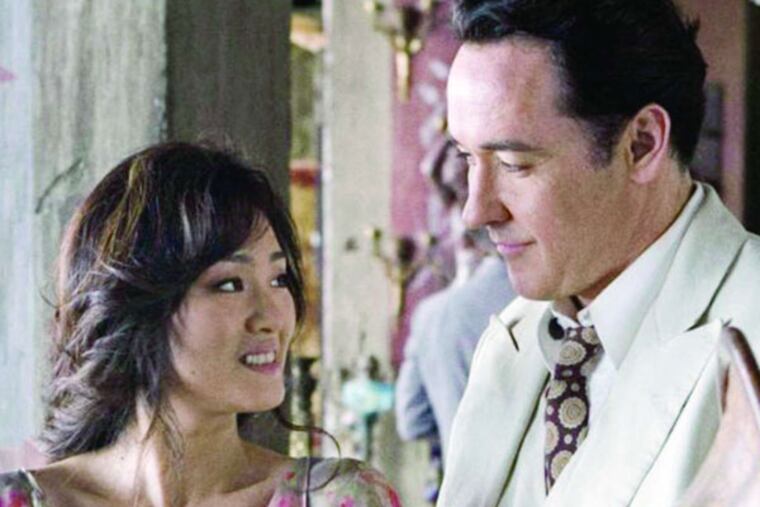
Shanghai is one of those oddball films that just doesn't seem to fit anywhere.
A derivative, muddled Casablanca-esque WWII spy thriller helmed by the reasonably accomplished Mikael Håfström (Evil, Derailed, The Rite), who specializes in crime thrillers and high-concept horror, it's not a good film, and it holds little prospect of commercial or critical success.
Perhaps that's why it languished in film-industry purgatory for five years before the Weinstein Co. finally gave it a limited release this month.
Yet. And yet. Hmm. Well, I really liked it, despite my better judgment.
John Cusack is badly miscast as Paul Soames, a Dashiell Hammett-esque American intelligence officer posing as a pro-Nazi journalist in Berlin, who follows a group of German dignitaries for a diplomatic visit to Shanghai.
A remarkable city, Shanghai is on the verge of being taken by Japanese forces, who already control much of China. The city is filled with soldiers, spies, drug dealers, arms merchants, and call girls from every corner of the globe.
Soames is called into action when his friend and fellow spy Conner (Jeffrey Dean Morgan) is brutally murdered after stumbling on a piece of information that suggests Japan's fleet may be amassing against U.S. forces in the Pacific.
That's right: Shanghai is about Japan's plot to attack Pearl Harbor. It's October 1941, and virtually everyone in the American intelligence establishment is blissfully unaware of Japan's plans. Everyone, that is, except Conner.
Yet instead of honing in on this promising premise, Håfström's film zigs, zags, and careers all over the place with a profusion of fruitless subplots. In one, Soames befriends top triad boss Anthony Lan-Ting (Yun-Fat Chow) while falling in love with his wife Anna (Li Gong). The daughter of a principled Chinese nationalist murdered by the Japanese, Anna is a spy for the city's anti-Japanese resistance force. Another subplot has Soames hunt down Conner's Japanese girlfriend.
Then there's Cusack's interminable voice-overs explaining the plot as the film moves forward (while going nowhere).
Shanghai has a fascinating if outlandish premise, amazing photography, and an amazing cast of international stars who also includes Ken Watanabe, David Morse, Franka Potente, and Hugh Bonneville. Yet it is hampered by weak writing and a badly executed story line.
Despite all its problems, Håfström's film has a nostalgic, 1940s film-noir feel that I found attractive. To enjoy Shanghai, you have to approach it not as a completed film in its own right, but as a disparate series of cinematic gestures that evoke a genre that was long gone by the 1950s.
215-854-2736
Shanghai ** (out of four stars)
StartText
Directed by Mikael Håfström. With John Cusack, David Morse, Li Gong, Yun-Fat Chow, Ken Watanabe, and Franka Potente. Distributed by Weinstein Co.
Running time: 1 hour, 45 mins.
Parent's guide: rated R (violence, profanity, drug use, smoking).
Playing at: Frank Theatres Montgomeryville Stadium 12.
EndText