'Masters of Sex' star sought man behind the curtain
He was "a mystery to himself," says Michael Sheen of the pioneering sex researcher he plays in new Showtime series.
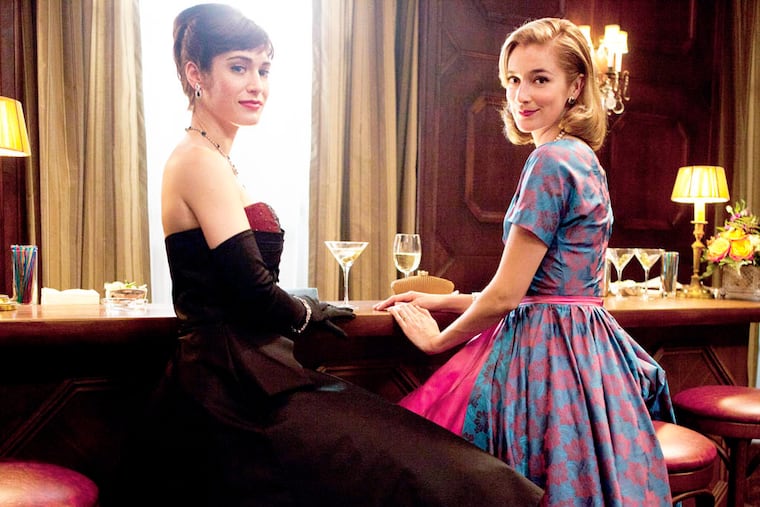
* MASTERS OF SEX. 10 p.m. Sunday, Showtime.
MICHAEL SHEEN'S played famous people before - David Frost in "Frost/Nixon," former British prime minister Tony Blair in three movies, including "The Queen" - but he's never portrayed anyone quite like Dr. William Masters, the groundbreaking sex researcher whose story Sheen brings to life in Showtime's "Masters of Sex."
"So much of him is buried, and he shows so little of what's really going on," said Sheen in an interview in Beverly Hills, Calif., this summer. "And I don't play characters like that. I play characters who have something very different going on under the surface as opposed to what's on the surface, but there's usually a lot more on the surface."
Characters, in fact, more like Virginia Johnson (Lizzy Caplan), the less repressed half of the team of Masters and Johnson, on whose 2009 biography by Thomas Maier the Showtime series is based.
As depicted in "Masters of Sex," which premieres Sunday, the collaboration of Masters and Johnson was, to put it mildly, complicated.
Especially for 1950s St. Louis, where few knew that Masters and the twice-divorced former singer who'd been working as his secretary were spending their evenings watching people masturbate or have intercourse, sometimes in brothels and sometimes in the hospital where Masters, a respected OB-GYN and fertility specialist, was on staff.
Even after the pair's book, Human Sexual Response, was published a decade later, most readers probably didn't realize the extent of the research in which some volunteers were assigned partners and then observed having sex while wired to machines that measured their physical responses.
"I dare you to get through it - it is so dry," said executive producer Michelle Ashford of that 1966 best-seller. "I think that people sort of read between the lines and realized what they were talking about. And so it became just explosive, and yet they were so careful to keep it so scientific that it's hard to know, when you're reading it, exactly what was going on. . . . This is why Tom's biography was so eye-opening, because no one actually knew what was happening in those rooms. And certainly no one knew what was happening between the two of them."
"Partly because I'm British, partly because of the generation I'm born into, I suppose," Sheen, 44, said he'd never heard of Masters and Johnson before the show.
"You just read the stuff that's going on, and it's extraordinary. You still can't quite believe it. That was partly what made me feel like this was a risk worth taking. Because there's such fertile ground there, dramatically speaking, as well as being incredibly informative and educational," he said.
Sheen sees Masters, who died in 2001 - Johnson died in July - as "a man who's a mystery to himself in a way, and I think a lot of very, very driven people, very, very motivated people, often have a kind of locked room inside themselves that becomes the engine room. The thing that actually drives them is maybe something that they don't have access to completely."
"It's a really interesting mix of actor and character," said Ashford, "because I think many things that are true about Michael were true about Bill Masters: fiercely intelligent, meticulous in his research and in his approach to subject matter. In Bill's case, it was sex, and in Michael's case, it's acting."
Sheen famously bears at least a superficial resemblance to Blair, but beyond the character's bow ties, there's been no attempt to make him look like Masters, who was, for one thing, bald.
"It doesn't really matter what you look like, anyway," Sheen said. "I don't think that's the point. I think that's something that people latch onto, but within a minute, that doesn't matter.
"The whole point is that in playing a person, you have to make an imaginative connection with them and an emotional connection with them, and you have to somehow, I think, give an audience an experience of what it's like to be them, to be looking out from behind their eyes."
Blog: ph.ly/EllenGray