Drug world's worst nightmare calls it quits
But even bad guys had respect for this FBI agent
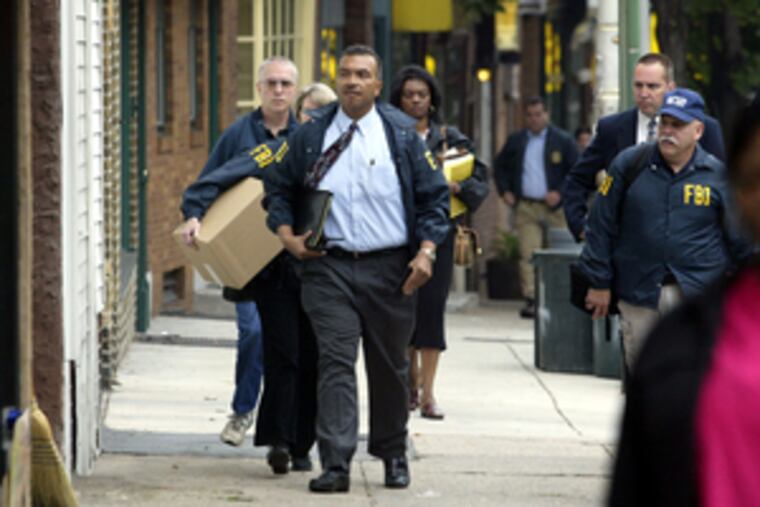
HIS FRIENDS and foes say he's never broken his word - an unusual phenomenon in the drug world, where he's considered larger than life.
He doesn't brag or take credit from others.
His razor-sharp radar zeroes in on what makes a drug dealer tick - and flip.
And now, after 28 years of taking down hundreds of the city's longest-running, high-profile, most violent drug-gang members, Jesse Coleman quietly turned in his FBI special-agent badge and Glock pistol and retired on June 1, two months shy of 55, the FBI's retirement age.
"The streets will be celebrating tonight. Matter of fact, I'm gonna go out and celebrate right now," said a Coleman target, home after a lengthy jail term.
"It's a huge loss," said Robert Courtney III, chief of the Organized Crime Division at the U.S. attorney's office.
"He's the most honest guy I've dealt with in my life," said defense attorney Michael Giampietro.
Coleman is one of those unsung heroes who put his life - and his marriage - on the line for the rest of us to be safe. He declined to be interviewed for this story.
"He really believed that if he didn't do his job, thoroughly and correctly, it would have a negative impact on the community," said Frank L. Labor III, deputy chief of the Organized Crime Strike Force in the U.S. attorney's office.
Named a special agent in 1979 after a four-year stint on the FBI's support staff, Coleman, a McKeesport, Pa., native, began his career interpreting street jargon on court-authorized wiretaps of major Black Mafia figures.
One of his last major cases was much like his first.
Listening to drug wiretaps, he heard an elusive longtime target - Muslim imam Shamsud-din Ali, who was once in the Black Mafia - urge a drug dealer to take $5,000 to Mayor Street's office. The FBI never determined if the drug money had been delivered and what it was intended for.
The dramatic exchange sparked an investigation of Ali, who was convicted of racketeering, and led to an ongoing public corruption probe and more than 50 convictions of politicians, city officials, financial consultants, city contractors and drug dealers.
Described by several peers as "one of the best investigators I ever worked with," and by defense attorneys as having "impeccable integrity," Coleman paid dearly for his work ethic and reputation.
His marriage broke up after he led an investigation against his own brother-in-law, Aaron "AJ" Jones, street boss of the notoriously violent Junior Black Mafia, which left a trail of more than two dozen homicides and ties to 33 businesses between 1987-91.
Now on Pennsylvania's death row in Waynesburg, Pa., Jones, 46, has escaped injection three times for two JBM murders while serving a mandatory life sentence for federal drug offenses.
Coleman didn't investigate the JBM alone. He and former State Trooper Thomas Ansel worked with city, state, and federal agencies to put Jones and dozens of JBMers, who wore diamond-encrusted initial rings, behind bars.
An associate in the JBM-probe, Hillary Connor, chief of investigations in the district attorney's office, called Coleman "one of the nicest persons I've ever met in this businesss. He's treated every police officer, victim, defendant, informant with dignity and respect."
No wonder that Coleman and his ex-wife, Patricia, remarried on Jan. 1, 2004, after an eight-year separation during which they talked every day.
Although his quarry didn't have household names like the Mafia's, Coleman specialized in major organized-crime figures revered in the African-American drug underworld: Roland Bartlett, Aaron Jones, Darrell Coleman, among others.
"He had a dangerous job. These people were killers," said former federal prosecutor Arnold Gordon, now first assistant to District Attorney Lynne Abraham.
Some investigators are "hostile" and approach targets with "fear and intimidation," whereas Coleman empathized with potential witnesses and was successful in getting them to "do the right thing," Labor said.
"He's a straight-up true guy," said convicted meth cook Idi Muhammad, now drug- and crime-free for nine years. "He helped me in so many ways. He scared me straight. I love him."
The name "Jesse Coleman" still strikes fear in drug circles, although few targets recognized him at the Blue Horizon, or a pro basketball game, or drug denizens, according to Jack Miles, an executive with the NBA's Washington Wizards, who sought him as a mentor when he was a deputy sheriff here 10 years ago.
Miles said Coleman helped him solve NBA problems such as drug dealers hanging around players, or a stubborn player who refused to get a driver's license.
Although he became "Mr. Expert" to young agents, Coleman told Labor that posing as a corrupt FBI agent was his worst job ever. Labor said, "It showed his courage."
In exchange for $5,000, a drug-trafficker wanted the agent to tell him in advance if anyone wiretaps his phone. The agent was recording the conversation while they talked inside Coleman's car, a dangerous situation that would result in FBI agent Chuck Reed's death two years later in 1996.
The taped-conversation was used to obtain the feared court-approved wiretap, Labor said. And the trafficker, Terrence "T" Gibbs, is now serving a life sentence for federal drug offenses.
In the courtroom, defense attorney Brian McMonagle and Coleman have been adversaries for years.
"We've had some enormous battles, and at the end of every one of them, we've shook hands," said McMonagle. "He's brought credit to the FBI and the African-American community."
Defense attorney Tariq El-Shabazz said, unlike some other agents, Coleman has "impeccable integrity.
"He could have buried people if he had exaggerated on the witness stand," said El-Shabazz. Instead, Coleman would reply: "That's right, counselor," even though the point might be detrimental to the government.
"Ain't nothing more dangerous than a law-enforcement officer who's credible," he added.
"Jesse was one of our best," said FBI Special Agent in Charge J.P. Weis. In the post-9/11 FBI, Weis said: "We need to figure out what we don't know, and Jesse got that. He was one of our best in developing sources, and he was one of our best case-makers.
"There was no better criminal agent in the division." *