The ball's in Chester's court
A struggling city looks to a riverfront stadium as a key to recovery.
If you visit the memorial to the USS Arizona at Pearl Harbor, you'll step past a giant anchor raised from the sunken battleship.
It stands taller than two men and weighs more than an elephant, strong and steadfast even in loss - and it was cast in the city of Chester.
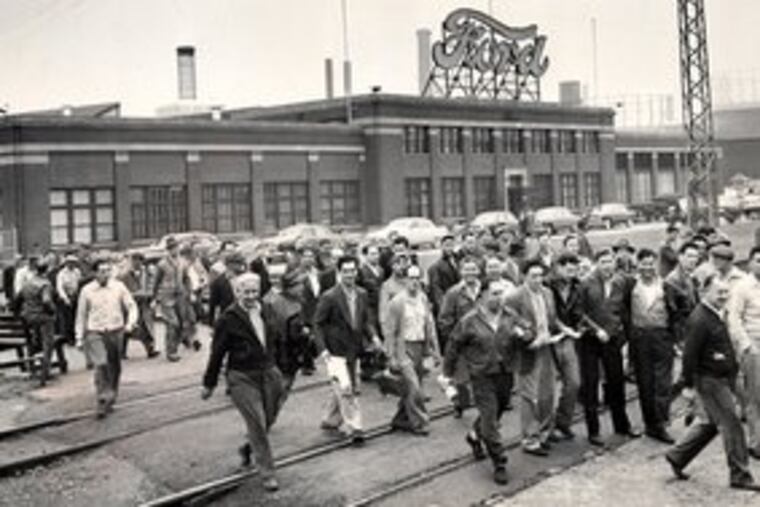
If you own a vintage 1950s Ford, there's a chance it was built in Chester, at a sprawling assembly plant that once employed a young salesman by the name of Lee Iacocca. If you listen to the sermons of the Rev. Dr. Martin Luther King Jr. or the rock-and-roll of Bill Haley, you can hear echoes of Chester.
Today the city is known mostly for its poverty. But it hasn't always been that way. Chester's indigence is relatively new.
Now, as government officials and private investors try to secure funding to build a $115 million riverfront soccer stadium, the key to luring a pro team to the region, people are talking not just about what Chester is, but about what it was - and could be.
Backers say the stadium will anchor a $500 million development project featuring stores, restaurants and housing, creating thousands of jobs and untold new tax revenues. Major League Soccer is expected to name its 16th team this month.
"It's not going to be the Chester we all remember," said historian John Bullock 3d, whose parents ran Bullock's Pharmacy in the city for more than 30 years. "We're not going to have to fight our way down the sidewalks on Friday night to shop at Speare's or Weinberg's or to go to the Boyd Theater. But I'm optimistic."
Thriving years
Chester made history early.
It was settled by Swedes as the tobacco-farming community of Upland in the 1640s. William Penn stepped ashore 30 years later - the true Penn's Landing, locals insist - and is said to have immediately changed the name of the settlement to Chester, the hometown of a close friend.
For the next few centuries, Chester thrived as an American workshop, churning out carriages, barrels and shoes. Baldwin Locomotive opened a plant in nearby Eddystone in 1906, building 2,500 locomotives that year alone.
The outbreak of World War I drew thousands to the factories, driving the population from 38,000 to 58,000. The Great Depression proved but a pause, with the Second World War igniting even greater growth.
During the war, Sun Shipbuilding tripled capacity, increasing its docks from eight to 28. The Baldt company sent anchors and chain to the Navy, not only for the Arizona but for ships including the USS Missouri, on which the Japanese would formally surrender.
People in Chester had plenty to do besides work. The Century Club and Central Rest Recreation Club held costume balls and banquets. Ukrainians, Poles and Russians ran social clubs. Theaters? Too many to count, including the Apollo, Boyd, Mac, Rio and State.
In the late 1940s, guitar player Bill Haley took a job interviewing local celebrities for a Chester radio station. A few years later he helped invent rock-and-roll. Martin Luther King entered the Crozer Theological Seminary, where he began to seriously study Mahatma Gandhi and develop his ideas about nonviolent protest.
By 1949 the Ford plant employed 1,750. They spent their money where they worked: On Friday nights, the downtown shopping district was so busy that people had to step into the street to move past the crowds on the sidewalks.
But the post-war American dream was a house in the suburbs, not a rowhouse in the city. Economic markets were becoming more global, and manufacturing jobs moved overseas, exerting particular pressure on places like Chester.
The Ford plant closed in 1961. The white population began to move out as more black residents moved in, and racial tensions simmered through the 1960s. In 1977, only five years after building the fabled Glomar Explorer, designed for a CIA operation to recover a sunken Soviet submarine, Sun Shipbuilding launched its last vessel.
Hope amid blight
Today, Chester is five square miles of misery.
Since 1950 the population has dropped nearly in half, from 66,039 to 36,854. The per-capita income is $13,000 a year, half the Delaware County average. One out of every four people lives in poverty.
Between 1970 and 2000, the unemployment rate tripled to 16.7 percent.
Eighteen people were murdered in Chester last year, compared with 16 in Allentown, a city three times larger.
Last year at Chester High School, 86 percent of students scored below basic levels in math, and 76 percent finished below basic in reading.
Nearly a third of Chester residents over age 25 do not have a high-school diploma. They live in a city that does not have a supermarket, a movie theater, a bowling alley or a skating rink.
"Any entertainment that doesn't involve drinking, you've got to leave Chester," said Jamar Cunningham, at work last week selling used goods at Joe's Furniture.
The city's poverty seems glaring beside the prosperous western suburbs of Philadelphia.
"The worst-hit places in the U.S. now are these small, formerly industrial cities outside the main city," said Drexel University professor Richardson Dilworth 3d, who studies urban planning. "Their rationale [for existence] in the 19th century has gone."
But city fathers warn against writing off Chester.
They say Chester has attracted $1.3 billion in public and private investment since 1996. The new Harrah's casino is projected to reliably deliver $10 million a year in gaming revenues to city coffers. On the waterfront, not far from the proposed site of the soccer stadium, the old Philadelphia Electric Co. station has been restored as an office complex called the Wharf at Rivertown.
It's owned by the Buccini/Pollin Group, among the investors trying to bring soccer here. Building the stadium complex will "change the face of Chester, put Chester on the map globally," said Nick Sakiewicz, president of sports promoter AEG New York, who is helping local investors. "This site is perfect."
Signs of change
Last week, on a cold Wednesday morning, there was plenty of room on the downtown sidewalks. There weren't many shoppers because there aren't many stores.
Several people said they thought Chester was changing for the better, slowly, perhaps imperceptibly. On Edgmont Avenue, once a hub, they point to solid businesses such as the Glassworkz, which sells windows to companies like Home Depot, and the Italian Brothers Fifth Street Deli.
"People came from all over the world to live in Chester," said Delores Freeman, recalling the glory days from the gallery in the Nia Center at the Freeman Cultural Arts Complex.
Freeman is known for her Chester pride and can-do determination, leading a years-long push to create arts programs for kids. She thinks soccer could help Chester - if its organizers connect the team to the community. She's asked if today she's more hopeful or less hopeful for change in Chester.
"More hopeful," Freeman answers. "We've seen good signs."
Go to http://go.philly.com/chesterhistory for more on Chester history, including photos.