Uneven Mideast swap draws cheers, anger
KIRYAT MOTZKIN, Israel - With the transfer of prisoners and fighters' remains yesterday across the Israeli-Lebanese border, the Shiite militia Hezbollah achieved a victory it had long coveted, and Israel received the long-feared confirmation that two of its soldiers were dead.
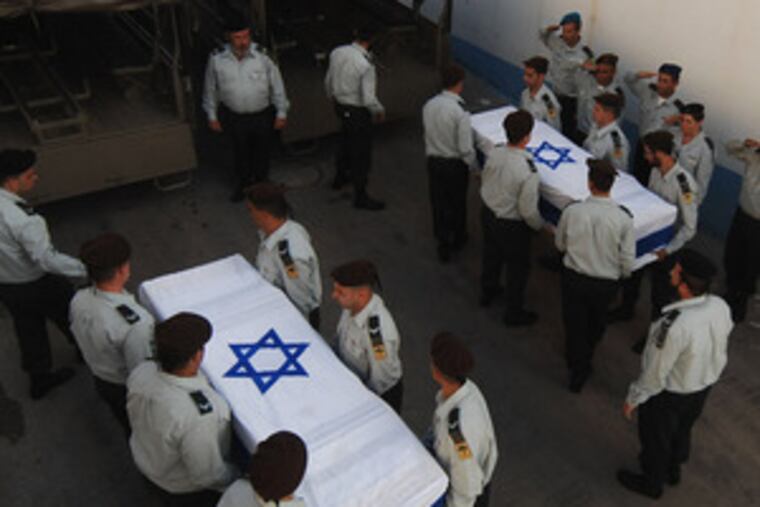
KIRYAT MOTZKIN, Israel - With the transfer of prisoners and fighters' remains yesterday across the Israeli-Lebanese border, the Shiite militia Hezbollah achieved a victory it had long coveted, and Israel received the long-feared confirmation that two of its soldiers were dead.
The swap between enemies began with two black coffins passing into Israel at a seaside border crossing. Subsequent confirmation of the identities of soldiers Ehud Goldwasser and Eldad Regev ended hopes that either of the two Israelis, whose capture by Hezbollah in July 2006 sparked a monthlong war, had survived their ordeal.
Hours later, the man Hezbollah had sought to free when it seized the Israelis - convicted murderer Samir Kantar - returned to Lebanon to a jubilant hero's welcome.
The divergent reactions reflected the basic nature of the deal as a trade of the living for the dead. For Israel, the exchange represented a collision of ideals: the obligation to never leave a soldier behind on the battlefield, and the determination to resist concessions earned through violence.
"We think of bringing our children home," said Moshe Sasson, 62, who was injured in Kantar's attack 29 years ago and is now a neighbor of the Goldwassers. "But they think of other targets."
For Hezbollah, the swap was treated as vindication of the group's strategy of taking hostages to bargain for Kantar's freedom, though the tactic also prompted a war that left more than 1,000 Lebanese and 159 Israelis dead.
"The most important element that brought us to where we are today is our steadfastness and our victory against Israel," Hezbollah leader Hasan Nasrallah told thousands of the group's supporters at an arena in southern Beirut.
Kantar also spoke to the crowds, saying he had returned "to Lebanon only because I want to go back to Palestine with my brothers in the resistance."
The ambivalence in Israel was displayed on television, radio and the streets, where arguments raged over the merits of the U.N.-mediated deal. At the emotional center of the debate were the families.
Both Goldwasser's and Regev's relatives had waged a public campaign to bring them home. With opinion polls showing most of the public on the families' side, the cabinet of Prime Minister Ehud Olmert ultimately agreed. Relatives of Kantar's victims, meanwhile, fought any deal that involved letting him go free.
Although Israeli officials had said weeks ago that the captured soldiers were almost certainly dead - as had been suspected since the first days of the war - televised images of the coffins crossing the border were still greeted by wails of grief here in Regev's hometown.
"We were always hoping that Udi and Eldad were alive and that they would come home and we would hug them," said Regev's father, Zvi.
Even here in the hometown, however, the deal had its critics. Shalom Millo, owner of a hardware store beneath the Regev home, said Olmert had blundered by giving up Kantar in exchange for two dead men.
"If they didn't have a sign of life, Olmert shouldn't have done the swap," said Millo, pounding his fist on the counter. "You don't trade bodies for live prisoners."
A short drive away, relatives of Danny Haran said they felt betrayed by their government. Haran was killed along with his 4-year-old daughter during Kantar's 1979 raid. Another daughter, 2, died when her mother accidentally suffocated her while trying to keep her quiet.
A policeman was also killed in the attack by Kantar, who was 16 at the time and who has said he was trying to take hostages to win the release of Palestinian prisoners.
"I feel that this is a victory for terror," said Ron Keren, Haran's brother.
Nina Keren, 82, pointing to pictures of the son and two granddaughters she lost in Kantar's attack, said she could not understand how Lebanon could hold a rapturous welcome for the man who had destroyed so much of her family: "He's a hero? Because he killed a 4-year-old? Because he smashed her head with his rifle?"
Although Kantar's attack predated Hezbollah and he has not identified with the group, Hezbollah rolled out a red-carpet welcome for him and four Lebanese veterans of the 2006 war. Appearing at an elaborate ceremony at the border town of Naqoura, Kantar wore the same uniform as the released fighters.
Many Palestinians also gathered in Naqoura, hoping to determine whether missing loved ones are among 199 bodies of Lebanese and Palestinian fighters that Israel returned yesterday. Killed during various conflicts over several decades, the bodies had been buried in Israel.
Kantar and the released Hezbollah fighters were flown to Beirut, where they were greeted by top officials.
"Our joy will be complete when we achieve the liberation of all our land," President Michel Suleiman said, referring to a disputed parcel of land along the Israeli-Lebanese border.
Hamas, the armed Islamist movement that controls the Gaza Strip, said it had been encouraged by Hezbollah's success to "capture Zionist soldiers, in order to swap them with our sons in prison."
Hamas already has one Israeli soldier in custody, Gilad Shalit. He is believed to be alive, and Israel has been trying to negotiate his release.