Women take the field at the Gettysburg reenactment
GETTYSBURG - Stare hard at a line of soldiers marching to the battlefield reenactments here, and you'll likely spot a ponytail or two tucked under an infantryman's cap.
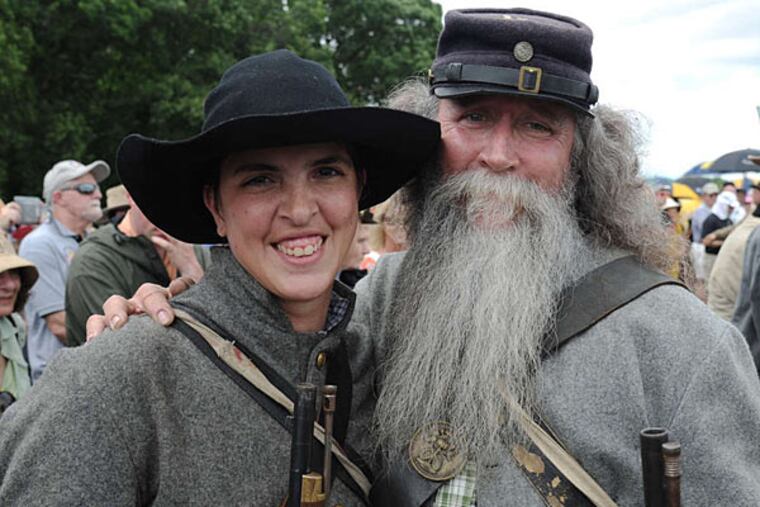
GETTYSBURG - Stare hard at a line of soldiers marching to the battlefield reenactments here, and you'll likely spot a ponytail or two tucked under an infantryman's cap.
"There are a lot of girl soldiers here," said Courtney Yoder, 17, clad in Union blue. "You just have to look for them."
Hundreds of women did fight incognito in the Civil War, and thousands more supported troops on the home front or at the battlefield, cooking or working for field hospitals and aid societies.
At the reenactment of the 1863 Battle of Gettysburg being held this weekend, women are portraying everything from cavalry soldiers to camp laundresses and the "ladies of ill repute" who followed the troops from battle to battle.
At the Chateau de Repose, a 19th-century bordello near the Union camp, "ladies of the evening" poured lemonade and served plum cakes to troops returning from battle. Several reenactors snapped photos for friends as they received decidedly chaste neck massages and cold-towel wraps.
"As with any war, females, regardless of age, were prostituted just to keep the family alive," said Valerie Francisangeli, a reenactor from Hinckley, Ohio, as she applied towel wraps.
And while some might view a military reenactment as the ultimate boys' club, the female reenactors at Gettysburg this weekend pride themselves on being able to present "a different perspective" to spectators, said Amelia Youhn, 23, who has been reenacting since she was six weeks old.
Youhn, who reenacts with the 20th Maine Unit, portrays a member of the Maine Camp and Hospital Association, a civilian relief organization that followed troops from Maine to battle, providing supplies and water.
"They gave out socks, shirts, combs," she said. "We talk to people about how women were in charge of making sure no one got scurvy."
As a child, Youhn spent most of her weekends at reenactment camps, she said, and while she "couldn't stand it" growing up, she does it for a living now, working as a living historian at a museum in Maryland. Many of the women in period garb this weekend also began reenacting with their husbands or families.
Marie Powell, 67, of Evans, Ga., is spending the week manning a cannon with her husband, David, 74, for the Confederates.
"When you're on the field with the men, you feel like a man," she said, laughing. "There's no difference between what I do and what a man does."
Part of the reason she portrays a soldier, Powell said, is simple logistics - it's easier to travel with men's clothing than the enormous hoop skirts in fashion at the time.
"Portraying a soldier is more fun than a hoop skirt," said Terry Papavasilis, 31, of Philadelphia, who portrays one of only two women known to die on the battlefield during Pickett's Charge 150 years ago.
Still, some 19th-century mores remain. Those who choose the hoop-skirted route may find themselves performing tasks traditionally assigned to women in the 1860s, such as serving water or cooking dinner for hungry troops.
Though there remains debate in the reenactment community about women portraying soldiers - some groups still don't accept female soldiers - attitudes have changed over the years, said Janet Brown of Bumpass, Va., who met her husband during a Civil War reenactment and has been attending battles for 30 years.
"It's better than it used to be. It was definitely a man's game. They didn't want women in the camp," she said. "But in today's world, with this economy, if the wives don't like reenacting, the man's not going to be able to do it."
For some reenactors, women in battle are simply not allowed. Most companies welcome women soldiers as long as they pass the 10-yard rule: If a female posing as a male soldier can pass from 10 yards away, she is fit for the battlefield, said Dennis Rohrbaugh, commander of a Union division.
"If a woman can accurately portray that type of soldier, they should do it," he said. The three women in his company, he said, "fit right in."
Julie Gondek of the Fourth Texas Citizens for Independence, another 30-year reenactment veteran, said showing how ordinary women were affected by the Civil War is just as important as depicting the soldiers' experience.
"We portray women whose husbands are off to war. We maintained the home front," she said. "This is what happened to us."
Yoder, who has been portraying William McBently, a soldier from the 148th Field Hospital, for a year, said her favorite part of reenacting is "the people you meet. Everyone's just fun to be around."
"We don't have stereotypes of girls on the field," she said. "They'll say, 'Come on, man up,' and I'm like, 'I think I'm man enough.' "