Colleges' outsize gym ambitions
Gettysburg College is proud of its liberal-arts program and commitment to community service, but it can't help envying the eye-popping Olympic-size swimming pool belonging to its academic and athletic rival, Franklin & Marshall College.
Gettysburg College is proud of its liberal-arts program and commitment to community service, but it can't help envying the eye-popping Olympic-size swimming pool belonging to its academic and athletic rival, Franklin & Marshall College.
"It's a wonderful swimming venue," said David Wright, athletic director at Gettysburg, which still uses a leaky, second-floor pool from the 1950s. In comparison, he said, "students are blown away by how poor our facility is."
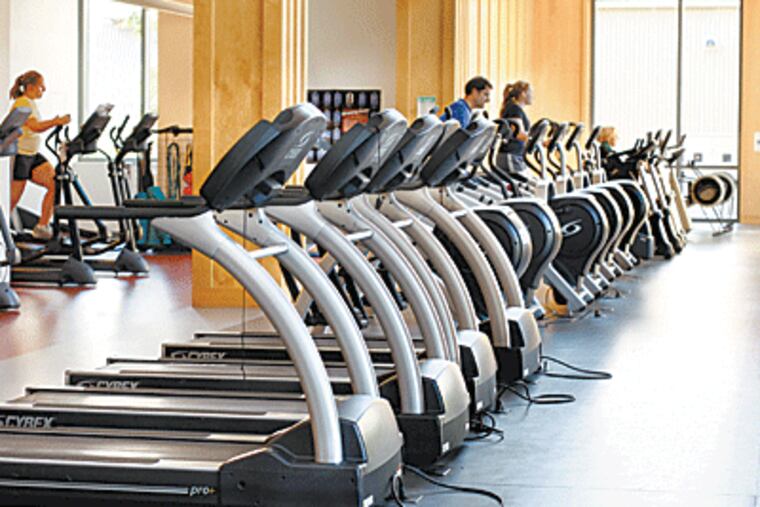
But last month, Gettysburg broke ground on a $25 million architectural gem that will feature its own competition pool, a warm-up pool, a hydrotherapy spa, a 10,000-square-foot fitness center, a rock-climbing wall, and space for yoga, Pilates, spinning and martial arts.
The tricked-out gym is the latest for the small but prosperous Centennial Conference, 11 well-regarded Division III colleges that focus far more on academics than athletics. With no athletic scholarships to hand out, the schools hope to lure top players, as well as nonathletes who have come to expect high-end amenities, with everything from dormitory suites to well-appointed gyms.
Without modern facilities, said Wright, whose school is next to the famed battlefield, "it could be potentially difficult to attract the best students."
Another Centennial Conference school, Ursinus, spent $13 million on a field house with multiple basketball and tennis courts, batting cages, and a six-lane track in 2001.
Haverford College opened the doors in 2005 to the sparkling stone-and-glass $30 million Douglas B. Gardner Integrated Athletic Center, featuring basketball and squash courts, workout rooms, and a 100-machine fitness center with large-screen TVs.
Franklin & Marshall is in the midst of a multiyear plan to build new sports facilities on two former industrial sites next to the campus. Buying and developing the land will cost $70 million, paid for with public, private and school funds.
And Dickinson College has a new basketball arena in its master plan after outgrowing a 28-year-old building.
"Schools more and more are investing in image," said Jack Maguire, a college consultant in Concord, Mass. "They are building [all kinds of] facilities to make them more marketable."
Critics say the spare-no-expense gyms are an example of the facilities "arms race" that the National Collegiate Athletic Association has warned is getting out of control.
"The basic question is one about priorities and what kind of message it sends when money is spent on some kind of athletic facility instead of going into academic programs," said John Curtis, director of research and public policy at the American Association of University Professors.
Whether it's high-tech science centers or professional-level performing-arts halls, "each college is trying to outdo the neighboring college down the road," he said.
Once recruits see Franklin & Marshall's 129,800-square-foot Alumni Sports Fitness Center, "it helps to get [them] here," says Shawn Carty, senior associate athletic director. "It's impressive."
It sealed the deal for Tom Grabiak, 19, a swimmer from Haddonfield.
"When I saw the pool, I fell in love with it," he said. "It's absolutely beautiful." Gettysburg's, on the other hand, "was pretty old. I just wasn't very impressed."
Haverford's Gardner Center was a "huge" draw for softball player and weightlifter Sam Fontinell, a senior from Long Island, N.Y., who looked at a lot of Division III schools.
"It was pretty much the most amazing facility I'd ever seen," said Fontinell, 20, who works as a fitness monitor in the gym.
While big-time sports schools are leading the building boom, 14 of the 50 new athletic buildings completed over the last five years were at Division III schools, costing an average of $20 million, according to a survey by the Chronicle of Higher Education.
Many are updating old facilities built when some weights and a basketball hoop were considered state of the art. Before Haverford replaced its 104-year-old gym with the Gardner Center, students worked out in a small, non-air-conditioned cinderblock basement.
"We never brought people down there on tour," athletic director Wendy Smith said. With the new building, "we want them to come in and say, 'Wow.' It reflects on how the college does things. This says we do things top-notch."
With 35 percent of college students participating in some type of sport, and many others working out, Ursinus' 65,000-square-foot Floy Lewis Bakes Center is occupied from 6 a.m. to midnight, said president John Strassburger.
"The activity level of kids has gone through the roof," said Joel Quattrone, associate athletic director at Dickinson, which is bursting out of the Kline Center and planning a second big arena. So have expectations. Many students come from high schools with top-of-the-line gyms.
"The dark and dank gyms with medicine balls and worn-out basketballs don't cut it anymore," said Tony Pals, spokesman for the National Association of Private and Independent Colleges and Universities.
Schools insist they aren't building sports palaces at the expense of academic buildings or professors' salaries. The centers are often funded by donors, such as Cantor Fitzgerald chief executive officer Howard Lutnick, who paid for half of Haverford's center as a way to honor three alumni killed on 9/11.
Gettysburg will have to borrow to pay for its building, and the costs may be passed on to students in the form of an activities fee. The school has raised $9 million and hopes to bring in an additional $10 million to $15 million by early next year.
"Part of providing a strong experience at a college like ours is also providing adequate facilities, and that's what we're trying to do," said interim president Janet Morgan Riggs. "Many parents are expecting a place that will allow their sons and daughters to be engaged in fitness activities."
Running around the battlefield in freezing temperatures, the way alumnus Bob Ortenzio did, doesn't cut it anymore. That's why the health-care executive ponied up $2 million after seeing first-class gyms during college visits with his sons.
Gettysburg "needs to have something like this to stay competitive," said Ortenzio, who founded Select Medical, which owns rehabilitation hospitals.
For tuition-hungry schools, keeping up with the Joneses is hard to resist. Swarthmore College has updated many of its sports buildings in the last six or seven years, and it opened a $3 million tennis and fitness center in 2000.
Still, its 1930s-era field house with exposed wooden beams is like a sluggish DeSoto compared with Haverford's streamlined Lexus.
"It has no modern amenities," athletic director Adam Hertz said.
Any time a rival puts up a new building, "you have to wonder how it's going to impact you," he said, but a new field house will have to take a backseat to other priorities.
"I don't think we're lagging significantly," Hertz said. "But I'd be foolish to say we don't look over and wonder what our place would be like with newer facilities also."