Hope for Gettysburg battlefield "witness tree"
To borrow oft-quoted words attributed to Mark Twain, reports of the death of the storm-damaged "witness tree" at Gettysburg have been greatly exaggerated.
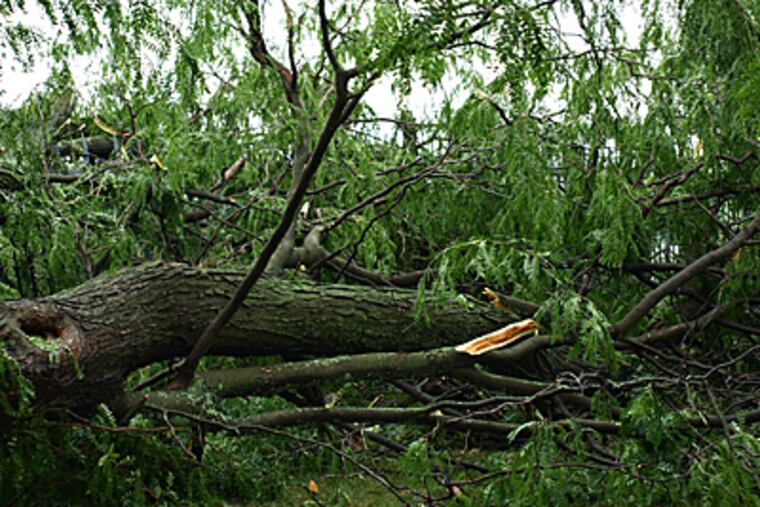
To borrow oft-quoted words attributed to Mark Twain, reports of the death of the storm-damaged "witness tree" at Gettysburg have been greatly exaggerated.
The massive honey locust, which stood on Cemetery Hill near where Union troops fended off Confederate forces during the 1863 battle and Abraham Lincoln delivered his Gettysburg Address four months later, cracked in a fierce storm almost two weeks ago.
The initial diagnosis was grim. The top of the roughly 120-foot tree had been sheared off, leaving only about 20 to 25 feet.
John Heiser, a historian at Gettysburg National Military Park, gave what amounted to an obituary, telling a reporter, "Nothing lives forever."
As word spread throughout the country, the park was flooded with calls from concerned citizens and Civil War aficionados offering sympathy and making inquiries about whether the tree could be cloned.
It looked as though the park had lost one of an estimated dozen known witness trees, the last living connections to the epic three-day battle.
But after the removal of the broken branches and a careful examination by the park's arborist, Randy Krichten, the tree revealed plenty of signs of life, officials said.
"The tree has multiple trunks and each has many living branches," said park spokeswoman Katie Lawhon. "We are hopeful that it will have new sprouting and that it will live."
Other witness trees stand in the heart of the battlefield: an oak in Devil's Den; a black walnut on Hancock Avenue, overlooking the field of Pickett's Charge; and another at the McPherson Farm.
The Cemetery Hill tree is not out of the woods yet. It still must undergo additional trimming, and its future survival is not 100 percent guaranteed, Lawhon said.
The fallen branches, however, will find new life as mementoes. They were turned over to the Gettysburg Foundation - the park's fund-raising partner - to help raise money for future battlefield-preservation efforts. The foundation is considering what kind of souvenirs the branches might become, Lawhon said. One possibility is walking sticks, like those made from trees cleared from the battlefield in recent years, that are available at the park's new Visitors Center.
The National Park Service since 2003 has been clearing more than 500 acres of trees that had grown since 1863 in an effort to return the landscape to its Civil War appearance.