Wheeling toward happiness at Swarthmore bike shop
When Lindsay Yanez looks at a bicycle, the left side of her brain sees an elegant piece of mechanical engineering, exquisite in its simplicity. The right side sees "a time machine."
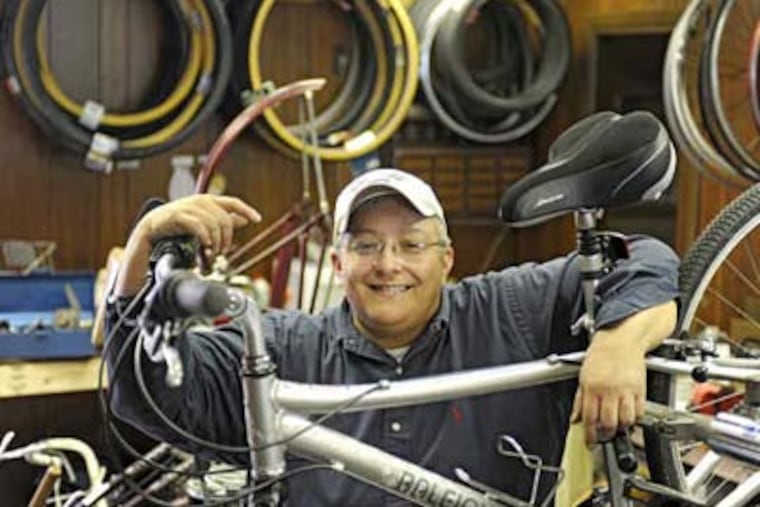
When Lindsay Yanez looks at a bicycle, the left side of her brain sees an elegant piece of mechanical engineering, exquisite in its simplicity. The right side sees "a time machine."
"Bicycles can transport you in more ways than one," she says. "They carry you back to childhood. They evoke memories and cause people to tell stories. They are great equalizers that remind us - no matter what our age or status - of the gravity-defying bliss of traveling on two wheels, with the wind in our hair, feeling free and unencumbered."
Yanez owns Swarthmore Cycles. It's a nonprofit disguised as a business, she jokes, because since she opened the shop in August 2008, the ledger has bled every month.
"I'm terrible with money," Yanez admits.
Only because her landlord, Alex Patuszek, is generous, and because her domestic partner, a research professor at Children's Hospital, subsidizes the enterprise, is it surviving.
But Yanez, 43, a civil engineer by training, is rich, at least by her definition. "You're rich if you're happy," she says. "Bicycles make me happy. I love these machines."
The shop, in a row of stores across from the train station in the heart of this cerebral borough, is homespun and funky. Here is how Yanez, deliciously frank, describes it: "This is not a concept store or boutique. It's a grungy little repair shop."
The faux wood paneling, reminiscent of a basement rec room circa 1955, is dark and drab. There are no dazzling displays of gadgetry and accessories. But Yanez and her coconspirators have tried to brighten the place with bold colors: orange, yellow, purple, blue, green.
What enlivens the shop most is Yanez herself, a large woman with a large personality.
"The jury is out on Lindsay," Yanez says of herself. "She's either a little too much for you or . . . too much for you!"
She misses the lurid glamour of New Orleans, where she lived before Hurricane Katrina forced her to flee. She quotes Fred LeBlanc of Cowboy Mouth, a band that makes her "crazy glad" to be alive: "Life is more than getting paid. Find a way to make a living having fun."
"I am humbled by the beauty of the people in this world," she says, "and feel so freaking lucky to be surrounded and constantly surprised by them."
The wall separating the counter from the repair shop is painted a color akin to aquamarine. Its name is celeste, the trademark color of Bianchi bikes, the line of new bikes Yanez sells. The Bianchis are light and sleek, gleaming with the latest high-tech hardware.
Mike Iannone, 31, a furniture designer and builder who lives in Glassboro, bought a Bianchi carbon-fiber road-racing bike at Swarthmore Cycles in September. Yanez offered him "a fantastic deal."
"She's very knowledgeable, and she really loves bikes, especially older bikes and bikes that are unique," Iannone says. "When you ask for her advice, she's straightforward and honest. It's nice when you're shopping for a bike to meet someone like that who is going to steer you in the right direction."
"The biggest thing is trust," Yanez says. "Me and my boys will take care of you."
Most of the bikes lined up in the showroom are used and lovingly reconditioned, including several vintage models that Yanez displays more to please herself than to entice a sale. They bear no price tags. Yanez keeps the prices in her head, and they fluctuate depending on her recall, mood, and whether she takes a fancy to you and your story.
"Not a great business model," Yanez confesses. "You can't run a store like a hobby."
Nevertheless, she does. She donates used bikes to city kids. She encourages participation in charity bike rides, often providing mechanical support. She insists on spending time with customers, listening to their tales and taking their measure, literally and figuratively. She won't sell them a bike otherwise.
"Every time I'm there and someone else walks in, she's all over them," says John Brodsky, 73, a physician who has commissioned Yanez to recondition the Raleigh relic he pedaled from New York City to Wilmington in his prime. "She loves to talk. Whether you're a college student, a senior citizen, or a 7-year-old, she's equally smiling and interested in your particular needs."
Before opening Swarthmore Cycles, Yanez, a Texas native, worked for nine months at a bike store nearby. "It wasn't for me," she says. "These are toys, and a bike store should be a fun place to work. You need to talk to customers for more than 10 minutes."
Bike sales account for only about a third of the shop's business. The rest is repair and tune-up, a specialty. For Yanez, who commutes by bike from her home about a mile away, restoring an ailing bike to mechanical health is deeply satisfying.
The shop's only paid employee is Peter Heinbockel, 15, a Strath Haven High School sophomore, whom she describes as a mechanical prodigy. Assistance comes as well from several other lads who volunteer at the shop because it's a pleasant place to hang out and learn.
The other day, Alex Reinke and Dave Corey, both 18 and seniors at Strath Haven, were happily performing various mechanical chores in the back shop.
"She's fun to be around," Corey said.
"She knows what's up," Reinke added.
Yanez calls her shop a "teaching hospital."
"If they want to learn, I'll teach them," she says. "It's no fun unless you're passing it on, man."
That's how Yanez became proficient. When she was 12, her father didn't have time to finish assembling her Christmas bike. So she went to a local bike shop in Houston and asked for help. The owner, a gruff, burly German with a kind heart, guided her. Impressed by her interest, he eventually hired her, and she worked there for two years during high school.
"He gave me the freedom to figure it out myself, to develop ingenuity and self-reliance," Yanez says. She calls her shop "a sort of homage" to him.
Yanez sometimes closes the shop for a couple of hours so she and her apprentices can shoot hoops, toss a football, or play miniature golf. Again, not the best business model.
"I suck at business," Yanez reiterates, defiantly, proudly.
Fortunately, Swarthmore is a forgiving place, and her customers are loyal.
"There are so many wonderful, sweet, idyllic people in Swarthmore," Yanez says. "The people here have kept me in business. They believe in supporting local business, they're adamant about that.
"Look at all the bikes at the train station. Swarthmore is the closest thing to Leave It to Beaver you're likely to find in 2010. It's awesome."
Yanez realizes that her store can't run in the red forever. Unless things turn around, she'll be compelled eventually to return to "something more lucrative," namely civil engineering.
"It pays the bills," Yanez says, "but fixing bikes feeds my soul."