A dance at Auschwitz draws viewers, controversy
For a Holocaust survivor and his family, it was just a celebration of life.
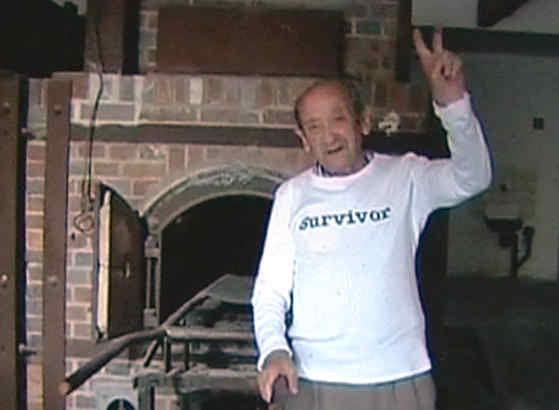
JERUSALEM - He's a Holocaust survivor dancing with his family on what easily could have been his grave.
A video clip of Adolek Kohn awkwardly shuffling and shimmying with his daughter and grandchildren to the sounds of "I Will Survive" at Auschwitz and other sites where millions died during the Holocaust has become an Internet sensation.
It's also sparking debate over whether the images show disrespect for those who perished - or are an exuberant celebration of life.
The fight - raging on Facebook, Twitter, and elsewhere - poses uncomfortable questions about how to approach one of history's greatest tragedies: What's the "proper" way to commemorate it? Can a survivor pay homage in a way unthinkable for others?
Adding to the irony, Kohn and his dancing brood owe their fame to neo-Nazi groups that posted the clip on their websites and turned it viral, his daughter said Thursday, before YouTube took it down.
The 41/2-minute video opens with the 89-year-old Kohn, daughter Jane Korman, and his three grandchildren dancing near the infamous railroad tracks leading to Auschwitz.
The group then moves to other Holocaust locations across Poland and Germany, including the notorious "Arbeit Macht Frei" ("Work sets you free") sign at Auschwitz's entrance; Poland's Lodz ghetto; and the Dachau concentration camp.
In one eerie shot, with his family behind him, Kohn presses his face to the small opening in a cattle car of the type that transported so many to their deaths. In another, he raises his arms and leads the troupe in a conga line to the disco beat of the Gloria Gaynor song.
Kohn, shown at one point wearing a white T-shirt emblazoned with the word survivor and flashing a V-for-victory sign, told Australia's Nine Network that he didn't think the video was offensive because the dance was distinct from the memory of those who died.
"Why did I do that? First of all because I came with my grandchildren," he said in an interview from his home in Australia.
Korman, a Melbourne-based artist now visiting Israel, filmed the clip during a trip she took with her father, four children, and a niece last summer to Kohn's native Poland, and to places in Germany and the Czech Republic where he once lived.
Both her parents are Auschwitz survivors and fully supported making the video, Korman said. "They both say . . . 'We came from the ashes, now we dance,' " she said.
The clip was posted on YouTube in January but didn't attract attention until a few weeks ago when neo-Nazi groups put it on their websites, she said. It originally was part of a video presentation by Korman in Melbourne in December.
While the footage has become an unlikely Internet hit, the controversy it has triggered is less surprising.
Michael Wolffsohn, a German Jewish historian at the Bundeswehr Munich university, called it "tasteless."
Said Rabbi Andreas Nachama, director of a museum at the site of the former Gestapo headquarters in Berlin: "If this video would be in his family album, nobody would care about it. But because it is in the World Wide Web, the video received public attention it does not deserve."
However, Piotr Kadlcik, the head of Poland's Jewish community, said reactions were mixed among Warsaw's Jews. He didn't find it offensive, he said, because it was made by a Holocaust survivor.
"It's extremely difficult to judge Holocaust survivors in places like that," he said. "Maybe he needs it; maybe it was important for him to do something like that" - to defy those who would have destroyed the Jews.
In Israel, home to the largest number of Holocaust survivors, the video has gotten scant attention.
By Wednesday, the clip had drawn 500,000 hits and numerous comments. On Thursday, YouTube replaced it with a message saying it had been removed over copyright issues.