Resurrecting the Palace of Depression
Nearly 60 years after that frightening first encounter, Kevin Kirchner can still picture the eccentric old man and his strange Dr. Seuss-like castle on Mill Road in Vineland.
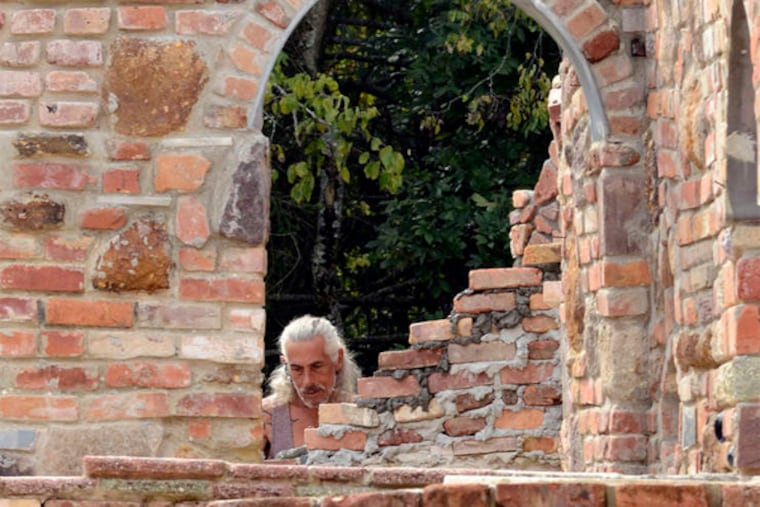
Nearly 60 years after that frightening first encounter, Kevin Kirchner can still picture the eccentric old man and his strange Dr. Seuss-like castle on Mill Road in Vineland.
Kirchner remembers his full beard, long hair, and penchant for scaring visitors by popping out of a maze of tunnels.
Kirchner was 5 years old when he toured George Daynor's so-called Palace of Depression, originally opened by its creator with P.T. Barnum-like energy in 1932, during the Depression.
Now, decades after Daynor's death and the razing of the palace, real progress is being made on the site's restoration by a host of volunteers led by Kirchner and Philadelphia artist Jeff Tirante.
They plan to reopen the castle and a 30-by-40-foot visitor's center on the four-acre grounds as a city-owned park in the next couple of years.
Some rooms - including Daynor's storytelling room and the Jersey Devil's Den with its fireplace and likeness of the mythical creature - have been completed.
'I jumped on it'
Walls and ramps have gone up and steel bar joists and a roof will soon be erected. Parts of the structure are decorated with fanciful mosaics of multicolored glass and bits and pieces of cars.
"It's been a dream," said Kirchner, 63, a retired Vineland chief building inspector. "I was always fascinated with the place and discouraged when it was taken down.
"When I had opportunity to put it back up I jumped on it," said Kirchner, president of the Palace of Depression Reconstruction Association, a nonprofit in charge of the rebuilding effort.
"I can still see [Daynor], looking like Lon Chaney as the werewolf in an old Abbott and Costello movie," he said. "I was petrified of him and had nightmares for two years."
Memories of the weird fairy-tale castle - with its distinctive turrets and spires - have also stayed with Tirante, a Port Richmond man who lives and works at the Vineland site as its caretaker.
'Rising again'
Daynor created the palace "to show you could pull yourself up by your bootstraps in the face of adversity without government help," said the 53-year-old artist. "It was to show how you could take one man's junk and create another man's treasure.
"The walls are rising again; it looks like a house under construction," said Tirante, a Vineland native who married in 1986 at the palace's original ticket house, which is still standing.
The Palace of Depression Reconstruction Association will hold its fifth annual Halloween Walk-Through from 7 to 10 p.m. on Oct. 18 and 19 to raise funds for the restoration. About 500 people attended last year's event.
Most of the labor and materials have been donated by contractors and suppliers who had to delay work at the palace last year after Hurricane Sandy to rebuild the Jersey Shore, which was devastated by flooding and high winds.
But work has picked up again more recently at the former site of Daynor's storybook castle, which was visited by hundreds of thousands of people, many of them on the way to the Jersey Shore.
According to Daynor, he lost a fortune from the Klondike gold rush of 1898. He invested and lost money in the California earthquake of 1906 and in the stock market, which crashed in 1929.
Daynor claimed angels later came to him in a dream and told him to go to South Jersey to build a palace - at the site of a mosquito-and-reptile-infested swamp and junkyard.
He and his common-law wife, Florence, arrived in Vineland in 1929, bought four acres of swampland and began draining it.
"The Palace of Depression was brought about by a man who had faith in himself and in his works," Daynor told the Washington Times-Herald in 1939. ". . . Self-educated, no schooling and with no instructors and no textbooks, he started to work without plans, tools or money."
The castle was built using mud and scrap metal. Archways were fashioned from car fenders, walls covered with car parts and broken glass, and a gate created from a baby crib.
Daynor had a periscope, ham radio station, indoor wishing well and "Knockout Room," where he offered to knock out the Depression with a dangling brick.
Rooster attack
The palace left an impression on youngsters like John Brodsky, who was 6 years old when he visited. He recalled crossing a makeshift wooden plank bridge over a ditch to enter Daynor's world, and seeing an old man with a scruffy beard.
"He had a rooster named Hitler," said Brodsky, 76, now a physician who lives in Swarthmore. "It chased me . . . and pecked my ankle. For this we paid 50 cents admission."
Daynor died in 1964 at age 104 and the deteriorated palace was demolished in 1969.
The reconstruction work began in 2001 and progressed slowly but surely, Kirchner said.
Daynor "comes back to me all the time," he said. "I constantly think of him."
PALACE TOUR
The Palace of Depression Reconstruction Association will hold its fifth annual Halloween Walk-Through from 7 to 10 p.m. on Oct. 18 and 19 to raise funds for the restoration.EndText
856-779-3833 InkyEBC