Bryant trial opens on new corruption charges
TRENTON - Former State Sen. Wayne Bryant was back at the defense table in federal court here Tuesday facing new corruption charges that could add time to the four-year sentence he is serving.
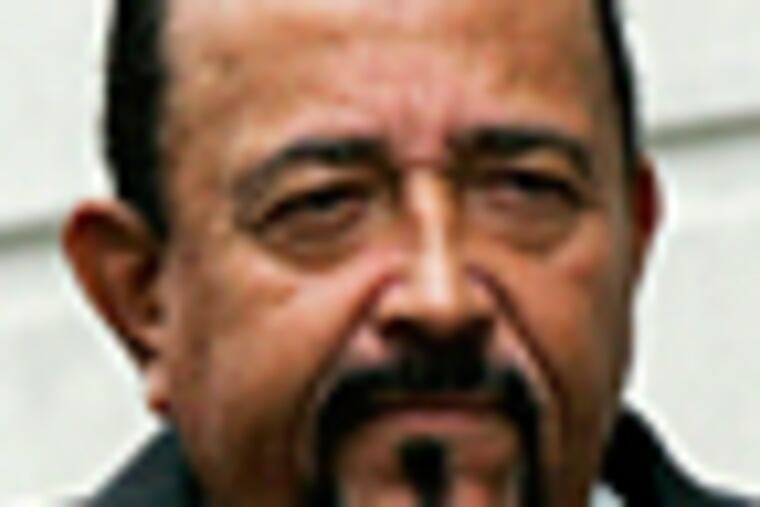
TRENTON - Former State Sen. Wayne Bryant was back at the defense table in federal court here Tuesday facing new corruption charges that could add time to the four-year sentence he is serving.
Dressed in a tan business suit, pale shirt, and floral tie, the once-powerful Camden County Democrat appeared grayer and thinner than he did in 2008 when he first went up against federal prosecutors in the same courthouse.
This time, at his request, Bryant is being tried without a jury. But the stakes are just as high for the 64-year-old whose two-decade career as a state legislator - 13 as a senator - ended in disgrace.
Bryant faces 22 criminal counts of bribery and fraud, each carrying a potential five-to-10-year sentence. The trial is expected to last for three or four weeks.
Bryant is accused of accepting $192,000 in legal fees between 2004 and 2006 from the lawyer for a North Carolina developer who had proposed three billion-dollar projects for New Jersey.
In exchange, prosecutors allege, Bryant did no legal work but voted in favor of legislation that would benefit the developer, Cherokee Investment Partners, and tried to scuttle legislation that would not be in its interest.
In opening arguments, Assistant U.S. Attorney Paul Krieger said Bryant was "in the pocket" of Eric Wisler, the attorney for Cherokee, whose projects included a $1.2 billion gentrification plan for Camden's Cramer Hill neighborhood.
Krieger called the $8,000-a-month legal retainer that Bryant began to receive in the summer of 2004 a "quid pro quo" for his influence in the legislature.
The prosecutor said neither Bryant nor his law firm did any legal work for the fee, which he said was part of a "carefully constructed bribery scheme."
"Nobody gets paid for nothing . . . not even Wayne Bryant," Krieger said.
Bryant showed little emotion during the opening arguments before Judge Freda L. Wolfson, the same jurist who presided over his jury trial in 2008.
His court-appointed lawyer, Henry E. Klingeman, told Wolfson that he did not expect to contest many of the facts in the case, but that he would offer "an entirely different scenario based on the same set of facts."
Klingeman said that Bryant's retainer was legal, even if he did no work. Bryant had agreed to provide legal services for the developer's North Jersey project, but not for its South Jersey plans because of his legislative interests there, he said.
In addition to the Cramer Hill proposal, Cherokee had development plans in place for Petty's Island in Pennsauken and the Meadowlands in Rutherford. All three projects have been abandoned.
Bryant supported legislation that benefited Cherokee, "despite his own constituents' opposition," Krieger told Wolfson.
But Klingeman said the prosecution's case was based on the "barest of circumstantial evidence" and urged Wolfson to consider his alternate scenario. Bryant had "a career dedicated to the improvement of Camden," he said.
The evidence would show, Klingeman said, that Bryant met only once with Wisler and that they never communicated after that first meeting in June 2004.
"The meeting lasted barely an hour. . . . They never met or spoke again," Klingeman said. Yet, he argued, the government contends that that meeting alone was the basis for a "carefully constructed bribery scheme."
Wisler, a partner in the powerful North Jersey law firm of DeCotiis, FitzPatrick & Cole, was indicted with Bryant in 2010. He died in August after a long battle with cancer.
There were no charges filed against Cherokee.
Bryant was sentenced to four years in prison by Wolfson following his conviction in an unrelated corruption case. The jury found that Bryant had improperly steered more than $10 million in state aid to the University of Medicine and Dentistry of New Jersey after he was given a low-show job at the school that helped pad his state pension and benefits packages.
Prosecutors intend to make reference to the earlier case to demonstrate what they alleged was a pattern of corruption on the part of the former senator.
The low-show job and alleged corruption occurred about the same time as the Cherokee retainer and alleged "quid pro quo" cited Tuesday by Krieger.