John Blake Jr., jazzman of the spirit
Holy Trinity Baptist Church, midwinter. On the 1800 block of Bainbridge Street, two blocks south of the former Graduate Hospital, Holy Trinity is taller than its rowhouse neighbors. Its 118-year-old facade is in good shape, although the wallpaper inside the sanctuary has started to peel.
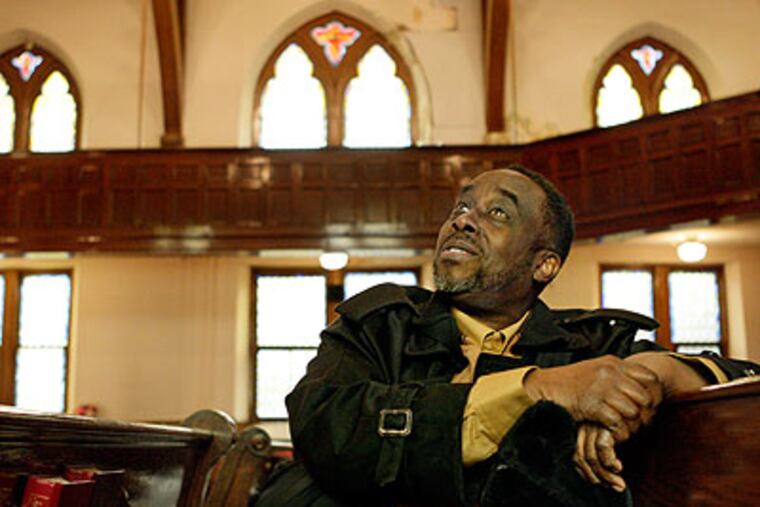
Holy Trinity Baptist Church, midwinter. On the 1800 block of Bainbridge Street, two blocks south of the former Graduate Hospital, Holy Trinity is taller than its rowhouse neighbors. Its 118-year-old facade is in good shape, although the wallpaper inside the sanctuary has started to peel.
Sitting in a pew, jazz violinist John Blake Jr. pointed to a small loft above the pulpit. It was there that it all started for him, there that his mother, Carrie Blake, played organ for more than 20 years.
"I used to love . . . when the choir did concerts," said Blake, 62, who grew up nearby. Its wide-ranging repertoire "gave me the desire to really be a musician and to play music that elevated people. It made me feel better about myself, and also made me want to do good because the music was so inspiring."
That desire has come full circle. After his lifetime as a jazz musician, Blake's newest album, Motherless Child, recalls the hymns, spirituals, and anthems Carrie Blake played Sunday mornings at Holy Trinity.
Blake's sidemen include pianists Mulgrew Miller and Sumi Tonooka, and Johnathan Blake, eldest of Blake's three children and a rising drummer, as well as Afro Blue, Howard University's a cappella jazz choir. The choir distinguishes Motherless Child from previous Blake projects, letting him treat the sacred songs of his youth with the sophisticated jazz harmony he's studied throughout his career.
Motherless Child also pays tribute to a time when Holy Trinity and other neighborhood churches occupied a more prominent place in South Philadelphia's black community. Blake credits his Holy Trinity days as shaping "a lot of who I am."
Blake, best known as a sideman with McCoy Tyner and Grover Washington Jr., became one of the first violinists to channel the late-'50s, early-'60s jazz of masters such as Miles Davis and John Coltrane.
"Whatever format he's in or genre he's in, he tends to adapt to that," said bassist Tyrone Brown, Blake's bandmate with Washington and other local acts. "I've heard him do classically oriented material as well as [jazz-rock fusion], the blues, and straight-ahead, hard-core jazz, too."
Blake recorded several jazz albums before becoming a violin instructor in the late 1980s at Manhattan School of Music and New School for Jazz and Contemporary Music in New York, and University of the Arts in Center City.
At his Germantown home, Blake returned to the subject of his mother's music, saying spirituals "were some of the earliest music I heard. There was something very reverent about those works because we knew that people created those works under great hardship and suffering."
Blake studied piano and violin at the Settlement Music School branch in South Philadelphia and graduated in 1965 from Overbook High School. He earned a scholarship to West Virginia University, where he studied classical music and music education. He became the first black student to earn an undergraduate music degree at the university.
He spent much of the 1970s studying jazz harmony, writing string arrangements for obscure acts, and performing at hole-in-the-wall venues like the Booty Butt, a dive at 13th and Fitzwater Streets.
Often in tandem with bassist Charles Fambrough, he played gigs for $15 to $25 a night.
"Back then," Blake said, "if people didn't like you [or] the way you played, you could have a hard time getting out of the club alive."
His day jobs weren't much better. In the mid-1970s he taught part-time at Holmesburg Prison in Northeast Philadelphia. Blake and his fellow instructors performed a concert in Holmesburg's gym. A riot broke out; folding chairs flew.
"It caused pandemonium," Blake recalled. The guards "had to go get dogs and guns and all that stuff. I was locked in with everybody. It seemed like forever, but it was only a few minutes. Even though the guards had left, the guys in the audience that were part of the prison music program, they protected me."
Blake also worked in orchestras and pit bands that backed headliners such as James Brown, Tony Bennett, Isaac Hayes, and Barry White in Philadelphia and Atlantic City. By 1977, Blake's talents had come to the attention of Grover Washington Jr., a popular sax man whose best-selling albums included Mister Magic (1974) and Live at the Bijou (1978).
Washington hired Blake as conductor for a booking at the Academy of Music, and eventually invited him to join his touring band, Locksmith. Amenities included limousines, luxury hotels, even personal chefs.
Doubling on electric violin and synthesizer, Blake worked with Washington until 1979. That year, McCoy Tyner, who had played piano in the John Coltrane Quartet, hired him. Concentrating solely on violin for the first time, Blake became increasingly confident as a soloist with Tyner, one of jazz's true road warriors: "He was really featuring me."
Mulgrew Miller, a respected pianist, recalled being "in awe" while listening to Blake perform with Tyner in New York: "He had that kind of intensity and energy that was [necessary] for the music and the band at the time."
Blake went out on his own shortly after recording his first album, Maiden Dance (1983). Although hailed as an emerging violinist, he struggled as a bandleader. The 1980s and 1990s were slow for jazzmen, and bookings were scarce.
Blake turned to teaching and lecturing at colleges and universities. The steady income allowed him to spend less time on the road and to focus on his family. He became a scholar of the violin, chronicling its use on Southern plantations throughout the 19th century, during the swing era, and in Africa and India.
"I wanted to reach a point," Blake said, "where I could stand on my own and have my own group and have my own programs, and develop myself to the point where I could be self-sufficient."
The violinist fondly recalled a gig he and pianist Tonooka performed in the mid-1990s at a North Carolina detention center for more than 300 inmates ages 18 to 21.
At first, seeing his instrument case, the inmates assumed he played sax. But when he brought out his violin, they expressed disappointment. Blake mimicked them over the phone: " 'A violin? Oh, man! We got to listen to this stuff? What is it, classical stuff?'
"So anyway," he continued with a chuckle, "we started performing, and before we knew it, we had won these guys over." Between songs Blake told his audience, "Your life isn't over. You maybe made some mistakes, but there's still time for you to make changes.
"Man, we just had a great time," he added. "They really loved the violin."