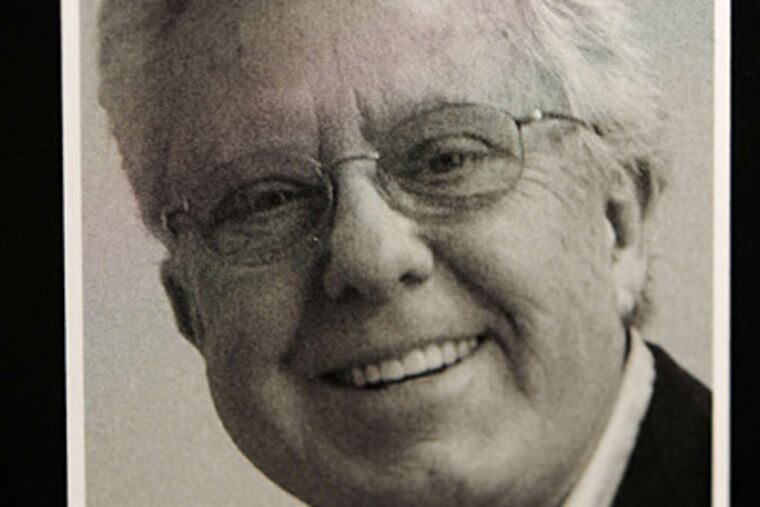
Gary Haynes, 76, celebrated Inquirer photography editor
WHEN BERT FOX got a load of the Inquirer newsroom in 1982, he fled. But Gary Haynes would have none of it. He had contacted Bert, who was picture editor at the Southern Mail Tribune in Medford, Ore., because he needed a picture editor to help him put together his dream team of photographers for the Inquirer.
WHEN BERT FOX got a load of the Inquirer newsroom in 1982, he fled.
But Gary Haynes would have none of it. He had contacted Bert, who was picture editor at the Southern Mail Tribune in Medford, Ore., because he needed a picture editor to help him put together his dream team of photographers for the Inquirer.
"I looked at the newsroom and said I can't work here - it's too big," Bert said. "But Gary called me and talked to me. He wooed me into the Inquirer."
Gary Haynes was not a man to take no for an answer.
Bonnie Weller found that out when she was assigned to photograph a female AIDS patient in a hospital for a story about a man who had deliberately infected women with the disease.
"I told Gary, I should call first and get permission to photograph her," she said. "But he told me to 'just walk in as if you own the hospital.' I did, and it worked."
He directed his passion for photographic excellence to put together what Bert Fox called the "best core of photographers ever seen on a newspaper."
Gary performed his feats of excellence in the Gene Roberts era of the 1970s and '80s, when the Inquirer won 17 Pulitzer Prizes, including three by photographers.
The photographers who won the cherished honors were all hired by Gary Haynes.
He was found dead in his home Friday after family and friends were not able to reach him. The San Francisco Medical Examiner's Office said he died of natural causes. He was 76.
"Almost overnight, he brought the paper into modern photojournalism," Roberts, the Inquirer editor who had hired Gary from the New York Times in 1974, told the Inquirer. "He brought in a whole new wave of photographers."
Among them was John Paul Filo, who had already won a Pulitzer by the time Gary hired him in 1981. He won for the famous photo of a girl crying over the body of a Kent State student who was one of the victims of the shootings by Ohio National Guard troops during campus demonstrations on May 4, 1970.
"I was one of the first to come into his department," said John, who was with the Associated Press when Gary hired him. "He was looking for a wire service photographer who could travel."
"He was a great boss. He expected hard work, but he also liked to play hard. He was very outspoken, very visual."
John, who is now on the staff of the CBS communications department, covered the 1981 National League baseball season, shortened by a players' strike. Two years later, he went farther west on a very different kind of story.
"I went from Dodger Stadium to the Philippines, to cover the assassination of [Benigno] Aquino," he said. "Everybody got a trip around the world. It helped me grow as a photographer."
"He was bigger than life," Bert Fox, now with the Charlotte Observer, said of Gary. "He was full of stories. His stories were endless; not just way back but what we did last week, what we were going to do next month. How we were going to tackle his big project. He was a leader by action."
"A lot of people were afraid of him," said Bonnie Weller, who was at the Inquirer from 1988 to 2010, a former teacher of photography and now a free-lancer. "He was very strong and determined about his work. Things had to be done his way. That was all there was to it.
"He was fierce and demanding. He kept his eye on everything to make sure it was done right. He was a funny man, a happy man, very passionate."
Gary was a native of Salina, Kan. He started taking pictures in the Army and was hired by United Press International in 1958.
He photographed some of the exciting doings of the remarkable '60s - the civil-rights movement, anti-Vietnam War demonstrations, space launches, the Tokyo and Mexico City Olympics, a World Series, presidential campaigns, and the like - before joining the New York Times.
He is survived by a son, Philip; and two daughters, Stephanie and Emily.
Services: Were being arranged.