Making NASCAR safer since Earnhardt's death
After watching Dale Earnhardt slam into a wall in the final turn of the 2001 Daytona 500, 10-year-old Joey Logano clicked off the television, picked up his basketball, and went outside to shoot hoops.
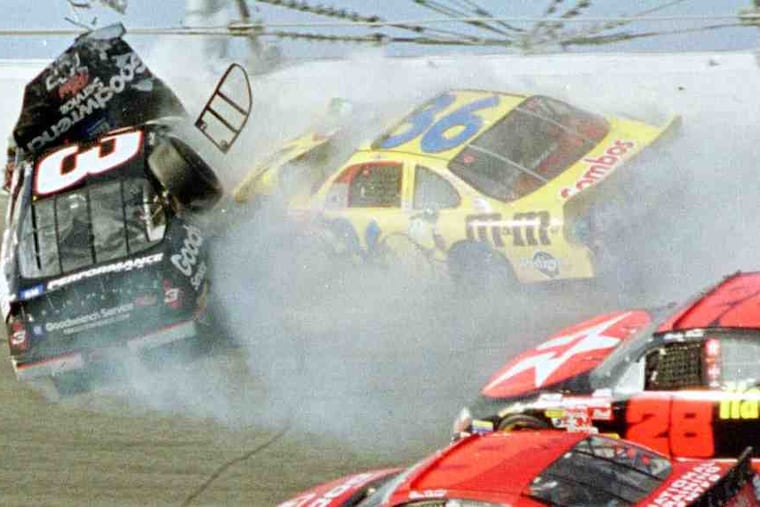
After watching Dale Earnhardt slam into a wall in the final turn of the 2001 Daytona 500, 10-year-old Joey Logano clicked off the television, picked up his basketball, and went outside to shoot hoops.
It wasn't until later that day, when he saw a TV report announcing the legendary driver's death, that Logano realized the impact of that crash.
Fast-forward eight years and seven months, to Dover International Speedway, where Logano was on his way to becoming the youngest- ever Sprint Cup rookie of the year. But as he navigated the Monster Mile's treacherous backstretch, his Toyota was clipped from behind and spun into the wall at Turn 3. The car spiraled into a violent barrel roll down the embankment, spewing debris in every direction.
That Logano was able to climb from the car unhurt, albeit terrified, was a tribute to the safety initiatives implemented by NASCAR since Earnhardt's fatal crash.
Sunday's Daytona 500 marks the 10th anniversary of Earnhardt's death, an event that will be remembered with a number of honors for the seven-time champion.
On the third lap, fans will stand in silence and raise three fingers to the sky, evoking Earnhardt's iconic black No. 3 Chevrolet.
Michael Waltrip, who drove an Earnhardt-owned car to victory lane on that fateful day, will pilot his No. 15 Toyota with an Earnhardt-inspired paint scheme in the season opener.
Adding to the pathos is the fact that Dale Earnhardt Jr. had won the pole position and, but for a crash during practice, could have been leading during the Lap 3 tribute to his father. After totaling his race car Wednesday, Dale Jr. was forced to go to his backup vehicle, which requires him to start at the back of the field.
Waltrip reflected recently on the race that killed his boss, mentor, and friend.
"That day was a quarter-mile away from being maybe the best Daytona 500 ever," Waltrip said. "It was an amazing race, it had everything - the upset winner, the champion [Dale Earnhardt] battling those guys [to protect Waltrip's lead] - it was just an amazing race. Now, instead, it's the worst race ever."
But the tragedy resulted in safety measures that make deadly crashes less likely.
Mark Martin, driver of the No. 5 Chevrolet, has witnessed the progress firsthand over the last 30 years.
"When I first came to NASCAR racing in 1981, the seats that were used were . . . outrageous, we were in the stone age," Martin said with a laugh. "We didn't have SAFER barriers or the HANS device, and that was brutal. As long as I live I will feel the effects [of the crashes] from those days."
In 2002, NASCAR moved its Research and Development Center to a 61,000-square- foot, $10 million facility outside Charlotte, N.C., and the pace of innovations quickened.
Stronger, composite seats with improved head protection were added in 2002, along with in-car accident data recorders, helmets for over-the-wall pit crew members, and the initial installation of SAFER barriers - or "soft" walls - at a number of tracks. And in response to what was found in Earnhardt's vehicle, NASCAR adopted more stringent seat belt regulations.
An automatic fire-extinguishing system was affixed to the car's fuel cell and optional roof escape hatches were introduced in 2003, along with a rule change eliminating racing back to the yellow line - essentially "freezing" the field under caution - as a result of Dale Jarrett's fiery crash at Pocono Raceway.
Full-face helmets became mandatory in 2005, and six-point seat belt harnesses became required equipment in 2007.
The HANS device and the Hutchens Hybrid Device are head and neck restraint systems designed to reduce the risk of - frequently fatal - basilar skull fractures that result when the head snaps forward upon sudden impact.
Although NASCAR had recommended the equipment to drivers prior to the 2001 season, few took advantage of it.
"I think I was at Bristol in 2000 and Brett Bodine had on a HANS device," Waltrip recalled. "I looked at him and said, 'You can't race with that thing around your head, how are you going to see?' "
Thomas Gideon, NASCAR's director of safety, research and development, believes "at least six drivers were wearing the HANS device on the day of Earnhardt's death."
Eight months after the crash, the head and neck restraint system became mandatory in all three of NASCAR's national touring series.
Bobby Labonte, who will drive the No. 47 Toyota on Sunday, said he began wearing the Hutchens device the week after Earnhardt's crash.
"Unfortunately, things like that had to happen to make" drivers reconsider protective gear, Labonte said. "It was a bad time in our sport. Dale gets recognized [for opening eyes] because of his popularity in the sport, but we had lost three other drivers - Adam [Petty], Kenny [Irwin], and Tony Roper. Those were some tough times."
Adam Petty was killed in a one-car accident during practice in May 2000 at New Hampshire International Speedway, and Kenny Irwin died after crashing head-on into a wall at the same track just eight weeks later. Tony Roper lost his life in October 2000 in a fiery crash during a truck race at Texas Motor Speedway.
In regard to the incidents involving Petty and Irwin, where stuck throttles were cited among the potential causes, NASCAR responded in 2001 with the introduction of engine cutoff switches mounted on steering wheels.
"One crash didn't change our sport from the safety side," said Tony Stewart, owner/driver of the No. 14 Chevrolet. "It was a lot of instances in a short amount of time that forced . . . the safety issue to be revisited."
Denis McGlynn, president and CEO of Dover Motorsports Inc., called Logano's wreck "the most spectacular" at the Monster Mile since he started attending races there in 1972. In recent years, he has overseen the track's multimillion-dollar upgrades, including the installation of SAFER barriers and the restructuring of pit road.
"I think all of us in this industry, including the fans, and most especially the drivers, appreciate the emphasis NASCAR continues to place on safety," McGlynn said.
Count Logano among that group.
"I've always had a full-face helmet, the HANS device - the whole gig," said Logano, who made his Cup debut in a handful of races in 2008.
"Everyone says they're nervous for me if I get hurt or something, but I think it's one of the safest sports out there," the slightly built driver said. "I would rather do this than play football against some 300-pound linebacker."
Still, there are inherent dangers, and accepting that aspect of racing seems to have served five-time defending champion Jimmie Johnson well.
"We all know that there's a lot of people that come to these races to watch a crash. We may not want to admit it, but we know that those fans are out there," Johnson said.
"To a large degree we have assumed those risks and our families have as well, we came to grips with that a long time ago. But to see the impacts with the data recorders on the cars and have drivers not lose consciousness, not break bones, to walk away, it's amazing where we are today."
Watch video of Joey Logano's crash at www.philly.com/nascarvideoEndText