Dean Smith: Most innovative college hoops coach ever
Upon longtime North Carolina coach Dean Smiths death at 83, Dick Jerardi marvels at his legacy.
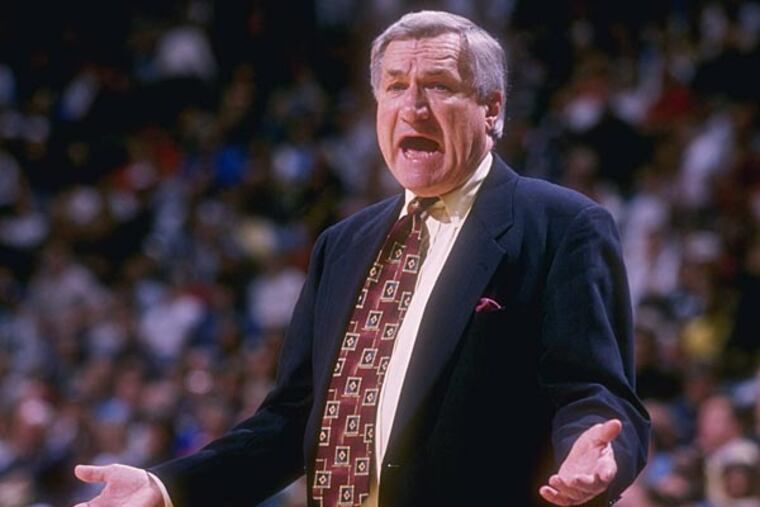
IF YOU LIVED in the northernmost ACC outpost as I did for the majority of Dean Smith's career at North Carolina, you simply could not like his teams. They simply won too much, against Maryland and everybody else.
If you watched his teams as I did religiously, however, you learned Larry Brown's "right way" long before it had a name. If you coached elementary-school and rec-league teams as I did, you found yourself emulating how those Carolina teams played - teaching your players to point at the player who passed them the ball that led to a basket, huddling up before a free throw, changing defenses every time down the court, putting up a fist if you were tired, the passing game, the traps, the hoarding of timeouts and, yes, even the four corners.
Smith, who died Saturday night 3 weeks shy of his 84th birthday, was simply the most innovative college basketball coach in history. At Kansas, he played for Phog Allen, who learned the game from James Naismith, who invented it.
Smith came east to coach under Frank McGuire at North Carolina, just a year after UNC beat Kansas and Wilt Chamberlain in the legendary 1957 triple-overtime championship game. When he became the head coach, he was not instantly successful. But once the success began, it never ended.
Smith will be remembered over the next few days for his life as a coach, the impact he had on his players' lives, and the impact he had on society as a Democrat in North Carolina when that was the norm in the early 1960s and when it wasn't after the passage of the Civil Rights Act.
I always thought his most important recruit was Charles Scott, the first black player at UNC. He was a truly great player on Smith's first great Carolina teams. You can see Scott's son Shannon on TV these days. He is the point guard at Ohio State.
Smith's most important player was point guard Phil Ford, the maestro of the Four Corners, a player so quick and so smart he was impossible to cover.
His best player obviously was Michael Jordan, but nobody really knew that when he left Carolina for the NBA. Smith had taught the prodigy the fundamentals. Jordan's will and talent made him the greatest player who ever lived, but the foundation was laid by one of the great teachers who ever lived.
Billy Cunningham, Walter Davis, Bobby Jones, James Worthy, Sam Perkins, Rasheed Wallace, Jerry Stackhouse, Antawn Jamison, Vince Carter. So many great players from the early 1960s to the late 1990s.
The players he coached and the coaches he coached will be Smith's basketball legacy. So will Big Ten commissioner Jim Delaney, who once played for Smith. And UNC coach Roy Williams, who learned from Smith as a kid who wasn't good enough to play for him but learned enough about coaching to find his own spot in the Hall of Fame. And all those players who went back to their high schools and coached there.
The best in-game coach in history? Dean Smith, without any doubt.
North Carolina was absolutely never out of a game. There was no margin too big. He almost never called a timeout unless it was in the final minute of a close game. And remember that back then, the clock did not stop after a made basket. Smith timeouts stopped that clock and his teams often made time stand still.
It was March 2, 1974 when North Carolina trailed Duke, 86-78, with 17 seconds left. The Tar Heels won the game in overtime, 96-92.
This was 13 years before the three-point shot. This was impossible - unless your team was coached by Dean Smith.
I always loved to watch the movement of the ball and the players. It was a basketball symphony conducted by an absolute maestro. In an era when teams actually played fast and fastbreaks were an actual strategy, Smith's teams were as fast and entertaining as anyone's.
If Smith did not want you to play zone and thought you could not keep his point guard out of the lane, he would send players to each of the four corners of the halfcourt and put the ball in the hands of his quickest player in the middle with open spaces all about. Layups, free throws and wins followed.
Thousands learned the sport watching Dean Smith's North Carolina teams. It was maddening if you liked the other team. It was enlightening if you loved the game.