Defenses focus to control the spread offense
Many of the top college football programs thrive with a version of the spread offense. At Florida, it's the spread-option. It's the shotgun-spread at Purdue. Georgia Tech employs the triple-option spread.
Many of the top college football programs thrive with a version of the spread offense. At Florida, it's the spread-option. It's the shotgun-spread at Purdue. Georgia Tech employs the triple-option spread.
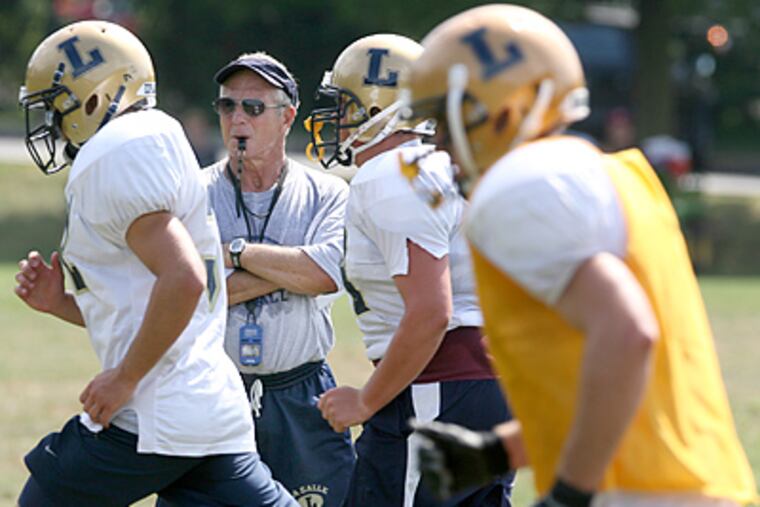
The popularity of the spread has reached high schools, too, making the game faster and more wide-open than ever. "It has filtered down from the colleges," La Salle coach Drew Gordon said.
The premise of the spread is as the word suggests: The offense wants to spread the defense out, forcing it to cover more space. The goal is to find mismatches in personnel and fully utilize the talents of quick-footed and athletic playmakers.
It isn't only about slinging the ball all over the field. It also can revolve around the run, even in four-receiver sets. The threat of the pass, creating a 7-on-7 inside matchup, can open up running space against inferior linemen and linebackers.
La Salle, the defending PIAA Class AAAA state champion, has a multiple-spread scheme. Pottsgrove, reigning District 1 Class AAA titlist, runs the spread-option. Abington, one of the Suburban One League National Conference's best programs, goes with a shotgun-spread.
Gabe Infante, new coach at St. Joseph's Prep, is from North Jersey, where the spread has been a high school staple for some time. "In a nine-game schedule, eight teams use the spread," he said. "That's pretty much all you see."
With the ball-control, ground-and-pound offense becoming a thing of the past, coaches, especially defensive coordinators, are hard at work trying to out-scheme spread-minded opponents.
"You can't sit back in a base defense against the spread," said Infante, whose Hawks have a multiple 4-3 defensive set. "If you do, you'll get cut off at the point of attack. You'll get butchered."
More time than ever is being put in to derail the spread attack, whose various forms also include the no-huddle and Wildcat. It involves, among other things, matching speed with speed, disguising schemes, identifying the offense's intention, mixing fronts, and having a capable rotation of defenders that might include up to 17 players.
For defenses, it's a take-control or be-controlled situation.
Mike Carey, new defensive coordinator at Archbishop Wood, coached alongside Mike Pettine for 24 years at Central Bucks West. With Carey overseeing the defense in the 1990s, the bruising Bucks won four Class AAAA state titles, including three in a row. In 2000, with Carey at the helm, they came oh-so-close to a fifth crown.
At War Memorial Field in Doylestown, with Pettine cracking the whip on the way to 326 victories, defense was a big-time priority.
"We played with many undersized kids over the years," Carey said, "but they could all run and were tough as nails."
Carey has been busy the last two weeks teaching the Vikings the wrinkles of a multiple-40 alignment, which has a four-man front and multiple sets behind it, including a 4-5-2 and 4-2-5, depending on the down and yardage needed.
"If you want to win championships, you have to have a great defense," he said. "Putting together a good defense is a tough thing to do. But when you get it right, it's something that can be a game-changer."
One of the keys to success, Carey said, is a form of bait-and-switch.
"We're not going to give the offense the luxury of knowing where we're at," he said. "We try to give the offense 'false' reads, meaning that what they see is not necessarily what they're going to get. Confusion is part of the deal."
Using multiple formations, Infante, head coach at Paramus Catholic (N.J.) the last two seasons, said he wants his spread offense, which includes bubble and jailbreak screens, "to force the defense to account for everybody."
With offenses wanting to get the ball to blistering players who can take it to the house, Carey knows the importance of choosing the right personnel. That means, in many cases, building a defense around quickness - on the line, at linebacker, and in the secondary.
"They're trying to isolate you, put a guy out on an island, and get a stronger guy taking on a weaker guy," he said. "As a coach, I love the chess game of trying not to let that happen."
La Salle, for example, wants to spot a chance to throw a short pass in the flat to fleet-footed tailback Jamal Abdur-Rahman, with the Villanova recruit matched against a lumbering outside linebacker.
"As a defense, you have to have good athletes on the outside," Gordon said. "Your best athletes have to be at linebacker and defensive back. The defensive back has a lot of run-stopping responsibilities."
La Salle's 4-4 unit, guided by veteran defensive coordinator John Steinmetz, yielded just 11.9 points per game last season, seven times giving up seven or fewer points.
"John brings an incredible intensity when it comes to creating schemes and teaching the responsibilities," Gordon said. "Each player has to know what he's doing."
In 2003, North Penn, with Carey a part of Dick Beck's staff, allowed just 13 points an outing while going 15-0 and winning the program's first state championship. Only three opponents posted 20 or more points.
Last season, spurred by a spread offense, often with four-receiver sets, Ridley averaged 30.1 points on the way to its second District 1 Class AAAA title in three seasons.
But a 4-4 defense, coordinated by guru Ralph Batty, was just as crucial in the drive to the state semifinals. Before losing to La Salle in a state semifinal, the Green Raiders gave up just 7.7 points per contest and pitched five shutouts.
In the district final, against equally rugged North Penn, which came in averaging 36.5 points, Dennis Decker's squad forced three turnovers with quickness and jaw-dropping hits and squashed the favored Knights, 19-10.
"There's a lot of talk about our offense," Decker said. "But if you know and follow high school football, you talk about Ridley's defense. That's our trademark."
And the trademark of many others, despite the continuing offensive transformations.