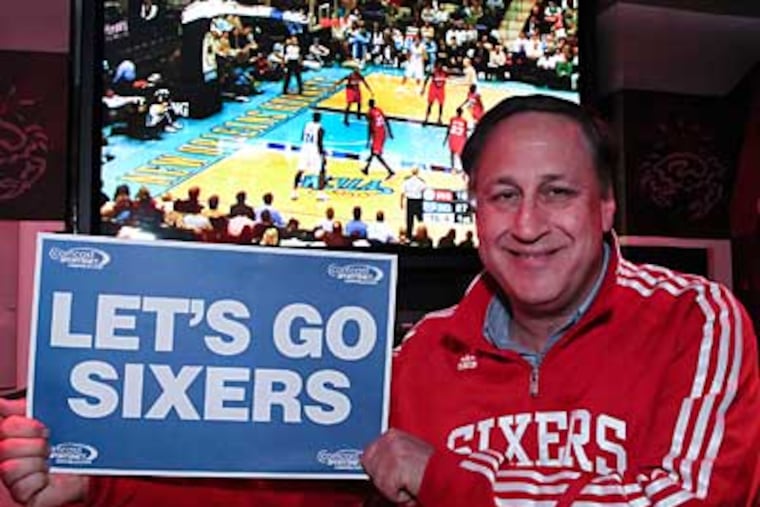
Adam Aron wants to shake your hand.
It's a Sunday evening in December, a time when the Philadelphia sports fan's attention is usually reserved for the Eagles. The new CEO and co-owner of the Sixers is lumbering through the Palestra during his team's open scrimmage. Over the course of the evening, he'll go from tracking fans on Twitter to securing seats for one of his co-owners to meeting veteran guard Lou Williams' mother to talking business with a Benjamin Franklin lookalike to heaping praise on coach Doug Collins. He checks on the Sixers' ticket sales. He finds out whether the laptops have been installed in the team's practice facility. He thanks Thaddeus Young for playing in the scrimmage. He listens to a fan's proposal about a more efficient offense. He answers his phone and scrolls through his iPad. "I haven't met you yet," Aron sometimes says, almost with an admission of guilt.
If you care the least bit about the Sixers, Aron wants to meet you. And if you don't, Aron especially wants to meet you. Why? Because he thinks he has the plan to get you interested in Philadelphia's basketball team.
"We put an exciting winning basketball team on the court, we create a happening on game nights and pay attention to improving the game presentation, and we engage and listen to Philadelphia sports fans," Aron says, as if he's verbalizing a mission statement.
This is a worthwhile cause, although not a novel concept. Since the beginning of time,
every new executive or owner of a sports team says he wants to engage the community and enhance the fan experience. After all, it's easier to promise fun than it is to promise wins, especially for someone with no direct influence on what happens on the court. But Aron needs to make this pledge, because for all his emphasis of the team's proud heritage - Aron designed business cards with championship banners depicted on the back - he's inherited a team at the nadir of its popularity. Tell Aron Philadelphia has four major professional sports teams, and he knows where the rest of the statement is going. He holds up every finger on his right hand except his thumb, a suggestion that he's about to be informed that the Sixers are fourth in the pecking order. Aron's heard it before, which is why he's using those fingers to shake as many hands as he can.
Six hours after the scrimmage begins, Aron walks down the stairway separating sections 112 and 113 at the Wells Fargo Center. The lights are off in the arena, and it's so cold that anybody inside is wise to wear a jacket. Aron doesn't seem to notice.
"Does anyone know what time it is?" Aron asks.
"It's 11:44," a colleague responds.
The two have just spent 3 hours watching the first edition of the light show that will precede Sixers games this year. Aron continues to insist it's unlike anything that's been witnessed at a basketball game in the arena, and that seems to be accurate. After all, it's produced by a Broadway light designer who's been nominated for 27 Tonys.
"You are a [bleeping] genius," Aron tells the designer at one point.
When he watches the rough cut of the pregame video presentation, he waves his hand like a conductor at the orchestra music.
Aron has spent the past 4 months orchestrating. He'll need to spend the next 4 months doing the same. Maybe the next 4 years. Aron is chief executive officer for an organization that is part basketball team, part reclamation project. He created that role for himself in early August, when he met with the managing owner, Joshua Harris, as he was preparing to buy the team. Aron is a partner at Harris' New York private-equity investment firm, Apollo Global Management, and Harris had called to ask his advice on raising the Sixers' profile. Aron came to Harris with suggestions, and at the end of the meeting, Harris asked whether Aron knew anyone who could run the team.
"I've got just the guy for you, and he was born in Philadelphia and raised in Abington," Aron responded.
Says Harris: "I would call it almost a perfect match. Usually I go through a rigorous process. But I knew he was the right guy."
One person at the scrimmage wants to work for Aron, although he didn't exactly endear himself to Aron when he accused the owners of being "carpetbaggers like Jeffrey Lurie."
There's no small bit of absurdity in that statement. Proximity seldom determines quality when it comes to team ownership. The Dallas Mavericks' Mark Cuban, perhaps the NBA's best owner, is from suburban Pittsburgh. George Steinbrenner grew up in the Cleveland area. The guy responsible for the Red Sox' two World Series - John Henry - doesn't exactly have a Boston accent.
More significant is the fact that the statement is also inaccurate. Adam Aron is from Philadelphia, as are seven members of the ownership group, and seven others went to Penn. Aron is simply the most visible of the group, if not by name then certainly by designation, and from the beginning of the new owners' tenure, he was billed as the local guy. He grew up in the suburbs and attended Abington High School, and now lives in South Philadelphia, where he can stroll through the Italian Market and make it back to the office in 5 minutes.
If his job is to understand Philadelphia fans, Aron has a head start. He and his father were Eagles season-ticketholders when the team played at Franklin Field. Aron watched Johnny Callison play rightfield for the Phillies and attended the final game at Connie Mack Stadium. He and his father spent days at Convention Hall to watch Wilt Chamberlain and Hal Greer play for the Sixers. And at age 15, in 1968, Aron and a friend bought an 18-game ticket plan for the Flyers, taking a train to a subway to a bus to sit in the Spectrum.
"When you say, 'How invested am I with this team?' I'm invested with my heart and my soul," says Aron.
He left the Philadelphia area after high school, going to Harvard for both undergraduate and business school before climbing the ladder in the travel industry. He's been a vice president at Western Airlines, a senior vice president at Hyatt and United Airlines, and the CEO of Norwegian Cruise Lines and Vail Resorts. In 2006, he started World Leisure Partners, which acts in partnership with Apollo, Harris' hedge fund. The way Aron explains it, he's not entirely an outsider to sports. Vail was in the recreational-sports business, and, at United, he was involved in sponsorship deals with the Chicago pro-sports franchises and helped engineer the naming-rights deal for the United Center.
"I've been around professional sports for much of my career," he says. "Beyond that, if you look at a cruise ship or a resort hotel, you're not only housing people - you're entertaining them."
And that is where the skill set of his previous job might be most transferable. Everywhere he's been, Aron has dealt with perishable inventory. Once a customer leaves a cruise ship, the money doesn't return. Same with a sporting event. So Aron needs to know how to sell an experience.
"Listening to his customers is something he's had to do his entire career," says Sixers senior vice president Lara Price, who's worked with the franchise for 16 years. "It's a very competitive market. And the tourism industry, those are the ones he's been in, how do you cut through all the clutter there? He's been able to do that . . . I really think his marketing, branding expertise and his knowledge of consumers can help us."
To better understand Aron, consider one of the changes he made at Hyatt in the late 1980s. Hyatt was in a competitive market for business travelers. Aron surveyed hotel guests to discover their pet peeves. Towels were too small. Lightbulbs weren't bright enough. But there was one that especially resonated with Aron: The clothes hangers were theft-proof. Guests didn't like this, so Aron fixed it.
"I want it written on my grave someday that I was the guy who put real coat hangers back into America's hotel rooms," Aron told American Demographics in 1990.
Asked about the hanger story nearly 2 decades later, Aron says he learned something from the experience that has become a core value of his leadership style.
"Very subtly, psychologically, [it] said that we don't trust you," Aron says. "It's like calling everyone who stays in a hotel room a thief. That was one of a dozen product changes we made at the time. And wherever I've been since - United Airlines, Norwegian Cruise Line, Vail - my focus on Day 1 was always the product, the product, the product."
"The sports business and other businesses are very similar," Harris says. "You bring in good people, coming up with your strategy, get them motivated to achieve the strategy. So it's similar to a lot of businesses. Where it's different is the talent side of it."
The last time there were such sweeping changes in the Sixers' organization, Pat Croce ran the team. Adam Aron is not Pat Croce. That's obvious upon sight. Croce, who started his career as an athletic trainer, climbed bridges and rappelled from the arena's rafters. Aron wears blue blazers, khakis and loafers. His belly hangs over the belt of his low-riding pants, and he has boxes of Tastykakes in a corner of his office. If Cheez Whiz spilled on his jacket, it wouldn't seem out of character. Aron's something of a cheesesteak aficionado ("Pat's, not Geno's," he says) - and likes his red gravy from Ralph's in South Philly.
Some fans find this endearing. At the viewing party of Wednesday night's Sixers game that Aron hosted at Chickie's and Pete's, he wore a Sixers track jacket and nibbled on fans' crab fries.
"It says a lot about him that he's in a sweatsuit and not a suit and tie," says Phil Anderson, 47, a season-ticketholder from Swarthmore. That's important to Anderson, who said Aron - a Harvard-educated, well-traveled executive - seems like "one of us."
Watching Aron interact with the fans, it's clear he'd blend into a crowd of other 57-year-olds who attend games - and maybe even some half his age. He starts "Let's go, Sixers!" chants; he appears overly gleeful at a Jrue Holiday three-pointer; he acts like Dave Zinkoff when announcing the score of the game.
But once Aron speaks, it's clear that what he and Croce have in common is more important than what separates them. "Their management styles are very different, but they expect the same end result," Price says.
Aron's been obsessive about listening to fans. He seeks feedback and suggestions, and tries to implement ideas. When this doesn't include shaking hands, Aron's taken to Twitter. Aron is active with his account (@SixersCEOAdam), responding to almost any fan who has a question or concern and seeing to it that their ideas are considered. On New Year's Eve, one fan tweeted to Aron, "you tweet alot. Is this really you? It's great." Aron promptly responded, "It's me. Every tweet. Because @Sixers fans like it. 7000+ followers in 64 days." Last weekend, he was asked by a fan to join in his fantasy league. "Thanks, but my fantasy team is Sixers, my fantasy league is NBA! lol," Aron wrote. That same fan replied, "Kinda cool that a fan felt comfortable to even ask an NBA owner," to which Aron concurred, "100% right! Loving the fan interaction."
Sitting courtside at the scrimmage at the Palestra, he talks with co-owner Travis Hennings about the power of Twitter. Aron looks at his feed and notices a note from a fan sitting in the upper bleachers of the Palestra with his friend who wants a better seat.
Aron scans the gymnasium, locates the fan and tells the fan (via Twitter, of course) to wait where he is. Aron walks up a flight of stairs, finds the questioner, introduces himself and brings the fan and a friend down courtside a few seats away from him.
The fans were Rob Thorum and Matt Galletti, 29-year-olds from Philadelphia who participate in social media, attend Sixers game and are looking for a reason to remain interested. These are the ones Aron needs to keep. Acts like this help, as both left amazed by the seat he got them.
"They're doing all the things - aside from making the team a champion immediately - to make people interested," says Howard Eskin's son, Spike, who has a popular blog and recently hosted a Sixers end-of-lockout party that Andre Iguodala attended. "I hadn't met him in person until the preseason game, and he was hustling from seat to seat to see every fan to see every fan he'd see on Twitter, spend 5 minutes with them and talking with them. It's been cool, to at least have owners who care - at least on the surface."
When the Sixers started online voting for their new mascot - a stunt that, if nothing else, showed that the team is trying to engage consumers - Jerry Rizzo, an enterprising fan fresh out of Penn State, created fake Twitter accounts for B. Franklin Dogg and Phil E. Moose, two of the four possibilities. "It's Friday and the MOOSE is LOOSE #HoovesUp!" read one of the tweets.
Aron wrote that the Sixers did not authorize the accounts. Because the accounts used licensed images, Rizzo had to take them down, although he was given Sixers tickets for his cooperation. (Rizzo declined to be interviewed for this story.) That's not where it ended, though. Aron later hired Rizzo as the team's social-media coordinator, and, during the scrimmage, Rizzo roamed the court with a video camera.
At the viewing party on Wednesday - one that was full of Aron's Twitter followers - a group of college students praised Aron's social-media effort. "You need to be on Facebook, Twitter, MySpace," one of them says. Matt Brotman, 19, from Villanova, reveals a T-shirt with an old 76ers logo as an example of something that should be unacceptable. He should have new gear, Brotman says, but the former ownership group disappointed him. Brotman believes the Sixers were "the second child" behind the Flyers under Comcast Spectacor, and feels invigorated by Aron and the new owners. "I couldn't name the old CEO of the Sixers," he says.
Aron will go anywhere to spread his message. That includes traditional media such as the city's newspapers, Comcast SportsNet and WIP, but also new media. When the popular blog "The 700 Level" included a post that critiqued the Sixers' new commercials and speculated about the future of Iguodala and Elton Brand because they were omitted from a commercial, Aron left a message - in the blog's comments section, just like any fan.
"The Brand and Iguodala TV spots are being edited as we speak," he wrote. "So you should read nothing into our launching with our first 3 commercials. Need to keep the campaign fresh after all. And as for the music and voiceover 'leaving a bit to be desired,' you are already writing about the commercials and the Sixers - and that one and all is the reason why one runs advertising in the first place." He signed the comment "Adam Aron; CEO and Co-Owner; Philadelphia 76ers."
"I think Adam has been most effective for everybody in the beginning, but as it goes on, the casual fans . . . are the fans that seems like he's doing the best for," Eskin says. "Almost like Pat Croce did. He's almost like Pat Croce in a suit and a tie."
Unless Aron wears his Sixers track jacket, of course.
When he started his job, Aron wrote a two-page, single-spaced memo of ideas for improving in-game presentation. Fans come for the basketball, he figured, but only a third of their time at Wells Fargo Center is spent watching the game. "A basketball game is 48 minutes long. People are in the building for 3 hours. So there's another 2 hours-plus where someone attending the game will interact with the Philadelphia 76ers in a metaphysical sense," Aron says. "And it seemed to us that we can make a lot of upgrades and enhancements during those 2 hours and 10 minutes."
That's why Aron left his office at 1 a.m. the morning after the scrimmage after spending 3 hours reviewing the game's opening act and then watching rough cuts of other videos. The NBA affords a team only so much time for the pregame spectacle, a challenge with which Aron is grappling. He suggests confining the player introductions, providing less information, so there's more time for the video. He wants to play up the Sixers' history, trying to ensure there's a clip of every player with a retired number. That's difficult with No. 15, Hal Greer, because footage is limited. Aron asks his staff to keep looking.
There will be a video presentation before every game, at halftime and between every quarter. The number of dancers has increased from 12 to 20, and they will perform at every game. The dunk team has doubled in size, too. The mascot, as requested by fans, will be replaced - although there's no announcement about the verdict after criticism about the initial entries. At halftime, there is a shot contest to win $76,076. If the Sixers win, there's a "special win celebration," as well as a walkoff interview with the star of the game on the video screen. Fans at the opener received rally towels, with customers in the lower seats of the lower bowl walking on red carpets and across velvet ropes.
And then there's Peggy Eisenhauer and Jules Fisher, the light designers who've worked on more than 150 Broadway productions and have earned the 27 Tony nominations. They've helped light concerts for the Rolling Stones, Kiss, Whitney Houston, David Bowie, Simon and Garfunkel, and Barbra Streisand. And now they've worked for Aron.
Price compared Aron's zeal to when the Croce regime started, when former mascot Hip-Hop was introduced and the team had a Beanie Baby promotion to attract fans who didn't care about the starting lineup.
"That's kind of the mindset right now," Price says. "Let's try to find those things, to see what we can do to try to entice people who may not be 100 percent basketball fans, but when they're in here, we know they're going to have a good time."
It's also going to be less expensive. At their introductory news conference, the new owners announced that they decided to slash ticket prices. This month, when the Sixers have 13 home games, all upper-bowl prices have been cut to $17.76.
"You'll never guess how we got that number," Aron says.
The online ticketing fees have been reduced, and Aron often pesters his ticketing staff about promoting ticket plans that are more affordable. Aron can stand anywhere in the Wells Fargo Center and tell you the price of every seat.
Given how conspicuous Aron has been, it's easy to forget that the managing owner is Joshua Harris, who - along with a group of 15 investors - bought the franchise last year for $280 million. Aron emphasized the purchase as a personal investment for Harris, who accumulated his wealth by turning around distressed assets. Even though Harris has remained in New York, Aron maintains daily dialogue with him and keeps him informed on all the team's plans.
"Josh Harris is a spectacular sports-team owner for Philadelphia," Aron says. "I've known and worked closely with Josh for 15 years. He's a nice guy, he's smart, and he's used to winning. Absolutely everything that I'm doing is the result of constant dialogue with Josh Harris, to make sure the Sixers are living up to Josh's vision of being a world-class, cutting-edge franchise."
This deal, however, did not include a piece of the Wells Fargo Center, where the Sixers are now a tenant, or a stake in Comcast SportsNet, which televises the games. Both were owned by the former owners, who benefited from the synergy. Still, Aron is convinced the Sixers were a good deal. "With no hesitation," Aron says. The deal was structured in a fashion - particularly as it relates to the lease and the media - to ensure that the Sixers could be a competitive franchise.
"I think we need to be very sympathetic to Comcast Spectacor," Aron says. "They were very helpful with the sale. We were very happy with the lease. This is a transaction where both the seller and the buyer got what they want and are content with the outcome."
Still, Aron was not yet willing to label the purchase a full-fledged success. That will be revealed in the coming season.
"We have to do a couple things," Aron says. "One of them is we need to sell more tickets than the Sixers have done in recent years."
In fact, the Sixers ranked No. 25 of 30 teams in average attendance last season and were last in the percentage of the arena that was occupied, at 72.6 percent. The Phillies, Flyers and Eagles, meanwhile, surpassed 100 percent capacity. So as their competitors have been able to maximize ticket revenue, the Sixers have a 30 percent void. Those figures are especially problematic, given the team's recent history. Only 10 years ago, the team was No. 5 in the NBA in average attendance. As recently as 2004, the team averaged more than 90 percent capacity.
"This is the fifth-largest city in the United States," Aron says. "The city is perfectly capable of supporting four major-league sports teams . . . You'll know, because if we're still sitting there with a one-third empty arena, we're not doing our jobs. But it's not going to happen overnight. This might take one, two, three seasons to get to where
we're consistently full. But just like the team, we want to show progress every year."
From the time Aron took over in October until the team opened training camp last month, he has learned much and slept little. He reads scores of tweets each day and even more responses on newsixersowner. com. When asked what his biggest takeaway from all the information is, he says, "Winning games is the most important thing." Asked for No. 2, Aron says, "Winning games is the most important thing."
That's the biggest challenge Aron and the ownership team face. They can invest all they want in the fan experience and the marketing efforts, but those are side dishes to the steak, which is the team that takes the court each night. For all the excitement Croce brought to the Sixers, transforming the organization would have been a virtual impossibility if not for the marriage between a superstar player (Allen Iverson) and a respected coach (Larry Brown). Fans didn't buy tickets to watch Tyrone Hill.
As likable as the Sixers' reincarnation might appear, they're still trying to find the player who actually might cause a fan to tune in to the NBA's Christmas Day games. That, for the most part, is outside of ownership's control, unless they develop a star, win the NBA lottery in the right year or land a marquee player via trade or free agency.
"The biggest impact I can make initially is to the business side," Aron says. "But Josh Harris and I pay a lot of attention to the basketball side. The first thing we did [was] to set a very clear signal that Rod Thorn runs our front office and that Doug Collins is our head coach."
When Aron spotted Collins leaving the Palestra, he chased him down, put his arm around him and confessed that he thanks the "basketball gods" that Collins coaches the 76ers. Aron talks about creating an environment that players appreciate, including "hundreds of thousands" of dollars of upgrades to the team's practice facility. One trainer raves about the players' lounge, which allows the players to enjoy down time. Aron was in the process of ensuring that snow is removed from the players' cars after road trips, giving them one less thing to worry about.
"In total, on the basketball side, we're basically in the hands of Rod and Doug," Aron says. "But if you give them the resources and a greater climate, everyone feels good. But it was not a small issue to re-sign Thad Young, Spencer Hawes and Tony Battie."
Still, there's a difference between a team that makes the playoffs and a team expected to advance deeply.
"We'll get there," Aron says. "Give us time. It's our ninth week."
Until then, he needs to take care of the side dishes. He's on Twitter and watching the in-game light presentation. He's checking on the players-lounge laptops and posting comments on blogs. He's talking with Jrue Holiday and the fan in the Holiday jersey. Because when you're No. 4 in a four-team town, there's much work to do. And
it'll require more than a new mascot and an impressive light show.
"Fans will be forgiving of bad lights with a great team," Aron says. "But why not do both?"