This secular congressman is urging Democrats to fight Christian nationalism
The Trump administration has vigorously pressed the idea that the U.S. is a Christian nation, sponsoring a June report that described church-state separation as a legal error.
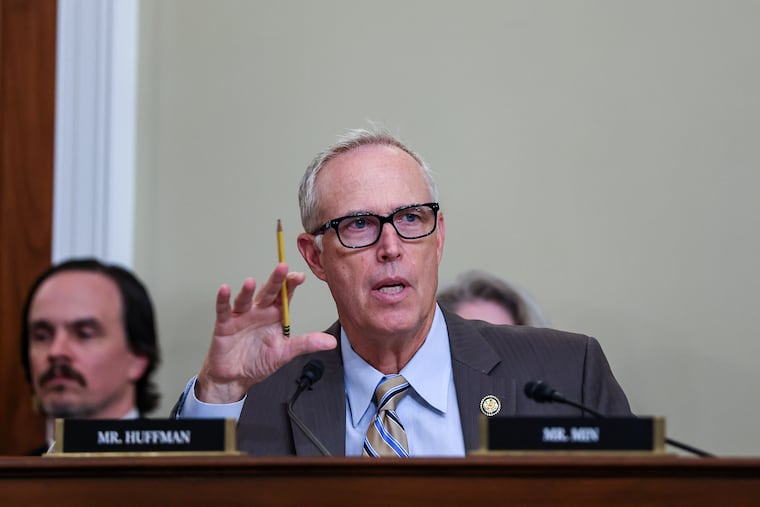
When Rep. Jared Huffman came out publicly in 2017 as a “nonbeliever,” he was only the second member of Congress in modern times to do so — even though a quarter of U.S. residents identified as nonreligious.
Things have changed since for the secular cause on Capitol Hill.
The Freethought Caucus, which Huffman launched in 2018 to promote church-state separation, has grown to 37 members — more House lawmakers than the uber-conservative Freedom Caucus (32) or the Congressional Prayer Caucus (34), according to the platform LegiStorm.
And the percent of lawmakers who choose not to give a religious affiliation or say the unspecific “other” has more than doubled in the past decade, from 16 to 40.
Along the way Huffman, a Northern California Democrat who is a Humanist, has become a kind of national spokesperson for promoting a secular government. And as some data shows many Americans increasingly displeased with the way religion and politics are mixing, he sees an opportunity for his cause, and for his party.
“I think the game has changed,” Huffman said. “Republicans have made a losing bet. Democrats need to understand that and be ready to connect.”
The data is somewhat more complex. Chip Rotolo, senior researcher at Pew Research, said growing majorities of Americans want congregations and pastors to stay out of partisan politics but also approve of some unspecific religiosity having influence in public life.
“It does seem people are more reluctant to see [organized religion] engaging with politics.” Rotolo said. “But at a national level they’d like to see ‘religious values,’ broadly spoken, incorporated.”
President Donald Trump’s administration has vigorously pressed the idea that the United States is a Christian nation, sponsoring a massive evangelical jubilee on the National Mall in May and a June report that described church-state separation as a legal error.
Those efforts have thrilled many Christian conservatives but also prompted concern from others, Huffman among them. He is taking aim at Christian nationalists on his biggest-ever stage, with a book “No Prophets” published this week.
The book argues that extreme Christian nationalism, which fuses Christian and national identities, is the country’s most dangerous political movement. Huffman, 62, accuses his congressional colleagues — including Democrats — of being far too timid on confronting the issue. At the same time, he argues that religious nationalists are “sailing headlong into a failing wind.”
Lance Wallnau, a MAGA influencer who has described himself as a Christian nationalist, rebuffed the idea that his worldview is dangerous.
“I’m looking for a leader whose values align with the transcendent values of when we were founded as a nation,” he said, noting that multiple early U.S. states officially aligned with various Protestant denominations. “They weren’t concerned about a Christian government. What I’m advocating isn’t some oddball thing. We shouldn’t shift the foundation of the house.”
As far as whether secularism is rising, Wallnau said: “Is it possible for America to get more un-Godly? Sure. The Bible talks about gross darkness covering the people.”
Majorities of Americans say houses of worship should not endorse candidates (79%, according to Pew Research) and should “keep out of political matters” (66%). And those numbers have grown. A decade ago, 66% opposed endorsing candidates and 49% said congregations should keep out of politics.
Just 10% of Americans say their views of Christian nationalism are favorable, while 31% are unfavorable (most Americans say they aren’t very familiar with the term). Sixty percent of Americans in 2024 told Gallup they would vote for an atheist, up from 49% in 1999.
University of Notre Dame political scientist David Campbell said Huffman is probably right that secularism’s impact in the U.S. is growing. He called the change “one of the most significant developments in American society in the last generation.”
However, Americans’ attitudes are complex and don’t point in only one direction.
Pew recently found that 37% of Americans say religion’s influence in the U.S. is growing — the highest percentage in 24 years. And 55% of Americans see that as a positive thing, compared with 22% who see it as negative.
Even as Huffman’s caucus is growing, Congress still significantly overrepresents Christians (87% versus 62% of American adults) and significantly underrepresents those who say they have no religion (28% of the U.S., 0.6% of Congress).
Experts who measure Christian nationalism say about a third of Americans embrace or sympathize with the movement. According to a PRRI survey last year, that one-third number has been stable since 2022.
Robert George, who teaches law, religion and philosophy at Princeton University, wrote in an email that Huffman and the Freethought Caucus are actually advocating for socially liberal causes — on abortion, gender and others — and dressing that up as neutrality.
The caucus, and Huffman’s political allies in general, want to further their own “doctrine” or worldview — just like those on the religiously conservative side, George wrote in an email.
“Neither side is violating the ‘separation of church and state’ when they do that, irrespective of whether their advocacy relies on secular or religious rhetoric,” he said.
In “No Prophets,’” Huffman argues that the Religious Right movement of the 1970s was focused on engaging the democratic system to attain culture war wins. Now, he writes, religious nationalists have morphed into a “scorched earth insurgency,” with crowds carrying crosses during the Jan. 6, 2021, assault on the U.S. Capitol, states passing laws mandating the Ten Commandments on display in public schools and Trump administration officials launching and taking part in Christian prayer services inside federal agencies. Huffman sees this movement as actively seeking “to destroy” democracy.
His book aims to be a call to action for fellow Democrats, whom he calls his “greatest frustration” on this topic. In his view, Democratic lawmakers and public officials have done far too little to push back against Christian nationalist ideas.
The Humanism that Huffman affiliates with is a loose philosophy based on the idea that humans should work to improve society and live ethically, guided by reason, not necessarily by anything supernatural.
He doesn’t reject the label “atheist” but says he prefers “leaving room” for new discoveries.
“We all want to understand our place in the universe and what all this means. You can see that — especially the younger generation — some are really struggling,” he said.
But to Huffman, who was raised in a very religious home in an offshoot of the Church of Jesus Christ of Latter-day Saints, personal questions of faith are very different from what he sees as government overreach.
“Reckoning with Christian nationalism is unavoidable,” he writes in his book. “This movement is forcing us to make urgent choices.”
Scott Clement contributed to this report.