Gov. Josh Shapiro has raised $60 million for his reelection campaign. What will he do with it?
According to Shapiro's campaign, the first-term Democratic governor has added $13.3 million to his war chest since June, as he maintains a significant fundraising edge over his GOP opponent.
Gov. Josh Shapiro has raised more than $60 million toward his reelection effort since he took office, his campaign said Tuesday.
According to the campaign, those preliminary figures mean that the first-term Democratic governor has added $13.3 million to his war chest since June, as he maintains a significant fundraising edge over his Republican opponent Stacy Garrity.
Filings on Tuesday showed Garrity had raised around $1.8 million this cycle, with her campaign coffers nearing $3 million. After spending $1.5 million, she will enter October with roughly $1.4 million cash on hand.
So with a massive cash advantage, where will Shapiro’s campaign money go? And could anyone else benefit from his spending?
Even as he pulls ahead in polls, Shapiro has spent heavily on advertising. His campaign has promised he’s keeping his foot on the gas through Election Day in efforts to secure his own victory and elect Pennsylvania Democrats up and down the ballot in hopes of flipping the state Senate and electing Democrats in four battleground congressional districts. He’s donated roughly $5.7 million in total to the state party to fuel the effort, an additional $2.5 million since June, according to his campaign.
» READ MORE: Gov. Josh Shapiro spent more than $2.4 million on ads this week. His GOP opponent, Stacy Garrity, spent $672.
Beyond the November election, he’s widely expected to launch another campaign as a 2028 presidential prospect. Although the law prevents him from transferring his gubernatorial campaign money into a political action committee that funds a run for president, that doesn’t mean he’ll spend all his fundraised money before this year’s election, experts said.
In the governor’s race, the first checks he owes are paying for campaign staff salaries, spending money on advertising, and renting leases for field offices, among other costs, according to campaign experts. As a careful politician, he’d likely also want to reserve a fair amount of cash for surprise developments in the race, they said.
But after all of Shapiro’s receipts are accounted for, experts said, a potentially large stock could remain available, presenting him with options for how to spend it — if at all.
Daniel Weiner, the director of elections and government at the Brennan Center for Justice, said Shapiro has several options available.
“It is incredibly common for candidates who are not facing an especially competitive race to still try to raise money hand over fist and amass a war chest,” Weiner said. “It can be used to fund a future run for office of one sort or another. It can also be used, increasingly in this era of very deregulated money in politics to just build a general political machine.”
Keeping it in the party
Shapiro, who has maintained high favorability among both Democrats and Republicans, has established himself as a formidable fundraiser, bringing in dollars from across the commonwealth and the nation. Donors can give him as much as they’d like, since there is no limit on political contributions in Pennsylvania, said Matthew Foster, a professor of political science at American University.
“There’s a lot of ways for politicians to use political cash to help their allies and to help their team,” said Michael Beckel, an expert on money in politics at Issue One, a Washington, D.C.-based bipartisan nonprofit. “They can spread that money around to help people who need it. And there’s certainly a lot of people who might potentially want help from a big name like Governor Shapiro.”
Pennsylvania law allows Shapiro to transfer endless amounts of money from his campaign account to other state candidates. His campaign said he had not given any money directly to state candidates, but that he has supported them in other ways.
He is also not allowed to transfer money from his gubernatorial campaign to any congressional candidates.
Instead, he has poured money into the state party.
Since last fall, Shapiro has given $5.7 million to the state Democratic Party and its election effort. That money is used to benefit Shapiro as well as state Senate and congressional candidates by pooling funds for their field offices, signage and volunteers.
“A donation to the state party historically has helped get the vote out statewide,” said Philadelphia-based Democratic strategist Adam Erickson.
Plus, donating to the state party versus national groups helps to ensure the money is spent on Pennsylvania races, Weiner added.
» READ MORE: Key Pennsylvania races to watch in the midterm elections this November
Pennsylvania Republicans have held on to the state Senate for more than 30 years, even as the House chamber and governor’s mansion have swapped partisan control and are currently both occupied by Democrats.
This year, Democrats have “a strong opportunity to flip the state Senate,” Erickson said, but that the effort will take “an unprecedented amount of spending” from Shapiro and the state party.
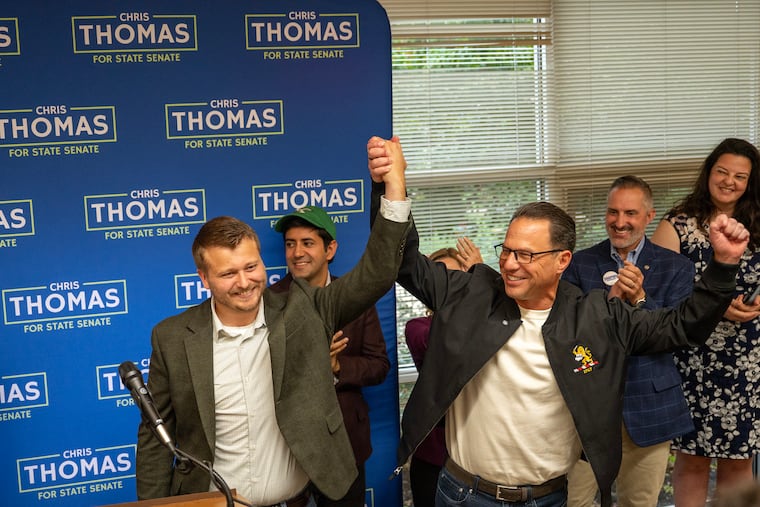
Often, Shapiro has appeared alongside candidates at campaign events, rather than donating to them. On Sunday, Shapiro joined Democrats in Chester and Montgomery Counties to kick off door-knocking and phone-banking efforts benefitting several legislative candidates, such as state House candidate Elizabeth Moro in Chadds Ford and state Senate candidate Chris Thomas in Harleysville.
“Under Governor Shapiro’s leadership, the Party is rallying support all across the Commonwealth and putting Democrats in a strong position to win everywhere this November,” said Manuel Bonder, a spokesperson for Shapiro’s campaign.
From Pennsylvania to Pennsylvania Avenue
Shapiro has batted away questions about his presidential ambitions, saying he’s focused solely on his gubernatorial reelection, but he has many of the signs of a future candidate: a book tour, frequent hits on cable television, and a voice on key issues likely to emerge in the next Democratic presidential primary.
Tim Ford, an attorney who handles legal concerns for Democratic campaigns in Pennsylvania, said Shapiro’s sizable bank account is “also a flex to show he’s capable of raising this kind of money,” and another clue that he may be eyeing a higher office.
If Shapiro does choose to run for president, he’s not allowed to legally transfer his state-level campaign fundraising to a federal political action committee associated with his campaign.
“One thing that I think people get wrong is they believe that he’s raising money for his next office,” Erickson said.
That would put him at a slight disadvantage compared to any sitting federal elected officials who can spend their campaign funds on a presidential run and who are also speculated 2028 presidential contenders, including U.S. Rep. Alexandria Ocasio-Cortez and U.S. Sens. Mark Kelly and Jon Ossoff, who has been the top fundraiser this midterm cycle.
Still, Shapiro’s cash stockpile “sends a message that he’s been a successful fundraiser,” Beckel said. “While past performance doesn’t guarantee future results, he certainly would try to [leverage] that to his advantage to say, ‘I’ve been a successful fundraiser in the past, I will be a successful fundraiser in the future’.”
Former staff or associates could create a federal super PAC, a type of political action committee that can take in and spend unlimited contributions but must do so independently of a candidate and without directly coordinating with the campaign. Shapiro could repurpose his state campaign account into that super PAC, Weiner said, but he would have no say on the messaging in ads or how money is spent.
While this practice of loose coordination skirts the spirit of the law, Weiner said it often goes unenforced.
“In theory, super PACs are supposed to be independent from candidates, but in practice, they work hand-in-glove with them,” he said.
Former staffers of Maryland Democratic Gov. Wes Moore, another potential 2028 contender, have established the Unity First PAC. Moore has headlined fundraisers for the group, but is not technically in control of the PAC.
California Democratic Gov. Gavin Newsom, who may also run for president, launched a super PAC called Campaign for Democracy. The PAC has poured $1.7 million into state party and legislative committee races, mostly in South Carolina, where Democrats will hold the first contest of the presidential primary race in 2028.
There are no official records that Shapiro, or those associated with him, have created a super PAC, according to FEC filings.
Super PACs have earned a negative reputation in some circles, particularly among Democrats who view them as a means to give wealthy donors outsized influence on elections. But in 2028, Shapiro and other Democrats will be under pressure to use all the tools available to them, Weiner said.
It’s a difficult bind, said Faith Williams, who works on anti-corruption and accountability efforts at Common Cause, a democracy-focused nonprofit.
“Our system is not good,” she said. “But at the moment everyone is playing in it, and that I think that makes it even harder to reform it because it’s hard to have the genuine desire to reform a system that currently benefits you.”
Shapiro could also develop a nonprofit organization with his campaign funds. The 501(c)(4) groups, which can spend on political ads but cannot make electoral activity their primary focus, are under no legal obligation to disclose their donors. In some cases, this opens the door to donations from so-called “dark money” groups, or those that obscure the role of their funders.
Experts pointed out that he could also use his leftover money for his second gubernatorial inauguration or donate it to charity. And, in an unlikely maneuver, Williams said Shapiro could refund his donors and ask everyone to donate again to a federal campaign.
But the best way to get from Pennsylvania to Pennsylvania Avenue, Erickson said, would be to ensure success in the statewide elections this year.
“Playing a large role in flipping the state Senate will put him in the best position going into 2027 and beyond for any larger aspirations,” he said.