Society Hill neighbors are spending $54,000 on a traffic study to examine bike lanes
Safety upgrades to bike lanes on Pine and Spruce Streets have been in limbo for more than two years as a lawsuit against the city by opponent group Friends of Pine and Spruce continues.
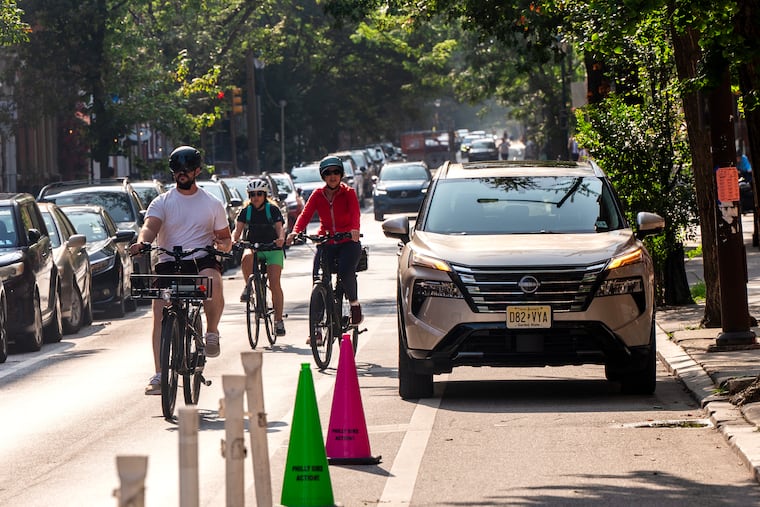
The Society Hill Civic Association will spend about $54,000 for an engineering firm to conduct a new traffic study of neighborhood roads, including evaluation of the city’s proposal to enhance protections for users of bike lanes on Pine and Spruce Streets.
Board members of the community organization approved hiring Dewberry Engineers Inc. for “fact-based recommendations” earlier this month in a special Zoom meeting, according to a Sept. 10 SHCA newsletter.
Last year the Society Hill association contributed $25,000 to help fund a lawsuit against the city by Friends of Pine and Spruce (FOPS), a group of residents challenging the legality of a plan that includes curb-style concrete barriers to separate bike lanes from motor-vehicle traffic.
The new traffic analysis is intended to update a 2018 “complete streets” study done for the civic association by the Howard Stein Hudson engineering firm, said Jay Borowsky, chair of the group’s streets committee.
“Since that time, the city has implemented significant traffic and street changes beyond Spruce and Pine, and is now considering additional changes that could negatively affect the community without any updated objective data,” Borowsky said in an interview.
The new study will also look at traffic counts and crash data on Third Street, where the city installed bike lanes in June, as well as Fifth Street and Lombard Street.
“The streets don’t work in isolation,” Borowsky said. The 2018 study included information only from Pine and Spruce Streets in the civic association’s territory, he said.
The Third Street bike lanes have drawn many of the same complaints and concerns that have arisen elsewhere. Some residents say that designated space set aside for bikes has clogged traffic and more difficulty getting deliveries and contractor services.
But others are happy with the change.
Questions of bias
“In my experience, traffic moves at a more reasonable speed and the street is quieter,” Nawaf Bou-Rabee, a mathematics professor at Rutgers-Camden and SHCA member, wrote in an email to board members. “Every neighbor I have spoken with about it has expressed support.” He also said he’s had no difficulties with deliveries or contractors loading or unloading to work on his home.
“The study should establish where arrangements are working and where specific improvements are needed,” Bou-Rabee wrote. He asked pointed questions about how data will be measured and evaluated and the impartiality of recommendations ensured.
Members of FOPS sit on the civic association board. Society Hill residents who support the bike lane changes say that opponents are using the nonprofit to pursue their own agenda despite a diversity of opinion on cycling protections.
A ban on stopping in bike lanes was enacted in 2024 after a physician, Barbara Friedes, was killed by a drunk driver while cycling on Spruce Street.
The crash helped galvanize support for physical barriers on Pine and Spruce Streets, which the Office of Transportation and Infrastructure Systems has proposed.
A Philadelphia Common Pleas judge in July blocked the city from resuming work to upgrade protections for the bike lanes along Pine and Spruce Streets, the latest ruling in the FOPS lawsuit.
The city had asked the court to lift an August 2025 injunction freezing the OTIS project.
Al Meinster, a SHCA member and cyclist who said he was on the board’s Zoom call, worries that opponents have the “deep pockets” to stretch out the litigation and delay safety changes.
In the meantime “people are exposed to danger, and somebody could be hurt, or somebody could die as a result of this impediment,” Meinster said.
Debate over cyclist safety
The lawsuit is part of a growing backlash against bike lanes. Boston has canceled some planned projects. Nationally, the Trump administration has cut federal grants for building the lanes; Transportation Secretary Sean Duffy recently denounced “DEI bike lanes” and said they contribute to traffic congestion.
Borowsky, of the SHCA, said that the study would collect information that will help city officials, bike advocates, and anyone involved in the debate.
“We’re looking at finding solutions that improve safety and access for everyone,” he said.
Neighbors fighting the city’s plans are mostly “caring, responsible people” who simply “don’t know how dangerous it is to be on a on a bicycle on Spruce and Pine and Third Street,” Meinster said.
FOPS has argued in court and elsewhere that cyclists are safer on Pine and Spruce Street than activists say. The roadways are not listed among the 12% of roadways where 80% of crashes with serious injuries or deaths occur — the metric the city uses in its Vision Zero safety program.
The Pine and Spruce bike lanes were built in 2009 under former Mayor Michael Nutter, whose administration made an agreement that residents would be able to park in front of their homes for up to 20 minutes for loading and unloading.
Enforcement was spotty, and conflicts arose when vehicles, including delivery and contractor vans, parked inside the bike lanes for longer periods, forcing riders to veer into traffic.
Members of FOPS contend that concrete barriers would block emergency vehicle access and violate the Americans with Disabilities Act by limiting access to transportation or those with mobility issues.
Meinster said those arguments are exaggerated or have solutions that don’t require opening up the bike lanes to motor vehicles.
If the legal theory that protected bike lanes violate the ADA catch on, building could be frozen or blocked citywide, he said.
“What’s happening here in Society Hill has great importance to the safer bicycling movement in the rest of the city because some precedents could be made here,” Meinster said.