Cape May’s aviation museum in a WWII hangar is plane impressive — and full of history
Step into fighter plane cockpits and learn the story of the Jersey Shore’s role in the war at this 92,000-square-foot museum at the Cape May Airport.
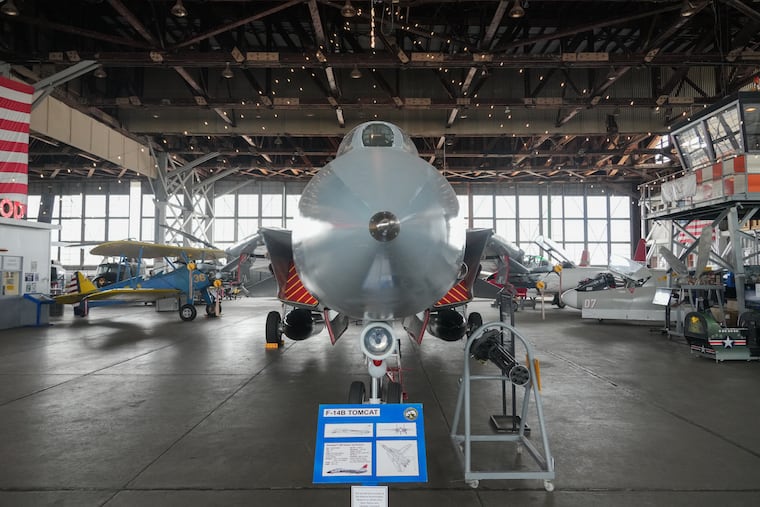
I was sitting in the cockpit of my third airplane at the Naval Air Station Wildwood Aviation Museum — probably saying something like “Pew! Pew! Pew!” or “This is so cool!” — when I looked around and realized that one of my dreams was coming true.
For the first time in my life, I had an entire museum all to myself.
The small group that was there when I arrived had left. The few staffers on site were in the back. And I was alone in the museum’s 92,000-square-foot World War II hangar at the Cape May Airport.
Opened in 1997, the Naval Air Station (NAS) Wildwood Aviation Museum is home to more than 26 aircraft and numerous exhibits about the Jersey Shore’s role in the war and the dive bombers who once trained there.
From the cockpit of the MiG-15 I was sitting in, I marveled at the vast, windowed building, awash in natural light and filled with massive flying machines.
Of course, my blissful solitude had everything to do with timing. I visited on a weekday in early March, when the museum was one of the few sites in Cape May open. It’s much busier during peak season, especially on rainy days, but it never feels crowded because of the hangar’s size, said Austin Myers, the museum’s events and communications manager. He suggests visiting in the summer or the shoulder season, from late May to June or September to October.
Last year, the aviation museum set an attendance record, drawing more than 60,000 visitors, with many first timers hearing about it through word of mouth, Myers said.
“People come and get so excited about this hidden gem they’ve discovered, just like you did,” he told me. “It’s really exciting for us.”
Jersey Shore and the war
The large parking lot was practically empty when I arrived, and big band music — including the Andrew Sisters’ “Boogie Woogie Bugle Boy” — pumped through a sound system outside.
As I entered the building, Uncle Sam pointed at me from a poster that read “I WANT YOU” (if he saw me run a mile, I’m pretty sure he’d change his mind). On a display wall to my left, an exhibit detailed the history of the base.
NAS Wildwood opened in 1943 as a training facility for World War II dive bomber squadrons headed to the Pacific. It was the first time I’d realized that training for the war took place at the Shore — a connection I’d never made before.
“Most people can’t believe there was a dive-bombing training facility in Cape May or at the beach,“ Myers said. ”But we’re on a peninsula, with water on three sides around us, and it was just a perfect site.“
But I had to ask: Why name it NAS Wildwood if it’s in Cape May?
“We’re technically in Rio Grande, New Jersey, but our mailing address is in Cape May. When the base was commissioned it was commissioned as NAS Rio Grande but the mail was getting flip-flopped with Texas,” Myers said. “Three months later they changed it to Wildwood because that was closest post office and there was already a Cape May Naval Air Station.”
NAS Wildwood operated as a naval training facility through the end of World War II. At its peak in 1944, the base marked 17,000 landings and takeoffs in one month. Not all were successful — 129 crashes occurred, and 42 airmen died in training exercises. The museum is dedicated to their memory.
The ‘Aggressor’ and the Hellcat
The base was decommissioned in 1946, and the building went into private ownership. It was eventually abandoned and fell into disrepair. In the late ’90s, a local doctor, Joseph Salvatore, convinced Cape May County officials to lease it to him for $1 a year, an agreement that still stands today, Myers said.
Salvatore used his own money and grants to rehab the building, which had a large hole in the roof and had become overrun by birds. In 1997, he opened the museum with just one aircraft on display.
Today, the museum has six land vehicles, a Coast Guard search and rescue boat, and more than 26 airplanes and choppers, from an F-16 Fighting Falcon to a UH 1 “Huey” helicopter.
You can climb inside the cockpits of about a third of the aircraft, which not only makes the experience more fun but also offers insight into the cramped conditions pilots endured.
I was particularly intrigued by the museum’s Northrop F-5E Tiger II. Its placard noted — without offering any further context — that the plane was “reported to have played the part of the ‘Aggressor’ in the movie Top Gun.’”
A personal favorite of Myers’ is the museum’s F6F Hellcat, which a pilot bailed out of in 1944 and which was rediscovered off the coast of San Diego in 1970.
“Here’s an aircraft that could have sat down there for eternity and it’s sitting in our museum,” he said.
Also scattered around the museum — which has no walls, maps, or set pathways to explore it — are enormous engines, model planes, guns, and inert bombs, including a B61 nuclear bomb.
‘It blows your mind’
Several unexpected exhibits stood out: one featuring photography and radio equipment, another on the Tuskegee Airmen, and one displaying front pages from The Evening Bulletin during the war. A life-size recreation of a U.S. living room during World War II is also on display, complete with Franklin D. Roosevelt’s “Day of Infamy” speech playing on the radio.
In one exhibit, I learned that motorists traveling within 16 miles of the Atlantic coastline during the war had to turn their headlights off at night so as not to attract attention for enemy submarines. In another, I was surprised to find out that German prisoners of war were brought to NAS Wildwood and put to work at Dias Creek digging mosquito control ditches.
“The German POWs planted cherry trees that are still there,” Myers said.
Whether I was knee-deep in exhibits or neck-deep in an airplane cockpit, I was fully engaged. The only thing that pulled me out of the museum experience was the intermittent, God-awful shrieking of a bird echoing through hangar. Given the volume and hatred in its voice, I kept looking around for a pterodactyl-sized beast in the rafters waiting to dive bomb me, but it never came.
“That’s actually a recording that helps keep the birds out of the hangar, it’s our saving grace a little bit,” Myers later told me. “Birds lived in there for a very long time. That’s our predator hawk recording to keep them out.”
It’s ironic that an aviation museum has to protect itself from avians, but then again, it feels ironic to go to a war museum at the Shore. But part of this museum’s power lies in that dichotomy — that a corner of the world so many people feel is their happy place today was once a corner of the world where we prepared for war. It’s important for us to know, and the museum does an excellent job blending it with hands-on learning that keeps visitors — young and old — from being bored.
“To think that there was thousands of people that went through NAS Wildwood and then went on and fought in the Pacific, it blows your mind,” Myers said. “We get people who’ve been coming to Cape May their whole life and never realized this was here.”
Know before you go:
The museum is open 10 a.m. to 4 p.m. all year, but it is closed on weekends in January and February and certain holidays.
Admission is $16 for adults and $12 for children ages 3 to 12. Kids under 3 are free and a $2 discount is offered to U.S. military veterans.
The museum’s hangar is not climate controlled, so dress appropriately.
Pets are welcome and “they will get a warm reception here at the museum,” Myers said.
There are plenty of benches spread around the museum to rest your feet.
Give yourself an hour or two to explore the space. I spent about 90 minutes at the museum and left only because closing time was approaching and I didn’t want to get locked inside.
For more information or to schedule a group tour, visit usnasw.org or call (609) 886-8787.