From New Jersey to Massachusetts, ‘Tony’ explores Anthony Bourdain’s parts unknown — and makes up a few
The evocative new biopic starring South Jersey’s Dominic Sessa is strongest when it captures Bourdain’s seduction by restaurant life — and weakest when it tries to be a tidy origin story.
Anthony Bourdain spent much of his career telling audiences that the best way to understand a place was to resist the easy story about it.
Tony, the new movie about his formative summers in Provincetown, Mass., might have taken that advice.
Director Matt Johnson’s film is an affectionate, funny, atmospheric, and beautifully acted origin story about the future chef, writer, and television personality. Its smartest decision is to avoid trying to encompass Bourdain’s entire life, which ended with his suicide in 2018 at age 61.
Instead, Tony concentrates on the period when a privileged, unhappy teenager from New Jersey stumbled into a restaurant kitchen and discovered a world more exciting than his own.
The historical outline is true. The story Tony builds around it is considerably less so.
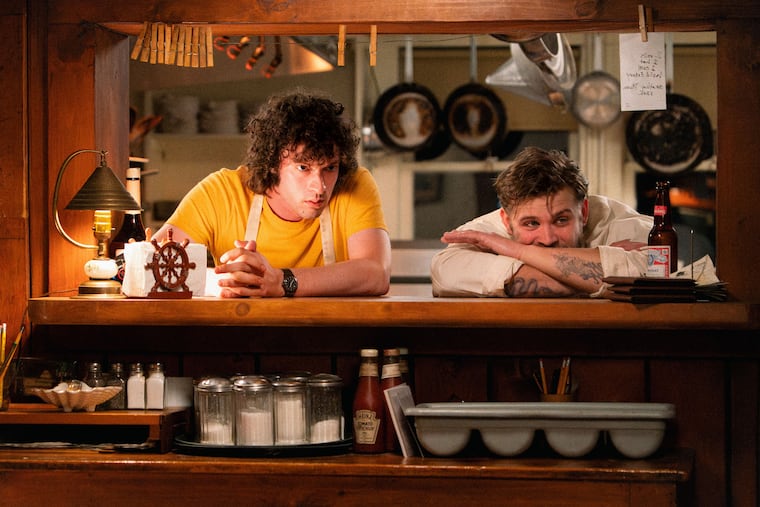
Cherry Hill native Dominic Sessa, who made an impression in The Holdovers, plays Bourdain at 19: a Vassar student, would-be writer, romantic, poseur, and world-class pain in the a—. He arrives in Provincetown chasing both an idea of himself and Nancy Putkoski (Emilia Jones), his girlfriend and eventual first wife.
Sessa wisely avoids a Bourdain impersonation. Rather than reproduce the familiar television cadence or Parts Unknown mannerisms, he gives us a young man who has not yet earned the persona he is trying on.
Bourdain later described his younger self as spoiled, narcissistic, miserable, and self-destructive. Tony takes him at his word. This Tony is clever but not nearly as clever as he thinks, hungry for experience but desperate for other people to notice him having it.
The movie becomes much more interesting once he lands a job washing dishes at the Flagship, a waterfront seafood restaurant in Provincetown that Bourdain renamed the Dreadnaught in Kitchen Confidential.
» READ MORE: From the archives: Anthony Bourdain didn't set out to become a celebrity
Here Johnson has something unusually valuable for a biopic: Bourdain’s own account of being seduced by the restaurant life.
He remembered the Flagship cooks as pirates and gods, former hippies, drifters, and hard-living professionals who drank, swore, stole, screwed, and seemed afraid of nothing. To a sheltered young man searching for an identity, they represented an intoxicating alternative to his comfortable world.
Tony is at its best capturing that attraction.
The kitchen is hot, filthy, profane, sexually charged, and physically punishing. The cooks haze newcomer Tony, who starts in the dish pit and discovers he likes being useful, gradually working his way toward cooking.
Sessa is especially good at conveying Tony’s fascination with people who seem more authentic than he feels.
Leo Woodall plays Sal, a charismatic cook with the confidence, appetites, and recklessness Tony envies. Antonio Banderas supplies the opposite influence as Ciro, the restaurant’s chef-owner, a disciplined professional who sees something worth cultivating in the callow teenager.
Both are effective characters. But neither should be mistaken for straightforward biography.
That is the complication at the center of Tony.
The movie draws from the opening sections of Bourdain’s 2000 memoir, Kitchen Confidential, and his later recollections in a 2014 Parts Unknown episode. With thin source material, Johnson and his cowriters have filled the gaps aggressively.
» READ MORE: From the archives: Anthony Bourdain's New Jersey
Johnson has acknowledged that he compressed Bourdain’s several formative summers in Provincetown into one, set in 1975. Nancy was real and worked at Spiritus Pizza, a gathering place in Bourdain’s Provincetown years. The Flagship was real, and Bourdain began there as a dishwasher. His fascination with its swaggering cooks comes directly from his writing.
Much of the rest is interpretation. Relationships are reshaped and characters are combined. Experiences Bourdain described retrospectively become revelations occurring in real time.
That is hardly unusual for a biopic, and some of the inventions work.
Nancy is not merely the girlfriend waiting to recognize the greatness everyone in the audience knows is coming. She is often the person least impressed by Tony’s performance of himself, and Jones gives her enough intelligence and independence to puncture his pretensions.
Banderas brings a quiet dignity to a movie otherwise swimming in adolescent testosterone. But Ciro appears largely to be a composite created to give Bourdain something his own account of Provincetown did not provide so neatly: a moral mentor.
» READ MORE: Philly chefs share their Anthony Bourdain memories
Sal serves the opposite function. He represents the seductive outlaw kitchen culture Bourdain embraced — drugs, sex, appetite, danger — and its costs.
The arrangement is dramatically efficient: two models of the man Tony might become.
It is also awfully tidy.
Bourdain’s relationship with restaurant culture was more complicated. The same world that gave him purpose also gave him permission to indulge some of his most destructive instincts. He understood that contradiction particularly well in middle age, when he returned to Provincetown for Parts Unknown and discussed his past with considerably less nostalgia.
Tony occasionally seems reluctant to live with that ambiguity.
Johnson, cinematographer Michael Bauman, and production designer Ryan Warren Smith compensate with a Provincetown rendered in a hazy mid-1970s glow. The movie moves languidly between the restaurant, Nancy, parties, beaches, and the community around him. At its best, it feels less like a conventional biopic than a memory of a summer whose significance became clear only later.
Some of Bourdain’s later literary observations are handed to his teenage self, a familiar biopic trick that makes young geniuses sound suspiciously like their accomplished older selves.
That is unfortunate because one of the interesting things about Bourdain’s story is how long it took him to become Anthony Bourdain.
He did not emerge from Provincetown as the finished article. He still had the Culinary Institute of America, decades of restaurant work, addiction, failure, writing, celebrity, television, travel, and reinvention ahead of him.
What Provincetown gave him was simpler: restaurants.
Bourdain found satisfaction in washing dishes and learning to cook. He discovered a tribe whose confidence and camaraderie fascinated him and people whose lives bore little resemblance to his cushy upbringing. Eventually he recognized that cooking might offer something writing had not yet provided — a place to belong.
Those facts are compelling enough without forcing them into a neat transformation.
That is why Tony succeeds when it stops trying to show us the instant Anthony Bourdain became Anthony Bourdain. The more it simply observes a confused young man falling in love with restaurant life, the closer it gets to the truth.
“Tony” is playing in theaters across the country.
