A Gilded Age flower show is giving people a rare glimpse inside the Lynnewood Hall mansion in Elkins Park
The 10-day exhibit by the company Fleurs de Villes, which opened Friday, is the public's first chance in decades to see the 127-year-old mansion.
After being closed for more than eight decades, the Lynnewood Hall mansion in Elkins Park is open, briefly, to the public. And if Friday morning was any indicator, people want in.
Spectators poured into the mansion for the first day of a 10-day flower show that offers a rare chance to view the second-largest surviving Gilded Age mansion in the U.S.
“I just love big, old, fancy houses,” said Karen Lacki, 47, who drove from Reading.
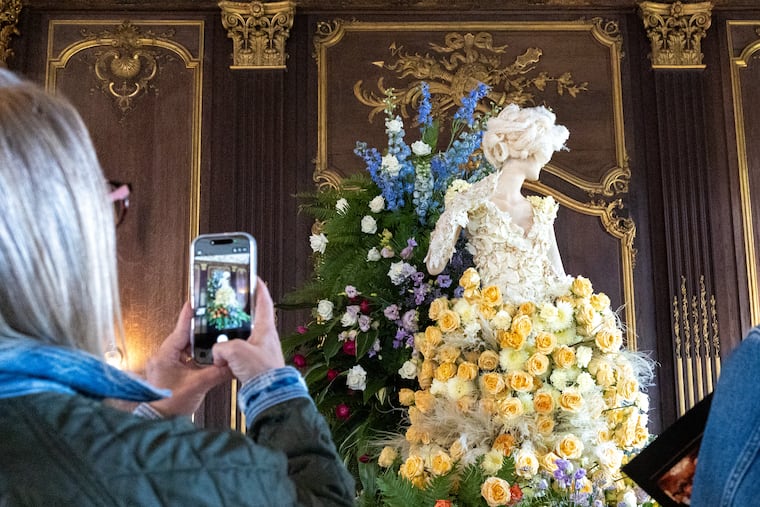
Lacki showed up early to snap photos of flower-adorned mannequins staged at the mansion, part of an exhibit by the floral display company Fleurs de Villes as a tie-in with the HBO series The Gilded Age.
Though the TV show is fictional, the 100,000-square-foot Lynnewood Hall could very well have been part of the story. Peter A.B. Widener, a West Philadelphia bricklayer’s son-turned-transit tycoon, built the neoclassical revival mansion around 1899. The architect was Horace Trumbauer, whose firm designed the Philadelphia Museum of Art.
The history behind Lynnewood Hall Mansion
Widener family history is what drew author Kelly Skwarcan to the flower show. Skwarcan wrote a book about the sinking of the RMS Titanic. She explained that Widener had sent his son George, daughter-in-law Eleanor, and grandson Henry on the Titanic’s doomed 1912 voyage. George and Henry died in the disaster.
“It was heartbreaking for Peter,” Skwarcan said, adding that Widener died three years later.
After his death, the estate, which housed an extensive art collection, was open to the public until 1940. But the art collection was moved, and in 1944, the family sold Lynnewood Hall.
By the time Karen Brown and Cameo John were children in Elkins Park, the 110-room mansion had fallen into disrepair. On Friday, the best friends, both in their mid-40s, showed up so that they could finally go inside.
“I always hoped that they’d try to do something with it,” John said. She hopes it could be a wedding venue and something educational for younger people.
As they and others walked onto the mansion lobby’s checkerboard floor, they were encouraged to vote on favorite flower installations.
“The flowers are gorgeous,” said Ellin Jones of Chestnut Hill.
But for Jones, and others on a guided tour Friday, the building itself was the main draw — and in every room, the long-neglected mansion’s problems were evident. A placard described how a failing downspout had caused rainwater damage.
Elsewhere, plaster had peeled from walls and ceilings, revealing rusted mesh lath and holes. In the high-ceilinged Van Dyck Gallery, ornamental molding had shorn off, revealing brick. In a dark alcove nearby, a ragged pipe organ jutted out from the wall.
“It’s absolutely amazing, but it’s also so terribly sad,” Jones said. She said it will take a lot of “money, and love,” to restore the building.
It’s going to be an expensive restoration project
Angie Van Scyoc, chief operating officer of the Lynnewood Hall Preservation Foundation, said she is dedicated to making that happen.
The first step, Van Scyoc said, is to stabilize the structure by fixing the roof, downspouts, and other urgent issues that cause water damage. That will cost about $10 million.
From there, she said, the foundation will seek a full restoration of the mansion.
“When you take on a project of this magnitude, you have to shoot for the stars, or it’s not going to take off,” Van Scyoc said.
The foundation has received $9 million from an angel investor, she said, and is working to secure grants and donations.
The site has already been used as a movie set, and Van Scyoc said she sees opportunities to raise considerable funds through film agreements and other leasing opportunities.
She noted that Highclere Castle in England was restored using revenue from the hit TV series Downton Abbey, which was filmed there. Another example is Wentworth Woodhouse, a 250,000-square-foot country house in England, where filming was a primary revenue source, she said.
To be sure, the restoration bill will be massive. Edward Thome, executive director of the foundation, said repairs will cost $300 million over 25 years.
In the near future, he expects to see increased work on the roof, as well as improvements to the grounds. The foundation also recently got $1 million to stabilize Lynnewood Lodge, an 18,000-square-foot building on the grounds.
But for Thome, it is worth it — for history, and for the community. Thome said he has been drawn to the mansion ever since he discovered it online at age 11. Now 28 — the same age, he noted, that Horace Trumbauer was when the mansion was completed — he feels a thrill at seeing people walking in.
“It’s fabulous. This house was built to entertain. It’s built to host.”
The floral exhibition runs Sept. 25-Oct. 4, open daily from 10 a.m.-6 p.m. Adult tickets are $30.50. lynnewoodhallpreservation.org.