Exonerated, then charged, Part II: Freed by Krasner’s office, a man was charged with another murder
Critics say the case shows how the district attorney’s office mishandles wrongful-conviction reversals. The record suggests they have a point.
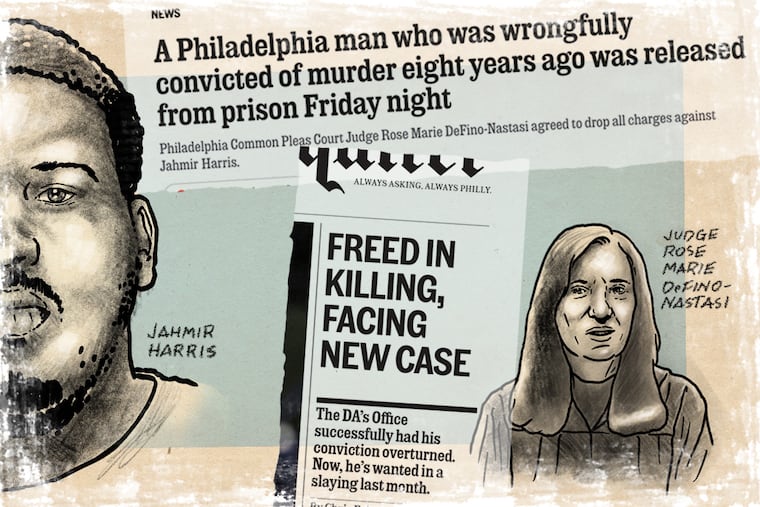

This is Part II of “Exonerated, then charged: Inside a murder case that tests Larry Krasner’s reform agenda,” a look at a prosecution at the center of the debate over how the district attorney handles wrongful convictions. Read Part I.
In 2015, Michael Wiseman took over as Jahmir Harris’ attorney handling his post-conviction appeal. After District Attorney Larry Krasner was elected in 2017, Wiseman asked the office’s newly formed Conviction Integrity Unit to review the case.
Patricia Cummings, then the head of the CIU, unearthed evidence that helped build a case to overturn Harris’ conviction. In the file was a partial license plate description that eyewitness Michele Markey provided to police.
Cummings subpoenaed records from Avis that showed another man had rented the car used in the shooting. The car was rented two days before the shooting and returned to Avis the day after.
The man’s name, address, and cell phone number appear in the file but are being withheld from this column because he was never charged. Phone records showed the man spoke with the victim, Louis Porter, eight times in the days and hours leading up to the shooting. Another 14 calls from the man to Porter went unanswered.
Police records showed the man who rented the car had prior arrests, including two for aggravated assault with a handgun, and had been released from prison in 2004. One conviction involved a dispute over drug territory.
Four days after the shooting, police also received an anonymous call to a tip line that referenced a drug deal gone bad and knowledge of events. “The victim was trying to get his money back, but the guy who sold them to him kept avoiding him,” the male caller said. “And one of the guys he sold them to was threatening him via text message.”
While Markey picked Harris out of a photo array, she was never shown a photo array with the man who rented the car.
“There is no evidence in the file that [police] did any investigation or even entertained the possibility that [the person who rented the car] was involved,” Wiseman wrote in a 2020 court filing. “The sole focus of their investigation was Harris.”
In a written declaration, Harris’ defense attorney at his criminal trial, Brian McMonagle, told Wiseman and the CIU he was not provided with information about the other possible suspect. If he had been, he said, he would have used it.
Wiseman wrote that he, too, did not have the information when he initially appealed Harris’ conviction, or he would have used it to argue key evidence was not turned over to the defense as the law requires.
Wiseman also argued Harris’ cell phone records were not shared with defense counsel before the trial, as is also required. But an August 2013 letter from an assistant district attorney to McMonagle lists “a voluminous packet” of cell phone records that were turned over to the defense during discovery.
Wiseman argued the video did not show a second person in the car as Markey claimed. A security guard at Walgreens told investigators the car windows were tinted, and he did not see a second person in the car. The guard did not testify at the trial.
“In a case resting solely on the Markey identification, with all of its inconsistencies and her quick glimpse of the shooter’s face, this information would have made a difference,” Wiseman wrote, adding that, in his estimation, “it exonerates Mr. Harris.”
‘The streets talk’
In January 2021, Philadelphia Common Pleas Court Judge Rose Marie DeFino-Nastasi, a former public defender, agreed to a motion to grant Harris a new trial, citing what she termed a “narrow finding” regarding the prosecutor’s failure to disclose relevant information.
But Krasner’s office never retried Harris. Nor did prosecutors ever contact Markey, the eyewitness whose testimony helped to convict him, to let her know he was getting released. Nor did prosecutors ever question the person who rented the getaway car.
When I spoke with Yvonne Porter, Louis Porter’s sister, she said she knew the person who rented the car but did not believe he was with Harris the night of the murder. She named a different man and said people in the neighborhood had told her he was in the car with Harris.
“The streets talk,” Yvonne said, adding that the man was recently killed.
Bottom line: Krasner’s office released Harris despite his conviction by a jury and never investigated anyone else for Porter’s murder. Instead, Krasner blamed the police and prosecutors before his administration for bungling the case.
“That alternate suspect was under-investigated in ways that cannot be fixed due to time passing,” Krasner wrote in an email to me. “As the [Philadelphia Police Department] investigation and the former ADA [Erin Boyle] under [former District Attorney] Seth Williams disregarded the alternate suspect and went all in on Harris, they undermined any possible future prosecution of the actual killer in that case.”
Boyle, a veteran prosecutor, was forced out of the DA’s office in 2018 — eight months after Krasner was elected. She had objected to the office’s controversial handling of Krasner’s first exoneration case, which involved Dontia Patterson, a man who spent 11 years in prison after being convicted of murder in a fatal shooting outside a Lawncrest grocery store in 2007.
Boyle disputed Krasner’s claim that prosecutors mishandled the Harris case.
“The pursuit of truth was the foundation of my work as a prosecutor,” she told me. “I took my oath and ethical obligations seriously, and I reject any suggestion that I deliberately disregarded those obligations in this case. I stand by the integrity and professionalism with which I handled this prosecution.”
In 2021, Boyle wrote in a legal declaration that the file she received did not contain information about the other suspect, and that Cummings and Wiseman found no evidence she intentionally withheld evidence.
Based on the findings, Krasner’s office moved to drop the charges against Harris.
An incredulous judge
Initially, DeFino-Nastasi declined to release Harris and instead ordered Krasner’s office to provide evidence of a more thorough investigation and determine whether Harris had colluded with the other suspect.
Cummings filed a motion accusing the judge of overstepping her authority.
At a March 2021 hearing, DeFino-Nastasi gave a lengthy address detailing her lack of confidence in the way Krasner’s office had handled the case.
A review of the judge’s blistering comments — most of which have not been fully reported before — seems more compelling given how Krasner’s office has been castigated recently by other state and federal judges for its handling of other exoneration cases.
“This court wonders how the [district attorney] felt confident in releasing a murder suspect from prison when … the criminal investigation into this matter was still ongoing,” DeFino-Nastasi said.
The judge pointed out that Krasner’s office failed to interview the other suspect or investigate whether he was connected to Harris. She questioned whether the district attorney’s motion to drop the charges against Harris was “reasonable.”
“The [district attorney’s] handling of this matter has caused this court great concern,” DeFino-Nastasi said.
The judge then raised an issue that has surfaced in several other cases involving Krasner’s office: prosecutors’ repeated lack of “candor to the court.”
“It is, of course, a prosecutor’s professional and ethical duty to seek justice when it appears a conviction was wrongful,” the judge said. “However, a prosecutor also has a duty of candor to the court, as well as a duty to act in good faith on behalf of the citizens of this jurisdiction. In this case, it is questionable whether those duties were violated.”
» READ MORE: Krasner’s controversial shortcut in one exoneration case? He’s used it dozens of times. | Paul Davies
DeFino-Nastasi said it was unclear if Cummings was “willfully deceitful or just inadvertently.” She said Cummings’ filings “created a confusing web of contradictions,” and that her pleadings included “several unsubstantiated claims.”
Cummings did not respond to several emails seeking comment.
DeFino-Nastasi then pointed to another problem that has dogged the district attorney’s efforts to overturn convictions: a consistent lack of compelling evidence to support the claims of innocence after a person has been convicted beyond a reasonable doubt by a jury of their peers.
“A prosecutor has an absolute duty to support their claims with evidence, plain and simple,” the judge said. “A hunch or assumption will not stand up in a court of law. In fact, failures to support a hunch or assumption with reliable evidence is arguably one of the ways wrongful convictions occur in the first place.”
DeFino-Nastasi questioned whether Krasner’s office had “acted in good faith” and if its investigation had “truly turned over every stone.”
DeFino-Nastasi — who did not respond to emails seeking to discuss the case — nonetheless approved Krasner’s motion to drop the charges and released Harris from prison in March 2021.
Unlike in most cases involving a wrongful conviction, the judge did not apologize to Harris for the time he spent in prison.
Yvonne Porter was incredulous at the turn of events. Her brother’s murder had already disrupted many other lives.
The Porter and Harris families were once friends but no longer spoke. Neighbors were divided and forced to take sides. Yvonne felt sorry for Harris’ parents, who she said were “good stock,” but later lost another son to a shooting.
A judge questioned whether Krasner’s office “acted in good faith” and if its investigation “truly turned over every stone.”
Meanwhile, Louis Porter’s two older sons were haunted by his death. “Their father was everything to them,” said Yvonne, who told me her then-5-year-old nephew, who was in the car the night her brother was shot, came home with his dad’s blood on his clothes.
“Who knows what he sees when he closes his eyes at night,” she said.
Yvonne believed Louis’ murder hastened her mom’s passing. At least Harris’ conviction had brought some accountability, she said, but his exoneration opened old wounds.
“I told [Krasner’s office], ‘You know how this is going to end,’” she said. “Either [Harris] is going to get killed, or he is going to kill someone else.”
Roughly 18 months later, Charles “Chali Khan” Gossett, 50, an artist and musician, was shot in the head and died after leaving a birthday party at a club in Overbrook. Gossett left behind a wife and 12 children.
Harris was charged with murder for his role in the September 2022 killing. A bench trial — or a trial decided by a judge without a jury — is scheduled to begin Dec. 7.
Interestingly, Harris has spent four years in prison in a case in which he is still presumed innocent and eight years in prison for a murder for which he was initially convicted.
Meanwhile, the lawsuit Harris filed in August 2021 against the city seeking payment for the time he spent in prison for Porter’s murder was dismissed on summary judgment in 2024 — a decision that was upheld on appeal the following year.
In rejecting Harris’ claim, the court said investigators had probable cause to arrest him, and it cited another precedent that offered legal protections to law enforcement while investigations were underway.
“It would be a deplorable state of affairs,” the court wrote, “if every police officer had to worry about the possibility of a civil action against him every time he arrested a seeming malefactor.”
About our columnists
In contrast to news reporters, who operate within an independent, nonpartisan framework, columnists are charged with including their perspectives, opinions, and viewpoints when presenting their reporting. Inquirer columnists include Jenice Armstrong, Will Bunch, Luis F. Carrasco, Paul Davies, Daniel Pearson, Trudy Rubin, and Sabrina Vourvoulias.