Sous-chef paid heed to presidential palate
When John Moeller first heard about the pretzel incident, he thought he was toast. It was Jan. 13, 2002, the memories of the Sept. 11 attacks still fresh, and President George W. Bush was doing what millions of other Americans were doing: trying to feel normal for a little while. He was watching football.
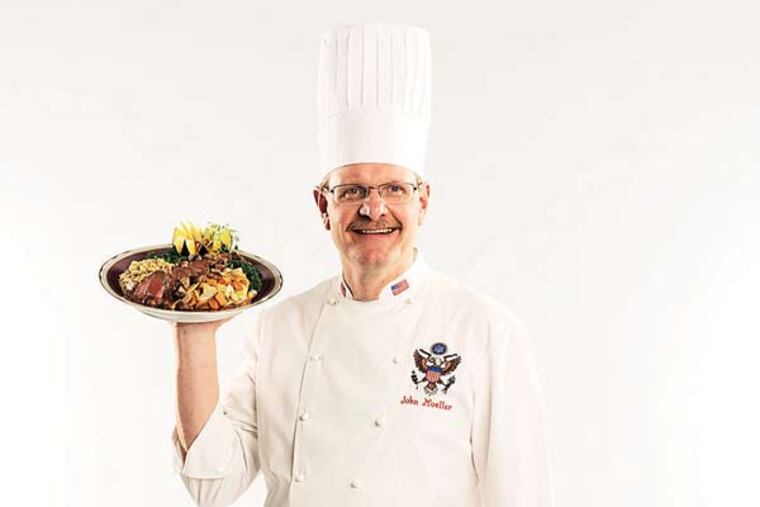
When John Moeller first heard about the pretzel incident, he thought he was toast.
It was Jan. 13, 2002, the memories of the Sept. 11 attacks still fresh, and President George W. Bush was doing what millions of other Americans were doing: trying to feel normal for a little while. He was watching football.
Alone in his White House quarters, Bush was popping pretzels while watching an NFL playoff game. One didn't go down right, and the president crashed to the floor after briefly losing consciousness. The fall caused only minor facial injuries - and perhaps a bruised ego.
Despite the passing, freakish nature of the incident, reporters wouldn't let it go. They were on the story like, well, mustard on pretzels. They wanted to know the source of the salty treat. The White House wasn't saying. "You're not going to get us to cough it up," press secretary Ari Fleischer deadpanned to the New York Times.
As a sous-chef in the White House kitchen, Moeller was one of the few people in the United States to know the bakery that produced the pretzel. Moeller, in fact, was the one who had introduced the snack to the White House, during the Clinton administration. The handmade beauties came from Hammond Pretzel Bakery in Lancaster, Pa., near where Moeller grew up. "Chelsea went wild on it for a little while," Moeller says about his hometown pretzel. Hillary Clinton wrote the bakery a letter, thanking it for the healthful and tasty treat.
Then came President Bush's snack-related scare, which practically caused Moeller himself to choke. His first thought upon hearing the news: "Am I going to be working here tomorrow?"
Moeller kept his job, but he got another lesson in the tenuous status of the White House kitchen staff, which "serves at the pleasure of the president," as the oft-repeated phrase goes. What does that mean in real terms for the men and women who work at the White House, feeding the first family and their many guests and dignitaries from around the world? It means that politics, personal tastes, or even a pretzel can potentially send a chef packing from 1600 Pennsylvania Ave.
Particularly the executive chef, the person who leads the small, full-time White House culinary team. The position has become increasingly political over the years, and Moeller, who worked in the White House kitchen from 1992 to 2005, remembers when the head-chef gig shifted from a mere job to a post invested with symbolism.
It was in late 1992, just weeks after Moeller started his job in the George H.W. Bush White House. Alice Waters, founder of Chez Panisse restaurant and earth mother of the U.S. locavore movement, sent a letter to president-elect Bill Clinton and Hillary Clinton, urging them to install an American chef. The letter was signed by dozens of top chefs.
At the time, Pierre Chambrin, a Frenchman, was leading the kitchen; feeling the outside pressure, "Pierre grew despondent and finally said, 'I've decided to leave,' " Moeller writes in his recent book, Dining at the White House: From the President's Table to Yours, a pull-back-the-curtain look at cooking for the world's most powerful family.
It took more than a year, but Waters finally got her American chef. Chambrin eventually was replaced by Walter Scheib, a native of Oakland, Calif., who introduced his own spin on American cuisine.
Waters' letter "maybe did politicize the position more than it had been in the past. It became more volatile than it had been," says Moeller, 52, as we sit in Paul bakery, a very French shop not far from the White House. Henry Haller, for example, served as executive chef for the White House for 21 years before retiring in 1987.
"I see a lot more interviews with White House chefs and stuff like that, where before we were just working," Moeller adds. "We served at the pleasure of the president . . . and very rarely would we get any fanfare."
These days, cooking for the first family may have its politics (and perks), but it remains a demanding job, requiring a chef who can plan and prepare both big, high-profile state dinners and quotidian family meals. It also requires an unassuming chef who doesn't insist on forcing flavors on a president and family members who have their own likes and dislikes at the table. The job, in essence, is that of a glorified personal chef.
Moeller likes to share an anecdote to explain why a White House chef needs to be ego-free. The Clintons, Moeller remembers, had just hired a new cook, and he was eager to impress. Chelsea Clinton wanted pancakes for breakfast. The newbie noticed real maple syrup in the refrigerator and was about to grab it. Moeller told him to forget it: Chelsea liked the imitation syrup.
"And he fought me about it," Moeller recalls. "I said, 'OK, fine. Put it up there.' It went up, and it came back two minutes later. . . . I said, 'You know and I know [real maple syrup] might be the better-quality thing. That is maybe something we do on the outside for people, but we're in a home. This is what she wants. We're going to give them what they want.' "
White House cooks may have to swallow their pride, but on occasion, they also have a chance to influence the president's palate. Moeller says that when a cook first starts, he or she is briefed on presidential food preferences, including dishes and ingredients to avoid. Everyone on the staff knew, for instance, never to serve broccoli to George H.W. Bush.
But Moeller also knew that the elder Bush was a well-traveled man who knew a lot about cuisine. So one evening, Moeller decided to take a risk. He prepared the president an Asian-flavored meal: miso soup, California rolls, and salmon teriyaki, among other dishes. He even had White House carpenters build geta serving boards for a Japanese-style presentation.
"Afterwards, the president came back, and he shook my hand," Moeller remembers. "He goes, 'John, in the four years that I've been here, I've never had a meal like that. Thanks a lot. That was fun.' "
White House chefs have also been early adopters of practices that have only recently taken root in the public's consciousness. Local and regional sourcing of ingredients? Moeller says he was buying produce not only from farms in Pennsylvania Dutch country, but also from farms in Montgomery County, Md., long before farmers' markets dotted the landscape. He even harvested ingredients from his own garden.
"I used to always let them know, 'Hey, those beets came from my garden,' " Moeller says about the Clintons. "The first lady used to like that."
The kitchen staff was also a pioneer in menu labeling. Long before the U.S. government mandated that chain restaurants with 20 or more locations start listing calorie counts, the Clinton White House demanded the same thing for its family dinner menus, Moeller says. (Joke all you want about Bill Clinton's love of fast food when he was on the road; Moeller swears the president ate more-healthful foods at the White House: "I'd make a couple of burgers from time to time, absolutely, but it was only once in a blue moon.")
"We read through books, and we were calculating the caloric value" for every dish, Moeller recalls. "We attached that to all the menus that we presented."
Despite his many years of service, Moeller never rose to the position of White House executive chef. He says he was acting head chef for several months in 2005 after Scheib was fired, reportedly for not meeting first lady Laura Bush's "stylistic requirements."
Moeller didn't get the job. The Bush White House selected Philippine native Cristeta Comerford, the first woman to hold the position. She was another veteran of the White House kitchen, originally hired in 1995 under Scheib. Moeller says he has no hard feelings about being passed over, though he does wonder whether the White House was under pressure to hire a woman by groups such as Les Dames d'Escoffier.
Whether politics played into the decision or not, Moeller opted to leave the White House several months after Comerford took over. "I figured it might be a good segue to just move on and start to do my own thing again," says Moeller, who now has his own catering company back in Lancaster, home of those infamous pretzels.
Chestnut Spaetzle
Makes 6 servings
EndTextStartText
1 cup flour
1 tablespoon plus 1 teaspoon salt, plus more as needed
1/2 teaspoon freshly ground black pepper, plus more as needed
1/4 teaspoon freshly grated nutmeg
2 large eggs
1/4 cup whole milk
1/2 cup finely chopped chestnuts, preferably
vacuum-packed
3 tablespoons unsalted butter
EndTextStartText
Beef tenderloin with cremini mushroom sauce, broccoli, and glazed root vegetables accompanied this spaetzle at a White House dinner on Jan. 10, 2005.
You'll need a large-holed colander. Because this dough is so thick, we found it created shorter strands than regular spaetzle doughs.
Make ahead: The dough needs 10 to 15 minutes resting time. The spaetzle is best when served just after it is cooked.
1. Combine the flour, teaspoon of salt, the pepper, and nutmeg in a mixing bowl.
2. Whisk together the eggs and milk in a liquid measuring cup.
3. Make a well at the center of the flour mixture; pour in the egg-milk mixture. Add the chestnuts, then gradually incorporate the surrounding flour mixture to form a thick dough. Let it rest for 10 to 15 minutes.
4. Bring a large pot of water to a boil over high heat; add the tablespoon of salt, then reduce the heat to medium or medium-low so the water is barely bubbling. Transfer half of the dough to the colander. While you suspend the colander over the pot of water, use a wooden spoon to push the dough through. Cook for 3 or 4 minutes; the spaetzle will rise to the surface. Stir gently to avoid sticking.
5. Use a Chinese skimmer or slotted spoon to transfer the spaetzle to a bowl. Wipe/rinse out the colander. Repeat with the remaining dough.
6. Just before serving, melt the butter in a large skillet over medium heat. Just as the butter begins to brown, add all of the just-cooked spaetzle and toss to coat; cook for 1 to 2 minutes, until lightly browned. Season lightly with salt and pepper. Serve hot.
Per serving: 190 calories, 8 grams fat, 5 grams saturated fat, 85 milligrams cholesterol, 23 grams carbohydrates, 5 grams protein, 2 grams sugar, 460 milligrams sodium, 1 gram fiber.
EndText
Pumpkin Seed and Tomato Dressing
Makes 6-8 servings
EndTextStartText
1/2 cup raw, unsalted, hulled pumpkin seeds (pepitas)
2 vine-ripened tomatoes, peeled and seeded (see note)
1 teaspoon pumpkin seed oil, or more as needed
1/4 cup extra-virgin olive oil
1 tablespoon plus 1 teaspoon sherry vinegar
Kosher salt
Freshly ground black pepper
EndTextStartText
This dressing was served on a first-course salad that accompanied an artichoke mousse at a White House luncheon honoring the spouses of members of the North Atlantic Council in April 1999.
Make ahead: The dressing can be refrigerated in an airtight container for up to three days.
1. Preheat the oven to 350 degrees.
2. Spread the pumpkin seeds on a rimmed baking sheet. Toast in the oven for 8 to 10 minutes, until lightly browned. Cool completely, then coarsely chop.
3. Meanwhile, place the tomatoes in a blender; puree until smooth. With the motor running, gradually add the oils, the vinegar, and a pinch each of salt and pepper; puree to form an emulsified dressing. Transfer to a container; stir in the toasted, chopped pumpkin seeds.
4. Taste for seasoning; for more of a nutty flavor, add a bit more pumpkin seed oil.
Note: To peel the tomatoes, use a small, sharp knife to cut an X at the bottom. Drop into a bowl of just-boiled water; let sit for a few minutes. You should see the peel start to curl where the X is. Transfer to a bowl of cold water or let cool, then discard the peel.
Per serving: 120 calories, 11 grams fat, 3 grams saturated fat, 0 milligrams cholesterol, 55 grams carbohydrates, 18 grams protein, 547 milligrams sodium, 9 grams fiber.
EndText