Delicious, dependable old tuna
I keep a supply of tuna in pouches or cans in our pantry, but I am the only one who eats it.
I keep a supply of tuna in pouches or cans in our pantry, but I am the only one who eats it.
My husband grew up on Manhattan's Upper West Side where, he insists, canned tuna feared to tread. He did eat lots of smoked, canned mussels as a child - on tiny toasts, he recalls.
By looking upon tinned tuna as déclassé and sometimes referring to it as "cat food," he has persuaded our daughter to eat the fish only when it is fresh, grilled, and spritzed with lemon juice.
It is tragic, so tragic, that neither will entertain the notion of eating Tuna Noodle Casserole made totally with pantry (read: canned, as in, also, cream of mushroom soup). They do not understand the joy of a tuna salad sandwich made suddenly and simply with mayonnaise and a bit of relish.
Among other ways, my friendship with canned tuna was formed by being reared a Catholic in the near-Midwest before fresh fish was flown daily from coast to coast and everywhere in between. I realized that it did not come only in cans only after I was old enough to worry about moisturizing under my eyes every night.
Over the years, there have been many reasons not to eat tuna.
The first was because lovable dolphins were being killed in the process of the capture of the less-cute tuna. Dolphin-safe tuna fishing resulted in the 1960s. Now there are protests over canned tuna because all sorts of tuna varieties, including the overfished bluefin, are being inadvertently caught in nets.
And then there is the more recent news of the high levels of mercury in most varieties of canned tuna.
Enlightenment has its price. For all of these reasons, I no longer eat the amount of canned tuna that I did as a child. Still, I have not abandoned it.
This has everything to do with convenience, taste, versatility, and memory.
It was the first protein I worked with in the kitchen. I still recall my pride when at age 10 I used the big old electric can opener to open enough tuna to stir into a huge pot of cooked, drained elbow macaroni mixed with several cans of cream of mushroom soup.
In my house, it was not required to dirty another dish by turning this mixture into a casserole and baking it. Nor were green peas involved - just those three ingredients.
It was easy, fast, cost-effective, hit the spot, and served many, particularly during summer vacation from school when siblings and neighbors filled the yard.
A few cans of tuna in the pantry mean a pardon from grocery shopping, especially on a summer day when the prospect of climbing into a car and walking across scorching pavement to buy, say, cold cuts is just too daunting.
Over the years, I've learned that canned tuna is related to tofu in the sense that it takes on the character of whatever ingredients it's mixed with. And rarely do you need to follow a recipe to make something of it.
Mix it with cooked spaghetti, sauteed garlic, and kale to make tuna-ghetti. Pair it with canned white beans and a simple vinaigrette to top salad greens. Complicate that salad by adding a hard-boiled egg, steamed green beans, tomatoes, and boiled potatoes to devise a Nicoise version.
As suggested by the recipes below, combine it with exotic ingredients: Lemongrass, chilies, lime juice, curry powder, ginger or olives quickly turn old-fashioned canned tuna contemporary.
Trying to cut down on fat and carbohydrates during a summer overloaded with outdoor events at which the concession stands offer only pizza, hot dogs, hamburgers, and other beloved but sabotaging fare?
Turn to the newer space-saving, no-draining-needed variety of tuna that was introduced in 2000. Before or during an event, rip open a package of tuna, add low-fat mayonnaise (flavored if you have it), relish, or even salsa, and stir with a plastic fork.
It's portable and, as I discovered recently, enviable.
As I walked around our swim club with an open package of tuna-turned-salad the other day, a friend downing a cheeseburger remarked: "I wish I'd thought of that."
Obviously, she had not grown up in New York City.
Thai Lemongrass Tuna Salad
Makes 2 servings
EndTextStartText
6 large lettuce leaves
8 ounces canned tuna in oil or water, drained
2 tablespoons finely chopped fresh ginger
1 lemongrass stalk, thinly sliced
3 small fresh red chilies, finely chopped
2 tablespoons fish sauce
2 tablespoons fresh lime juice
2 teaspoons sugar
2 green onions, sliced on the diagonal, white and green parts
EndTextStartText
1. Arrange the lettuce on a serving platter and set aside.
2. Flake the tuna into a bowl, add all the remaining ingredients, and mix well. Turn the mixture onto the lettuce-lined platter and serve.
Per serving: 303 calories, 37 grams protein, 17 grams carbohydrates, 10 grams sugar, 10 grams fat, 20 milligrams cholesterol, 1,806 milligrams sodium, 3 grams dietary fiber.
EndText
Indian Curried Tuna Salad
Makes 2 to 3 servings
EndTextStartText
1 1/2 tablespoons vegetable oil
1 small onion, peeled and cut into very fine half rings
1 clove garlic, peeled and very finely chopped
1 teaspoon curry powder
1 can (6 ounces) good-quality tuna, packed in oil
1/2 to 1 fresh hot green chile, cut into very fine rounds (do not remove seeds)
1/2-inch piece fresh ginger, peeled and cut into very fine slices, then into very fine strips
1 to 3 tablespoons chopped fresh cilantro
Salt to taste
Freshly ground black pepper
EndTextStartText
1. Put the oil into a nonstick frying pan and set over medium-high heat. When the oil is hot, put in the onion and garlic. Stir and fry until the onion turns brown at the edges. Put in the curry powder. Stir once or twice. Put in the tuna. Stir it around and break up any big lumps.
2. Turn the heat to low. Add the green chile, ginger, and cilantro. Stir to mix. Check for salt, adding if needed. Add a generous amount of black pepper. Mix well and remove from the heat.
3. Serve hot, at room temperature, or cold.
Per serving (based on 3): 192 calories, 17 grams protein, 5 grams carbohydrates, 2 grams sugar, 12 grams fat, 10 milligrams cholesterol, 217 milligrams sodium, 1 gram dietary fiber.
EndText
Tuna Tapenade
Makes 1 cup or 4 servings
EndTextStartText
1 cup pitted Nicoise or other black imported olives
1 tablespoon minced garlic
1 tablespoon capers, drained
3 tablespoons extra-virgin olive oil
1 can (3 1/4 ounces) tuna packed in oil, drained
Juice of half a lemon
Toasted French bread slices
EndTextStartText
1. Combine the olives, garlic and capers in a food processor, and process to form a paste.
2. With the motor still running, slowly add the olive oil through the feed tube and blend thoroughly.
3. Then add the tuna and lemon juice. Continue processing until smooth.
Per serving (without the bread): 180 calories, 7 grams protein, 4 grams carbohydrates, trace sugar, 16 grams fat, 4 milligrams cholesterol, 454 milligrams sodium, 1 gram dietary fiber.
EndText
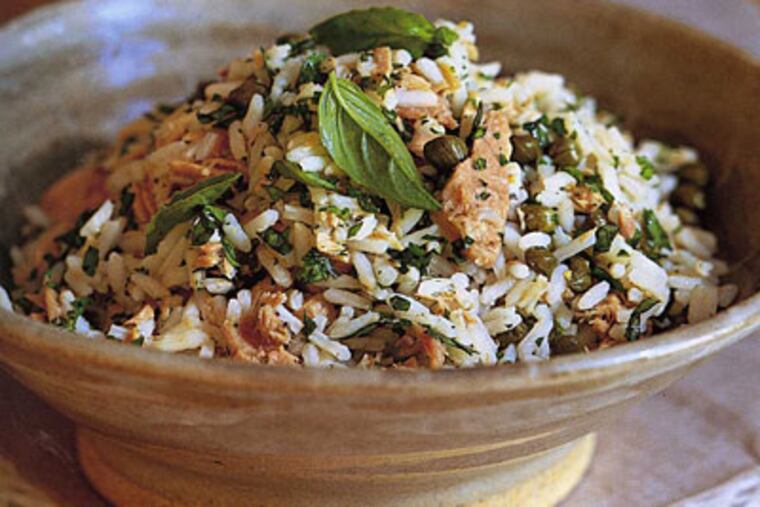
Rice Salad With Tuna and Capers
Makes 8 servings
EndTextStartText
2 cups long-grain white rice
2 cans tuna, preferably packed in olive oil
1/4 cup fresh lemon juice or white wine vinegar
1/4 cup extra-virgin olive oil
Salt and freshly ground pepper
1 1/2 tablespoons capers, rinsed
1/2 cup chopped fresh flat-leaf parsley
1/2 cup chopped fresh basil, plus whole leaves for garnish
1/2 cup chopped fresh cilantro
EndTextStartText
1. Prepare rice as directed. When finished cooking, remove the rice from the heat and let stand, covered, until completely cool, at least 1 hour. Separate the grains with a fork.
2. Drain the tuna of its excess oil. Transfer it to a bowl and flake with a fork.
3. In a large bowl, stir together the lemon juice, oil, 1 teaspoon salt and 1 teaspoon pepper. Add the rice, tuna, capers, parsley, chopped basil, and cilantro, and mix gently.
4. Transfer the salad to a serving bowl and garnish with whole basil leaves.
Notes: To make individual servings, cut large tomatoes in half and scoop them out, leaving a shell. Fill the halves with heaping portions of the salad and garnish each serving with a basil sprig.
Also, you can cook the rice the day before making the salad and refrigerate it overnight. Let the rice come to room temperature before assembling and serving the salad.
Per serving: 318 calories, 16 grams protein, 38 grams carbohydrates, trace sugar, 11 grams fat, 8 milligrams cholesterol, 217 milligrams sodium, 1 gram dietary fiber.
EndText