Forgotten and unforgettable flavors
Yes, the wintergreen zing of the teaberry - an acquired taste, to be sure - is a devil to find these days.
Yes, the wintergreen zing of the teaberry - an acquired taste, to be sure - is a devil to find these days.
And no, catfish and waffles (a combo predating that other odd Philadelphia couple, fried oysters and chicken salad) is no longer for supper at the Old Catfish and Coffee House, itself long gone from the banks of the Schuylkill.
But they are part of the abiding flavor of this place, as potent once as others that grace our tables still - toasty casseroles of Cope's dried sweet corn, briny salt oysters (currently enjoying a modest revival), and a sweet-vinegary slaw called pepper hash.
And on Saturday, should you be in the mood, they will be, one and all, on the buffet at the Reading Terminal Market, players in a fall festival of "forgotten foods." (Samples will be sold for $2 and $3 from 10 a.m. to 4 p.m.)
It is a fine time to review the inventory in the local larder, our vintage foodscape eroding in spots, the scents of our street food overshadowed too often by the cheesesteak.
A number of the flavors, indeed, are headed for oblivion. At his Down Home Diner stand in the market last week, Jack McDavid was puzzling over how to re-create the authentic textures of catfish and waffles, a dish already popular (especially along Wissahickon Creek and the Schuylkill) before the Civil War.
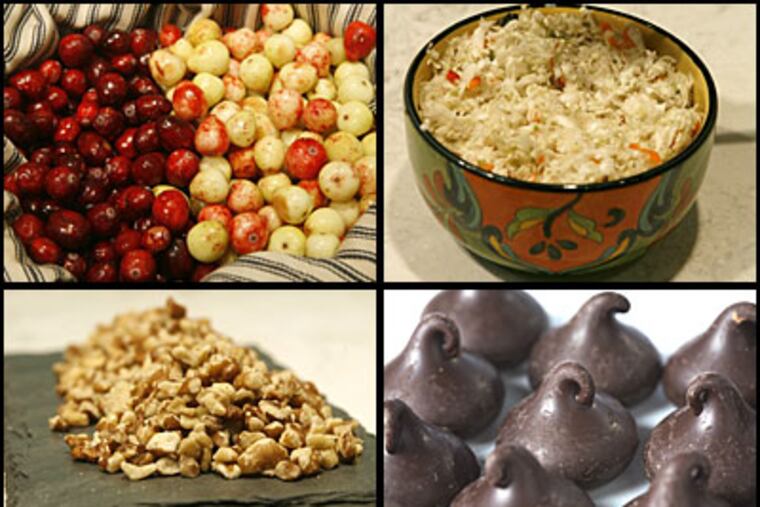
The city's iconic snapper-turtle soup is getting harder to find. As are curly-topped Wilbur Buds, the original naked chocolate. And butter cake and anise-tinged springerle, the stamped, bone-white Christmas cookies (though Haegele's, the scratch Mayfair baker, still carries both).
But, in the nick of time, a curious reversal has occurred - a seemingly spontaneous countertrend. And it is a wonderful good thing to behold.
Salty, glistening Cape May Salts on the half shell can be had at Village Whiskey, the new bar at 20th and Sansom.
Yards, the riverfront brewer, has re-created a strong golden ale from the original recipe of Thomas Jefferson.
New restaurants (in particular, one called MidAtlantic) serve the saffron noodles of the Pennsylvania Dutch, and well-cooked platters of Berks County heritage pork with thick-cut sauerkraut and airy apple fritters.
Locally brewed root beers whose roots reach to the root teas of the original settlers here - the Lenape tribespeople - are suddenly hip. Varga Bar pours draft pints from Downingtown's Victory Brewing. A liqueur called "Root" is making the cocktail circuit. (For its part, minty birch beer has resurfaced, too. At Supper on South Street, it is the base of the lacquered red glaze on the chicken wings.)
Even Gourmet magazine, albeit in its final November issue, has weighed in. It celebrates a Thanksgiving menu from Pennsylvania's rural heartland - magenta red-beet pickled eggs, golden onion pie (called zwiebelkuchen, in Lancaster County's German dialect), and Toasted Sweet Corn Pudding, the custardy, roasty-scented casserole made from beaten eggs and, yes, ground Cope's dried corn.
There is a narrative - and in the case of our overfished waterways, a cautionary tale - in the rise and fall of our local heroes.
It was the native Indians who passed along the slow corn-preserving techniques and the cranberry lore reflected in the quiet bogs that dot New Jersey's Pinelands: One grower, Paradise Hill, still sends a small harvest of heirloom cranberries to the Reading Market's Fair Food Farmstand, a rare sighting of the berries that grow only 40 miles away. (Most of the local crops now ends up in juice.)
In the spirit of New Orleans' Preservation Hall, the jazz protectorate, the Drexel-based food historian William Woys Weaver is putting the finishing touches on a research institute called the Keystone Center for the Study of Regional Foods and Food Tourism, the better to document and celebrate the region's thousands of unique dishes.
"The city was a riverfront baby," he reminds us in his masterful essay on three centuries of Philadelphia food and drink, a companion to the Library Company of Philadelphia's 1986 exhibition called "The Larder Invaded."
It was the rivers, indeed, that yielded the first salt oysters, and hosted the epic spring shad run that gave Fishtown its name. (Fishtown held its first latter-day Shadfest last year, though the grilled shad were imports, the Delaware's cleanup welcoming for fish-life, but insufficiently inviting to bring back the shad in mighty numbers.)
It was the forests that provided the mangolike stone fruit called the pawpaw. And black walnuts. And teaberry, its red berries once collected by little girls, its evergreen leaves a cold-weather treat for deer.
Teaberry and birch bark both yield oil of wintergreen, the distinctive flavor of birch beer and the pink teaberry ice cream now regularly sold at the Franklin Fountain in Old City. (It will make a cameo appearance Saturday at Bassett's, the ice cream counter that dates back a century at the Reading market.)
It was the Pennsylvania Dutch, adapting their German foodways to the lush new farmlands of Lancaster County 300 years ago, who brought forth a smorgasbord of defining local tastes.
By some accounts, in fact, it was their delight in the bountiful fruit harvest that inspired a gusher of fruit pies that (in contrast to Europe's savory tarts) came to be equated eventually with the very notion of America itself.
It is from that same tradition that we see the ham loaf that shows up at the Dutch Eating Place in the Reading market, and the crunchy, surprisingly sweet "bleached" celery at Benuel Kauffman's produce stand there, and scrapple that traces its ancestry to the hog-butchering days of antiquity.
Scrapple, in its turn, is also enjoying a boomlet (or reinvention), its boundaries being stretched by adventuresome local chefs.
At Noble on Sansom Street, they make their own. At Davio's, the Italian steak house, it has appeared in the risotto.
MidAtlantic's Daniel Stern has recast it in crab and chicken and vegetarian iterations.
On the eve of a festival of forgotten foods, how rich is that?
The rise of scrapple chic!
On the Side: Festival of Forgotten Foods
Where: Reading Terminal Market, 12th and Arch Streets
When: Saturday, 10 a.m. to 4 p.m.
Cost: Free admission; nominal charge for food samples.
Information: 215-922-2317 or www.readingterminalmarket.org
EndText