Shore dunes took a beating on Thanksgiving and in a fall nor’easter. Now mayors confront their beaches’ future.
Incoming U.S. Rep. Zack Mullock wants to put more focus on building up dunes, a shift he said that would require lawmakers “to stop legislating based on the loudest people on the beachfront.”
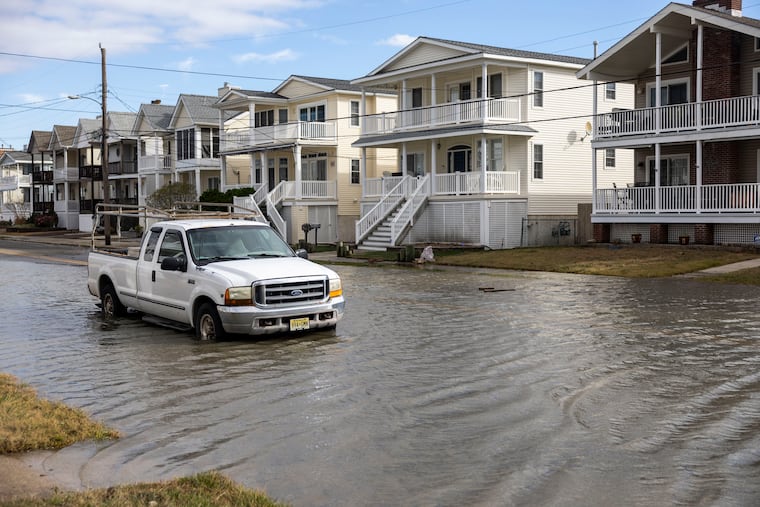
South Jersey’s Shore towns were on the front lines of Thanksgiving’s nor’easter, and their protective dunes took another pummeling after an already rough autumn.
A late September nor’easter that battered the region had already visited many towns with the worst flooding and erosion since Hurricane Sandy in 2012.
“Our beaches were beat up, again,” Vince Sera, mayor of Brigantine, said on Friday. “This storm definitely had a massive toll, and we’re in need of emergency beach replenishment.”
The Brigantine promenade also suffered, after taking a bad hit in September.The county-owned infrastructure on the north end of the island, which also serves as a sea wall, provides protection to homes, streets, and other properties.
“We’re concerned about breaching now, not just to the north, but also to the south as the dune system starts to erode,” Sera said. “We think the homes further south of [the promenade] are also starting to be in danger of being hit by the ocean, especially if these storms continue.”
New Jersey’s Department of Environmental Protection will be assessing the full extent of the damage across the Shore until early next week, according to NJ.com.
Sera said he’s been in touch with the Atlantic County government about their plans for repairing the promenade and that he’s been working with U.S. Rep. Jeff Van Drew’s office on beach replenishment.
This year, $73 million in federal funds were allocated for that purpose along the Jersey Shore.
Van Drew, a Republican, will be leaving Congress at the beginning of next yearto be replaced by Cape May Mayor Zack Mullock.
“I think that we got more water than we’ve ever seen, certainly more than Sandy,” said Mullock, the Democratic congressional representative-elect for the area and current mayor of Cape May.
“And we just had this in September,” Mullock said. “Just going with what the scientists say, this is what’s going to keep happening. We have to take serious and bold action, frankly, on a national level.”
» READ MORE: The Shore picks up the pieces after a Thanksgiving storm brings outages and flooding: ‘There’s nothing you can do’
Mullock said a part of the solution will be building dunes higher, even if it means sacrificing some oceanfront views — a concession that has been politically controversial in many Shore towns.
“We have to stop legislating based on the loudest people on the beachfront,” Mullock said. “You have beachfront properties who don’t want to see the dune ruin their view. But it’s just such a dumb argument at this point.”
Mullock points to Cape May Point — which is a separate jurisdiction from his — as an example to emulate. For the last few decades, the borough has been allowing its dunes to grow largely unchecked.
Twenty years ago, their dunes were of average size, but today they are 20 feet high. As a result, Cape May Point was protected from the flooding caused by Thanksgiving’s storm, he said.
“In Cape May Point, they didn’t have a drop of water anywhere in the entire town,” Mullock said. “That’s because they’ve allowed their dunes to grow and flourish and basically kind of be wild.”
But there have been trade offs.
“Now, they’ve lost their view from those beachfront homes. But those are the same homes that wouldn’t be there otherwise,” he said.
By contrast, many Jersey Shore towns have small dunes that offer little protection from flooding.
“When you see a lot of those towns where there’s a ton of water in the streets, look at their dunes,” Mullock said. “I would call them wimpy dunes. They’re built up a couple feet, like a little berm, throw some dune grass on it and call it a dune. To me, that’s not a dune.”
Mullock’s said his own Cape May has “good dunes, but not great dunes.” The city was largely protected on Thursday, but there was a breach at Wilmington and Beach Streets.
Cape May’s government has been working to extend its promenade and sea wall to that intersection, and the Tuesday before Thanksgiving, officials received bids under the project’s estimated $26 million cost. A contract is expected to be awarded in December.
“It will be wonderful for bicyclists and runners and will add like eight feet of protection to our beachfront exactly where we had a breach,” said Mullock.
While beach replenishment is needed, in the future, Mullock said the Jersey Shore needs to look at more aggressive measures to keep sand in place.
» READ MORE: Parts of the U.S. clean up, power outages being restored after Thanksgiving storm soaks East Coast
He wants to see jetties and artificial reefs installed to retain the sand, so that replenishment efforts last longer, and the fruits of those federal funds don’t wash out to sea.
In the near term, most local politicians are focused on the immediate recovery process after a troubled holiday.
In Sea Isle City, Mayor Lenny Desiderio said that his municipality’s engineer and the public works department are monitoring the state of the local dunes and he expects a report by Monday, at the latest.
In the meantime, Sea Isle City’s annual Christmas tree lighting and holiday parade — from 29th to 84th streets — is scheduled for Saturday night, a one-day postponement after they had to devote Friday to post-storm clean up.
“We lucked out,” Desiderio said. “We suffered some erosion, but the dunes did their job like they were supposed to do and protected properties.”