United, American say fuel cost surge may mean capacity cuts
Analysts expect energy prices to remain elevated as the Iran war continues. American, PHL’s largest carrier, estimates fuel will add $1 billion in extra costs in the last three months of the year.
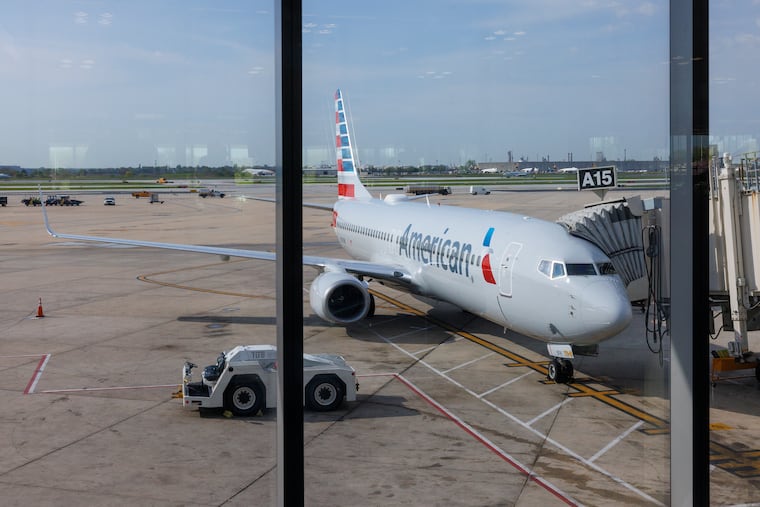
United Airlines Holdings Inc. and American Airlines Group Inc. said they may need to cut more capacity in the fourth quarter as the aviation industry continues to contend with high fuel prices.
“If fuel prices remain as high as they are right now, I think that that’s going to require some adjustments in terms of our capacity planning as we take a look out into the future,” American chief executive officer Robert Isom said at a Morgan Stanley conference in California on Wednesday.
Speaking after Isom at the same event, United chief financial officer Mike Leskinen said that if fuel remains high, the company will “make some adjustments into the first quarter and beyond into 2027.”
“We are not flying to maximize market share, we’re flying to maximize profitability and free cash generation, so we’ll make those adjustments,” Leskinen said.
American stock briefly jumped as much as 4%, and was trading 0.3% higher at 12:24 p.m. in New York. United also rose as much as 2.7%, before paring gains and was down 0.9% at 12:21 p.m. United’s shares have declined 5% this year, while American is down 16%.
American estimates fuel will add $1 billion in extra costs in the last three months of the year. At the same time, the airline is seeing benefits of its focus on premium products, with more revenue coming from the front of the aircraft. At this point, the company continues to feel “really good” about its guidance, he said. American is the largest carrier out of Philadelphia International Airport by passenger volume.
United earlier this year forecast adjusted third-quarter earnings of $2.50 to $3.50 a share and sees about $6 billion in added fuel costs for 2026, which it plans to offset by the end of the year.
The Chicago-based airline, which has been able to stay nimble amid high costs alongside Delta Air Lines Inc. with its industry-leading premium strategy, moved quickly and aggressively on capacity. The carrier earlier this year announced a 5% reduction in scheduled flights for the second and third quarters, targeting weaker off-peak routes — midweek and overnight flights — and trimming operations at Chicago O’Hare.
“As you look into the fourth quarter, there’ll be some flights in December that we won’t fly, that we thought we were going to fly,” Leskinen said.
With the U.S.-Iran war showing no signs of abating, analysts expect energy prices to remain elevated. President Donald Trump has said the fighting would only end after the November midterm elections. Brent is up almost 70% this year, and refined products such as diesel have posted even steeper gains, reflecting supply risks from the conflicts in Ukraine and the Middle East.
The surging costs are significantly squeezing airline margins. New York-based JetBlue Airways Corp. last week cut its capacity outlook, expecting it to rise between 1.5% and 3.5% from a year earlier, down from its previous forecast for growth between 3% and 6%.
American Airlines has faced the most acute pressure among its major rivals, having cut guidance twice so far this year. In April, it guided to a full-year range of a $0.40 loss to $1.10 profit — down from its original $1.10–$2.70 profit target — after absorbing an estimated $4 billion in incremental fuel costs from the Iran war.
In July, it cut guidance again to a range of a $0.65 loss to $0.65 profit, as fuel expense surged over $2.2 billion or 83% year-over-year in the second quarter alone. American was able to offset only roughly 50% of that fuel headwind through higher fares.
One penny of extra fuel cost equals about $10 million, chief financial officer Devon May said at the conference, adding that the airline will guide to the fourth quarter when reporting earnings next month.
“That’s $1 billion dollar run up we’re seeing in the fourth quarter,” May said. “The great thing is we’re coming in with a stronger balance sheet or a less debt than we’ve had in more than a decade. The company is sitting on a lot of liquidity, so we feel really good about the positioning we have right now.”