John Fetterman’s favorability dips as voters see him more as a Republican than a Democrat
Three quarters of likely Democratic voters view the Pennsylvania senator as more of a Republican in a poll conducted after Fetterman participated in Donald Trump's midterm convention.
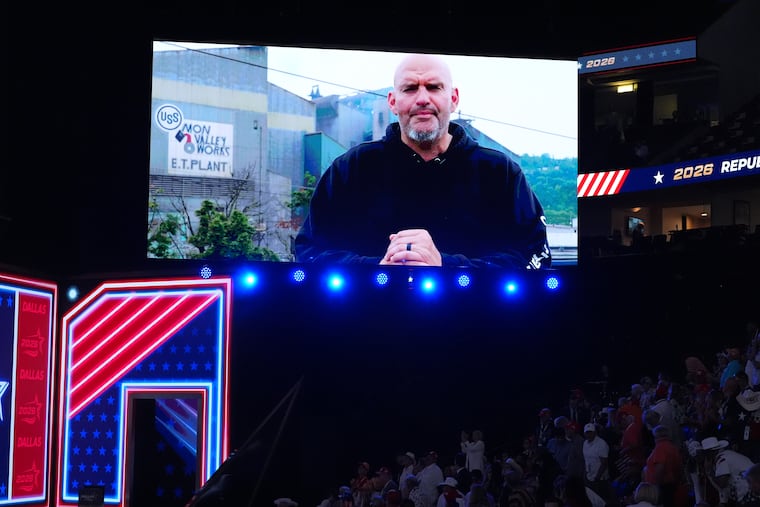
A majority of Pennsylvania voters view U.S. Sen. John Fetterman (D., Pa.) more as a Republican than a Democrat as he continues to heavily criticize his party and side with President Donald Trump in some major policy areas, according to an Inquirer/New York Times/Siena University poll published Thursday.
Fetterman’s overall favorability among Pennsylvanians — which had already taken a dramatic turn in the last year and a half — has also dipped in recent weeks, a period that featured new revelations about the senator’s job performance and his surprise participation in the Republican Party’s midterm convention with a video message praising Trump.
For the first time in polling conducted by Siena University on behalf of The Inquirer and the New York Times, a plurality of likely voters in the state have a negative view of Fetterman.
The senator is viewed “somewhat” or “very” unfavorably by 47% of voters and favorably by 42%, according to the poll of 615 likely voters from Sept. 15 to 21. That’s an 11-percentage-point swing since the organizations’ poll in August found Fetterman maintained an overall positive favorability rating.
Four years after he flipped a Republican-held seat with a promise to be Democrats’ 51st vote in the Senate, just 26% of likely voters consider Fetterman as more of a Democrat than a Republican, the poll found.
A majority — 57% — view him as more of a Republican.
“He insists that he’s not going to be changing parties. However, a lot of people are afraid of that because of the way he has voted,” said Sandra Boyles, a retired teacher and Democrat in Fayette City who believes “a lot of people feel betrayed” by the senator.
Nearly three-quarters of Democrats see Fetterman as a Republican. And roughly half of Republicans feel the same way, as do a similar proportion of independents.
Fetterman’s party loyalty has become a pressing question — not just for his own political future, but also for which party controls the U.S. Senate during the final two years of Trump’s presidency.
Democrats need to win at least four competitive Senate races in Trump-friendly states to win the majority, an uphill battle that has seemed like more of a possibility in recent weeks as the president’s popularity lags.
Independent election experts consider Democrats to have a real chance of winning states like Texas, Iowa, and Alaska. Ohio, North Carolina and Maine are also official Democratic targets. Even Kansas, which Trump won by 16 percentage points in 2024, appeared to raise some level of concern for Republicans when Vice President JD Vance tried to boost the GOP incumbent this month.
Neither of Pennsylvania’s U.S. Senate seats is on the ballot this fall. But if Democrats retake the majority by one or two votes, Fetterman’s role as a wild card — even one who votes with Democrats the vast majority of the time — could have an impact as his party tries to rein in or reverse the president’s agenda.
“That would definitely be a concern of mine,” said Boyles, 74.
Fetterman has not said whether he will seek a second term in 2028, and he has repeatedly rejected the idea that he would switch parties.
“I’m a lifelong Democrat who votes overwhelmingly with my party — and should the Senate flip in November, I will still be the 51st vote that I ran on,” he said in a statement while facing a new round of criticism for appearing by video at the GOP convention in Dallas this month.
Fetterman’s Democratic colleagues have tried to keep him in the fold.
U.S. Sen. Kirsten Gillibrand, a New York Democrat and chair of the Democratic Senatorial Campaign Committee, said this week that Fetterman is a “very reliable Democratic vote.” As she leads her party’s effort to win the Senate races, Gillibrand said, she does not have, nor has heard others having, concerns about Fetterman’s role in a slim Democratic majority.
Asked if Fetterman — who appeared at a convention aimed at boosting Republican campaigns — was involved in the Democratic campaign efforts, Gillibrand said she thought Fetterman had visited some candidates but she was not sure.
“I’m very grateful that Sen. Fetterman is serving in the U.S. Senate as a Democrat, and I think he will continue to do so,” Gillibrand said.
Still, Fetterman has supported parts of Trump’s immigration enforcement agenda, the war in Iran, and some of the president’s nominees. Senate Democratic leaders would likely try to act as a check on Trump in each of those areas if they win the majority for the next two years.
Fetterman has also left the door open to leaving the Democratic Party if it makes opposition to Israel an official party stance. The senator has not explained exactly what that situation would look like, though he has been highly critical of Democrats when they push back against the Israeli government’s war against Hamas.
With the three-year anniversary of the conflict approaching on Oct. 7, more than 70,000 Palestinians have been killed and nearly all Gazans have been displaced, according to the Council on Foreign Relations. Critics say Israel’s military response has been excessive, while Fetterman has said he supports the war in order to root out Hamas fighters who initiated the war by killing more than 1,200 people in Israel in a terrorist attack.
The latest poll of Pennsylvania voters shows Fetterman’s position is out of step with a majority of voters.
Among Pennsylvania likely voters, 60% are against the U.S. providing additional economic and military support to Israel, compared with 34% who support it.
Four in five Democrats, and about a third of Republicans, oppose the aid to Israel. In a sign that Fetterman would face a challenging reelection campaign, 63% of Democrats said they would support a candidate who opposed aid to Israel.
Victor Oyola, 47, of Philadelphia, said he considers himself a conservative Democrat and has no issues with politicians supporting Israel’s right to exist. But Fetterman has been more of a voice for the foreign nation than for his home state, he said, while also showing limited interest in other aspects of his position.
“You don’t want to do the job, but you’re strongly supporting Israel over Pennsylvania?” said Oyola, who works in retirement management. “Everything is Israel, Israel, Israel. But what about Pennsylvania, Pennsylvania, Pennsylvania?”
Reports of Fetterman’s lack of interest in doing routine aspects of his job as a senator also appear to have played a role in how Pennsylvanians view him.
In a widely circulated story earlier this month, the Wall Street Journal reported that Fetterman tried to evade meetings with leaders at Children’s Hospital of Philadelphia and with wounded veterans, as well as a funeral for three York County police officers who were killed while on duty.
Donald Harer, a Democrat from Northumberland who voted for Fetterman in 2022, said that he saw the story and that it seemed like the senator has “really not held his end of the bargain and done his job the way he’s supposed to.”
As an Army veteran who served in Iraq, Harer said, he was particularly disappointed in Fetterman’s reported refusal to meet with wounded veterans.
“When he campaigned, when he first started to run, he seemed like a go-getter,” said Harer, an operations manager for a grocery store. “But he let a lot of people down. I kind of call him a traitor.”
Don Levy, the director of the Siena Research Institute, which conducted the poll, said he did not know if changes in Fetterman’s favorability ratings since last month could be attributed to the recent national attention on him.
But with recent polls continuing to show Fetterman’s widespread cross-party support, his position as a Democratic darling for the GOP and antagonist for Democrats “looks pretty baked in,” Levy said.
“The Republicans have now grown in their favorability for him, which may be a reflection of them starting to feel like ‘he’s one of us,’” Levy added. “And Democrats are even more upset with him for moving away from what they believe they elected him to do.”
Staff writers Joe Yerardi and Gillian McGoldrick contributed to this article.

The New York Times/Philadelphia Inquirer/Siena University poll of Pennsylvania was funded by a grant from The Lenfest Institute for Journalism. The poll was designed and conducted independently from the institute.
- Most of Pa.’s likely voters disapprove of Donald Trump and his policies, new poll shows
- Josh Shapiro has a 16-point lead in the governor’s race — and most Pa. Democrats would support him for president
- Pa. Democrats say John Fetterman is siding with Donald Trump too much, new poll shows
-
6 in 10 Pennsylvania voters oppose data center development, new poll finds
-
Pope Leo XIV is popular with Pa. Democrats after feud with Trump. But Republicans are split.
-
Young Pa. voters are frustrated with Trump as they grapple with ‘the cost of continuing to exist’
-
Pa. voters are more critical of Trump’s handling of the economy than they were a month ago
-
John Fetterman’s favorability dips as voters see him more as a Republican than a Democrat
-
1 in 4 Pa. GOP voters don’t know who Stacy Garrity is as Josh Shapiro widens lead in governor’s race