1 in 4 Pa. GOP voters don’t know who Stacy Garrity is as Josh Shapiro widens lead in governor’s race
Shapiro’s lead has now expanded beyond the advantage he held ahead of the 2022 election against Doug Mastriano — a drubbing the GOP vowed not to repeat.
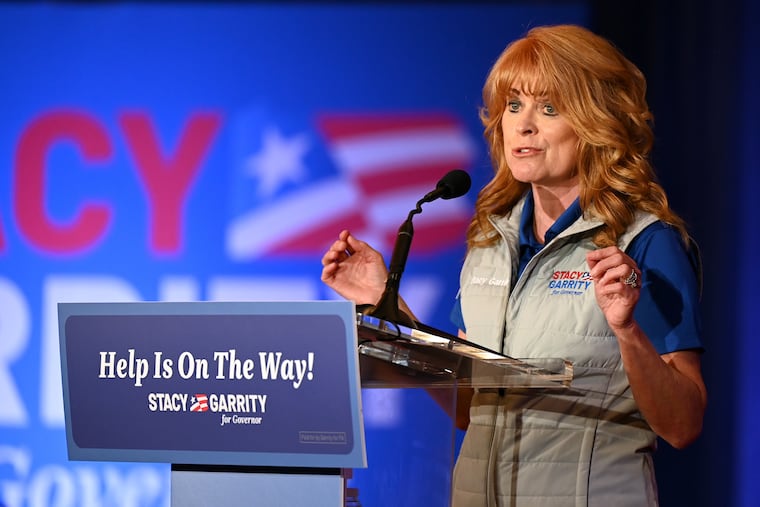
One in four likely Pennsylvania GOP voters have not heard of the state’s Republican candidate for governor, as Gov. Josh Shapiro continues to pull ahead with less than six weeks remaining until Election Day, according to a new poll.
Shapiro, a Democrat seeking reelection and a potential 2028 presidential candidate, is ahead of his Republican challenger, state Treasurer Stacy Garrity, by 21 percentage points among likely Pennsylvania voters, according to the poll conducted by The Inquirer, the New York Times, and Siena University.
According to the poll, Shapiro’s lead has now expanded beyond the advantage he held the month before the 2022 election against State Sen. Doug Mastriano (R., Franklin). Shapiro went on to beat Mastriano in that election by nearly 15 percentage points, or 800,000 votes — a drubbing that the GOP vowed not to repeat.
Pennsylvania Republicans endorsed Garrity in September 2025 — an unprecedented early nod to unify behind her in an effort to put up a stronger fight against Shapiro after the party largely withheld its support for far-right Mastriano. Garrity has won statewide twice and received the most votes in Pennsylvania history for a statewide office, a record previously held by Shapiro. In January, President Donald Trump endorsed Garrity, calling her “an America First Patriot.”
But building on that early enthusiasm has proven to be a challenge for Garrity, who for months has struggled to fundraise money, compete with Shapiro’s $60 million war chest, and gain name recognition in the critical battleground state where registered Democratic voters narrowly outnumber Republicans.
Garrity, 63, the state’s treasurer who entered politics in 2020 after a long career in the U.S. Army Reserve, raised only $1.8 million this summer and spent $1.5 million, according to her latest campaign finance filing posted Tuesday. Shapiro raised $13.3 million during that time, and spent $31 million.
And while Shapiro has dramatically increased his advertising spending on TV and streaming services to top $27 million this year, Garrity has spent a total of $744,000 on ads so far, according to media tracking firm AdImpact.
Both Shapiro and Garrity have released ads attacking each other for their past support for data center development, an increasingly unpopular issue among both Republicans and Democrats. Garrity’s ad criticizing Shapiro has been viewed around 802,00 times in the Philadelphia media market, according to AdImpact. Shapiro’s commercial labeling Garrity as “Pennsylvania’s number one fan of data centers” has been viewed 416 million times.
“Within the data right now, Josh Shapiro is a favorite son in the state of Pennsylvania, and they see him as doing a fantastic job,” said Don Levy, the director of the Siena Research Institute, which conducted the poll of 615 likely Pennsylvania voters from Sept. 15 to 21. “Barring double lightning bolts or a triple rainbow, he’s going to win.”
Garrity’s lack of campaign spending has allowed Shapiro to define her in the race, experts have said.
George Stanton, 77, a registered Republican from Lebanon County who participated in the poll, said he will support Garrity in November. He cited Shapiro’s attack ad about Garrity’s past support for data centers, which he said he agrees with, as a place where he’s learned more about her positions.
Voters trust Shapiro more than Garrity on all of the top issues facing them, the poll found, including: handling the state’s economy, managing the cost of living, dealing with data centers and AI companies, and handling vaccine policy. In recent weeks, Shapiro has been embroiled in a battle with U.S. Health and Human Services Secretary Robert F. Kennedy Jr., whom he has blamed for spreading misinformation as Pennsylvania experienced a deadly measles outbreak. And at a summit in Pittsburgh last week, Shapiro called for more regulation of AI companies, but said innovation of the technology should still be harnessed.
Scott Byers, 79, a Republican from Westmoreland County who supported Trump in 2024, is planning to vote for Shapiro this fall because “he just seems to be more in line with the public, with the feelings of his constituents.”
That includes Shapiro’s position on AI and data centers, which Byers believes should be more difficult to build. All he knows about Garrity’s views is what he catches on commercials — but it doesn’t feel comprehensive, said Byers, who participated in the poll.
“I think technology in itself is going a bit beyond what is necessary. I feel that it’s hard to pinpoint, but I just feel that there’s too much emphasis on technology,” Byers said.
Approximately 60% of likely voters strongly approve or somewhat approve of the job Shapiro is doing as governor, according to the poll. That includes 30% of Republican voters, 89% of Democratic voters, and 59% of independents in the critical swing state where Shapiro maintains high popularity.
As a moderate politician, Shapiro has been able to capture most independent voters and even win over some Republicans, according to the poll.
Lesa Yeager, 63, considers herself an independent voter with centrist views who voted for a third-party candidate in the 2024 presidential election. She’s an ardent union supporter and also thinks the nation should have a strong border. As the state’s treasurer, she said she trusts Garrity to do a better job handling Pennsylvania’s economy.
But she’s supporting Shapiro this November, in large part, because of his work on schools.
“I like that he’s very pro-education,” she said. “I am a fan of charter schools because I sent my kids to charter schools.”
Two of her children, now 35 and 37, benefited from smaller classroom sizes and adjustable curriculums, she said.
Yeager said she has also reached her limits with Trump’s behavior during his second term and believes Shapiro would continue to represent the state positively.
“I just think Trump is such a bully and so mean and just does whatever he wants, and I just want someone who isn’t in that,” Yeager said.
She appreciates the Republicans who distance themselves from Trump. “But it’s tough to tell who is and who isn’t, a lot of times, and I would rather vote for someone I know isn’t going to support Trump on a lot of the things that he does,” she added.
Still, Garrity has found some backing among Pennsylvania’s electorate, even though some of those supporters say they don’t know much about her.
Susan Roller of Lancaster said she plans to vote for Garrity this fall because “she’s more responsible and will protect our freedoms.” Roller, who is retired, said she is particularly distressed about Shapiro’s positions supporting access to abortion and encouraging vaccines.
But as far as getting to know more about Garrity, Roller, 72, said she hasn’t “seen a lot” of messaging on television about Garrity.
Shapiro and Garrity are set to face off in a televised debate on Oct. 7.
In 2022, Shapiro did not participate in any debates while he maintained a double-digit lead over Mastriano, declining his requests as an “unserious stunt.” Shapiro held a 13-point lead over Mastriano in a New York Times/Siena poll conducted that October — a closer margin than Shapiro’s lead over Garrity this year.
The 2022 midterm election was much different political moment for Democrats, Levy said.
“That was a point in time when the Democratic star was on the decline,” he added. “Everything was a bit of a referendum on Democrats, on the job that [former President Joe] Biden was doing, how we were coming out of the pandemic.”
“The overall political climate in which the ‘26 election is taking place versus ‘22 is really kind of night and day,” Levy said.
Staff writers Joe Yerardi and Fallon Roth contributed to this article.

The New York Times/Philadelphia Inquirer/Siena University poll of Pennsylvania was funded by a grant from The Lenfest Institute for Journalism. The poll was designed and conducted independently from the institute.
- Most of Pa.’s likely voters disapprove of Donald Trump and his policies, new poll shows
- Josh Shapiro has a 16-point lead in the governor’s race — and most Pa. Democrats would support him for president
- Pa. Democrats say John Fetterman is siding with Donald Trump too much, new poll shows
-
6 in 10 Pennsylvania voters oppose data center development, new poll finds
-
Pope Leo XIV is popular with Pa. Democrats after feud with Trump. But Republicans are split.
-
Young Pa. voters are frustrated with Trump as they grapple with ‘the cost of continuing to exist’
-
Pa. voters are more critical of Trump’s handling of the economy than they were a month ago
-
John Fetterman’s favorability dips as voters see him more as a Republican than a Democrat
-
1 in 4 Pa. GOP voters don’t know who Stacy Garrity is as Josh Shapiro widens lead in governor’s race